
EGBERTO, archbishop of TREVIRI. – Son of Count Teodorico of Holland, educated in the abbey of Egmond, d. in 993.
He took part in the politics of the Empire and was chancellor of Ottone III in 976–77, whom he accompanied to Italy in 980–83. Ottone III pardoned the repentant E. for his policy of conspiracies with the Guelphs and sent him in 987 to the king of France, Ludovico V, as a peace mediator. He made his residence in Treviri a center of literary and artistic life, particularly of book illumination. The earliest works of this school are the Codex Egberti or Liber Evangeliorum preserved in the Municipal Library of Treviri, and the Psalterium Egberti of 981, presented by St. Elisabetta di Turingia to the Chapter Library of Cividale.
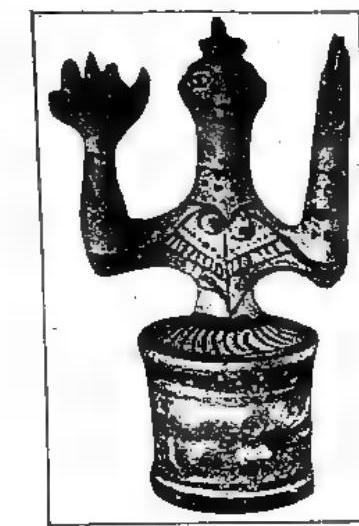
EGEAN RELIGION. — The conventional name “Aegean” is given to the civilizations of the countries washed by the Aegean Sea (Greece, the islands, Anatolia), from the Neolithic period to the end of the Bronze Age. But neither the civilization, although it displays points of contact, nor the religion can be considered as an organic whole; it is necessary to treat the various centers separately. The sources are scarce, being represented solely by the results of excavations, which are easily interpreted arbitrarily because of the lack of written controls. The numerous forgeries of statuettes and seals make it diff-
(from R. Th. Bossert, AlHureta, Berlin 1927, p. 167)
EGEA, RELIGIONE — Terracotta statuette. Painted female idol with a dove on her head, from Knossos (Late Minoan III). Candia, Museum.
Offerings in the cave of Amnisos (terracotta vessels) were placed around two stalactites enclosed by a wall, and continued until the Roman period.
In the Early Minoan period, the cave of Arkalochori (weapons, votive objects) begins; in Late Minoan III, when the cave of Amnisos collapsed, the offerings were deposited outside. In the Middle Minoan period there are the caves of Skoteino (double axes and figurines), Kamares (terracotta vessels), which continued until the end of Late Minoan III, and Psychro (weapons, male and female figurines, animals), which continued into the Geometric period; there were also various open-air cults, limited to the Middle Minoan period alone, at Zakro (male and female figurines, goats, oxen), Petsofa, and Mount Juktas (the place of worship was enclosed by a wall; the offerings, figurines and parts of the human body, were thrown into the fire).
The cave of Phaneromeni (male worshippers, knives, double axes), which continued into the Orientalizing period, dates from Late Minoan I. From Late Minoan III are the cave of Patso and the open-air cult in the courtyard of Haghia Triada, which lasted throughout the Geometric period, with highly varied offerings of figurines, weapons, horns of consecration, animals, and so forth. At Haghia Triada there were also an altar (?) and a sacrificial pit containing ashes, charcoal, and the burnt bones of small animals. Less important in the Late Minoan period was the cult of Phaistos (figurines, animals, libation tables), a few metres above the ruins of the second palace. A votive deposit from the end of Late Minoan III comes from a covered spring near Knossos (vessels and sphinxes). It is not known which deities were worshipped at the localities listed. In the historical period Eileithyia was venerated at Amnisos; in the case of Patso, Hermes Cranios has wrongly been mentioned. Perhaps the cults of Petsofa and Mount Juktas were addressed to healing deities, since reproductions of human limbs were among the offerings; those of Arkalochori, Psychro, and Phaneromeni, where weapons were numerous among the votive offerings, to a warrior deity; and those of Phaistos, Patso, Haghia Triada, and Zakro to an agrarian deity protecting animals and agricultural labor. In the cases of Kamares and Amnisos, a judgment is difficult.
The island of Crete alone provides more abundant cultic evidence, but we cannot extend it to the entire Greek world. The cults of the island of Cyprus, which lie outside Aegean religion properly speaking, although they present certain points of contact with it, are not discussed here.
CRETE. — Places of worship were caves, open-air sites enclosed by a wall or not, and small shrines: the open-air cults and caves are associated with votive deposits of greater or lesser richness, whereas none have been found in connection with cult chambers. The earliest [evidence] dates to the Neolithic period
an identification, [namely] the finding of only vessels as offerings. At the spring of Knossos, a water deity may have been worshipped; this might also be the deity represented by a female figure with raised arms inside a rounded urn, found in the votive deposit.
In the Middle Minoan period, the first reliable evidence of worship in palace chambers appears: in the first palace of Phaistos there was a chamber intended for worship, with three adjoining accessory rooms and a sacrificial pit.
Reliable representations of deities occur only at the end of the Middle Minoan period. The female figurines in Early Minoan tombs and the vessels with female protomes, in which images of the Minoan Mother Goddess have been thought to be represented, are merely funerary offerings; even in the case of two female statuettes with snakes from Knossos, it is uncertain whether they are deities. From the end of the Middle Minoan period onward, a goddess, mistress of the animals, is represented on seals, gems, and sealings between two lions, dogs, or griffins; another wears a pointed cap and carries a spear, and is likewise accompanied by a lion or a dog. Other seals show an identical scheme for a male deity: a god between two animals (griffins, dogs, or lions), and another wearing a pointed cap and carrying a spear and a quadrangular shield, who is likewise accompanied by a lion or a dog.
The god does not seem to occupy an inferior position in relation to the female deity; it is therefore impossible to speak of a paredros. Seals depicting supposed marine or warrior deities provide no certain evidence. Cult statues occur only in Late Minoan III: they are female deities with raised arms, wearing on their heads a diadem with various emblems (birds, horns of consecration, poppies, etc.). Some hold snakes in their hands. It is not known whether they represent the same deity with different attributes or several goddesses. The snake goddesses cannot have been domestic deities, as was supposed, because they were found in sanctuaries separated from every dwelling. The female deities never appear nude: a figure incised on a jug from Mallia and a statuette from Haghia Triada, if they really are goddesses, represent foreign concepts and cults.
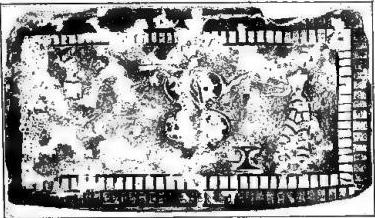
GRECIA. — There is no trace of cults until the beginning of Minoan artistic influence, but at that point it is not easy to determine whether the cult scenes do or do not represent imported concepts. In a shaft grave at Micene there were two nude female figures with doves, perhaps goddesses; the type is foreign to Crete, but may have been imported from the East. A slab from Micene shows a female figure, almost entirely covered by a large bilobate shield, which might be a Greek warrior divinity. In the Late Mycenaean period, numerous female figurines
(from H. Th. Bossert, AlHureta, Berlino 1927, p. 35)
EGEA, RELIGION — Painted pinax. Female figure covered by a shield (deity?) between two women (beginning of the 14th century B.C.) — Athens, National Museum.
Numerous female figurines have been found in tombs, houses, and places of worship: those in the tombs will have been funerary offerings, while the others may represent either goddesses or worshippers.
The places of worship are not earlier than the Late Mycenaean period: at Klenies, a cave with votive offerings was discovered; at Haghia Triada in the Argolid, there was an open-air cult with a votive image; at Delphi, beneath the temple of Apollo, there were ashes and the remains of sacrifices, while beneath that of Athena Prensis, there was an enclosure with an altar and female figurines. Rooms intended for worship have also been found in the palace at Mycenae and at Becheti. At Asine, one room of a house contained a stone bench supporting vessels and statuettes; it recalls those of the Cretan sanctuary-rooms, but the deity worshipped was male (unlike the Cretan ones), and an attempt has been made to identify it—but without proof—as Zeus or Poseidon. In the courtyard at Trinte there was an altar. Beneath numerous Greek sanctuaries, Mycenaean constructions have been found (Eleusis, Athens, Argos, Delos, etc.); but no certain trace of worship.
ISOLLE DELL'EGEO. - Although various divinities and places of worship are traced back to the pre-Hellenic age, no evidence has been found of cults predating the Greek period. In the marble figurines from the tombs of the Cyclades, some have wished to recognize a goddess of fertility, but the hypothesis is much debated.