
LIBERALE da VERONA. — L. di Jacopo dalla Biava, or Biavo, illuminator and painter, b. in Verona around 1445 and d. there between 1526 and 1529. He is known to have been active between February 1467 and the end of 1469 at Siena, at Monte Oliveto, and between 1470 and 1474 in Siena itself, in the Duomo, leaving numerous graduals, now preserved in the cathedral of Chiusi and in the Piccolomini Library of Siena.
He was present in Tuscany in 1476, but from 1488 he is again recorded in Verona, where in the following years he executed frescoes in S. Anastasia (1490), in S. Lorenzo, S. Vitale, S. Fermo, and the Duomo, as well as in private palaces. A stay in Venice, perhaps preceding his journey to Tuscany, may be inferred from the background of the S. Sebastiano in Brera, in which the Grand Canal is faithfully reproduced. The Saint, too, is inspired by Rizzo’s Adamo in the Palazzo Ducale. He must have learned the practice of painting from Girolamo da Cremona, but his continual travels gave him the opportunity to become acquainted with the Pollaiolo, Mantegna, the Venetians, and the northerners. In the miniatures, his exuberant temperament, under Sienese influence, expresses itself in swollen linear rhythms of an almost baroque imaginativeness. The panels, such as the predella in the Archbishopric of Verona, the Adorazione dei magi in the Duomo, the splendid frescoes of the Bonaveri Chapel in S. Anastasia, the S. Sebastiano in Berlin, the Pietà in Munich, and the S. Giovanni Evangelista in Philadelphia, show him tenaciously devoted to plastic investigations, although he preferred “to chase the figures in metal rather than paint them” (Fiocco). He therefore never freed himself from Mantegnesque and Paduan expressionism, even though, through the medium of a soft, pastose colour, as in the Morte di Didone in London, he achieved a brilliant and poetic union of expression and decoration. — Vedi tav. LXXIX.
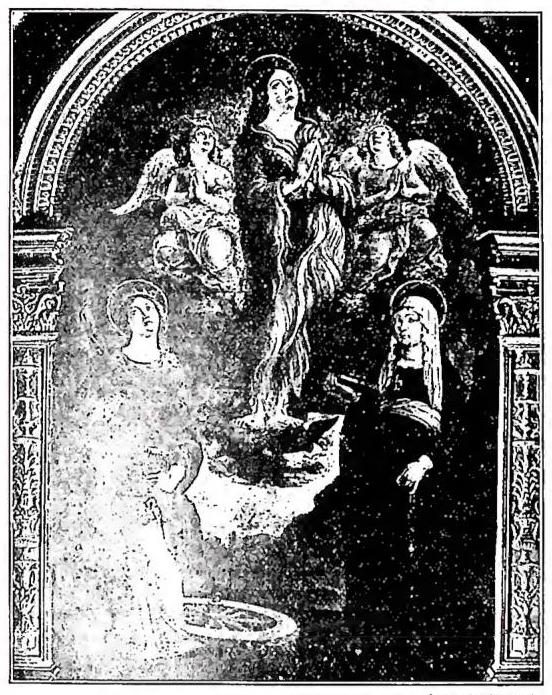
(phot. Anderson)
LIBERALE DA VERONA — Saint Catherine of Alexandria and Saint Anastasia: in the center, the Magdalene between two angels. Altarpiece by L. da V. VERONICA, church of Saint Anastasia.