
PONTIFICAL REGISTERS. — By r. are meant the books in which the chancery copied, for the record, the letters that it dispatched.
The name gesta or regesta had already been used for the commentaries of the Roman period, in which the senate and consuls, and later the emperors, the imperial authorities of the provinces, and the barbarian kings, preserved copies of the acts they had issued. Special officials were responsible for maintaining these books, but one must not imagine a genuine registration, regular and complete, in the sense in which it is conceived in the modern age; the acts were copied in chronological order, though not always rigorously, and notices of administrative interest and copies of letters received were often inserted among them. The compilers of the great Roman legal collections drew upon them; the Variae of Cassiodorus derive from the registers of the court of Theodoric, although they had rather a didactic purpose.
The use of r. among the popes is connected with this tradition: the ancient canonical collections likewise drew chiefly upon them, for example, the Collectio Dionysiana, the Quesnelliana, that known as the Frisinga collection, the Collectio Avellana and, later, the Collectio canonum of Deusdedit, which explicitly indicates the source of the individual fragments. Copies of documents extracted from the r. in official form have always been regarded as possessing public authority.
I. BEFORE INNOCENT III (1198)
The existence of p. r. in the 4th century is generally admitted, but there is no conclusive evidence for II. A recent authoritative study (Silva-Tarouca) has demonstrated the inconsistency of what had until then been considered irrefutable proofs of the existence of the r., namely the references littera uniformis, et alia manu and a pari, found in a letter of Pope Liberius (355) and in others by various popes of the 4th-5th centuries; nevertheless, it is certain that the manuscript tradition of the letters of s. Leo the Great derives from the r.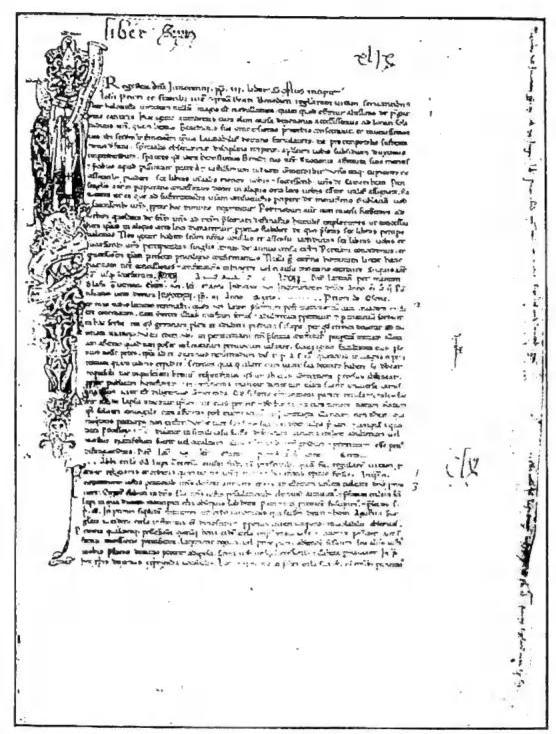
(Int. Enc. Cutt.)
REGISTRI PONTIFICI - Incipit of Book I. VII of the Registrum of Innocent III (1198–1216) - Vatican Archives, Reg. Vat. 5, f. 49f.
For the ninth century, besides the fragments of the register of Leo IV, John VIII, and Stephen VI contained in canonical collections, there remains a copy of 314 letters relating to the last six years of John VIII (872–82) in a codex written at Montecassino in the eleventh century, now preserved in the Vatican Archives. They derive from the register and are arranged by indictions, like the register of Gregory the Great; it seems that the original register was divided into three parts, of which only the last two are attested in the Vatican codex. It is debated (Steinaeker) whether this eleventh-century copy reproduces the original in its entirety or contains only a selection of letters made for a particular purpose. There is no evidence for the tenth century or for the first half of the eleventh; after a gap of almost two centuries, the Collectio Britannica contains a certain number of decretals extracted from the registers of Alexander II (1061–73).
The first surviving original register is that of Gregory VII (1073–85), preserved in the Vatican Archives. It contains 381 letters and is divided into books according to the years of the pontificate, no longer according to the indictions: this division was thereafter always observed in the following centuries. In it, as in the ancient commentarii, there are also inserted items of information, for example concerning the councils of the period, and the famous text known as the Dictatus Papae. For Urban II (1088–99), Paschal II (1099–1118), and Gelasius II (1118–19), there are only mentions and extracts. A fragment of the register of the antipope Anacletus II, with 38 letters belonging for the most part to May 1130, is preserved at Montecassino in a thirteenth-century copy. The register of Alexander III (1159–81) was divided into 22 books grouped in four volumes (Holtzmann); many registers of the twelfth century were still preserved in the Chancery of Honorius III (1216–27), but were subsequently lost.
II. FROM INNOCENT III (1198)
With 1198 begin the registers preserved in the Vatican Archives; the series is not complete because many volumes have been lost and some are dispersed in various libraries. For the thirteenth century they are assembled in a single series (Reg. Vaticana) which, with gaps, extends to the year 1597 (2042 vols.); for the fourteenth century, alongside the preceding series, there exists a second series (Reg. Avenionensia) formed by the registers of the Avignonese popes and of certain antipopes up to the year 1415 (349 vols.); with 1389 a third series begins (Reg. Lateranensia), extending to 1897 (2467 vols.). The Vatican Archives also preserve the registers of the secretaries who dispatched bulls and briefs: the registers of the Secretaria Camerae, 222 vols. from 1470 to 1796; the oldest registers of the briefs in Arm. XXXIX (fifteenth century); the registers of the Brevia Lateranensia, 852 vols. from 1490 to 1800; the large series of the Segreteria dei Brevi, 3660 vols. divided into various subject groups, from 1566 to 1846. A separate group is formed by the registers of the Brevia sua epistolose ad principee, 292 vols. from 1560 to 1836 (earlier volumes are found in Arms. XLIV–XLV). In addition to the registers of letters, the registers of the Suppliche are preserved, 7365 vols. (1342–1809).In such a variety of series, numerous problems arise concerning their relationships and, above all, the character of each series and of the individual registers, the procedures of registration, and the provenance of the various groups from the different offices or organs which, in the development of the Curia, came to be added to the oldest office, the Chancery, in the issuing and registration of papal documents.
At least for the thirteenth century, only a portion of the letters dispatched is found inserted in the registers: this too is a problem not yet adequately explained, one that concerns the very meaning of “register.” It has been thought (Heckel) that, as a rule, documents of interest to the Curia were registered, while for the others registration took place only at the request of the parties concerned, but this fact has not been proved. The careful study of the registers of Innocent III (Kempf) has shown that, in their formation, they display simultaneously the character of an “office book,” a “collection of letters of historical interest,” and a “collection of decretals.” In the later centuries, by contrast, a stricter conception prevailed: each office, or even certain individual officials, preserved copies of the documents dispatched, with a presumption of regularity and completeness, while nevertheless following different criteria and procedures.
Other problems, rich in consequences for the historian, are whether the letters were copied into the registers from the originals or from the drafts, and whether this was done before or after dispatch; sometimes the drafts themselves were preserved in bundles or bound into volumes possessing the character of registers.
There is therefore a difference between registers of the same pontificate and an evolution in the concept of registration, within the framework, nevertheless, of a tenacious persistence of traditional forms.
The Reg. Vaticana (= RV) constitute the oldest and most important series. The volumes are arranged according to the succession of the popes and, for each pontificate, in chronological groups; but the composition of the series is uneven, because it was formed in the seventeenth century by bringing together groups of registers that belonged to different offices. The first three volumes are, in a certain sense, extraneous to the series: RV. 1 is a copy of the register of John VIII (v. above), RV. 2 is the original of Gregory VII (id.; V. PAPA), and RV. 3 is a modern copy of the preceding volume. With RV. 4 the more or less regular series begins, with the letters distinguished according to the years of each pontificate. For the thirteenth century and much of the fifteenth, the registers are attributed as a whole to the Chancery; however, some of them, individually or in groups, belonged to the Apostolic Camera, which took part in dispatching and registering letters of particular administrative or political interest. The letters of the Chancery were later distinguished into classes according to their content (litterae communee); those of the Camera were called litterae secretae; litterae de curia are found both in the Chancery and in the Camera. In the mid-fourteenth century, secretaries entered into service within the Apostolic Camera, and soon had registers of their own.
A large part of the registers from the Avignonese period are not originals, but contemporary official copies, carefully written and on parchment, of the original paper registers which today form the series of the Reg. Avenionensia; nevertheless, a certain number of volumes, on paper and original, actually belong to that series. A few others from the fourteenth and fifteenth centuries, on the other hand, belong to the Reg. Lateranensia.
Many volumes from the thirteenth and fourteenth centuries have a special character or are not true registers: RV. 6 is the R. super negotio Romani Imperii of Innocent III; RV. 29 A, 30 A, and 33–36 contain secret letters of certain papal notaries from Urban IV to Honorius IV (1261–87); RV. 46 A is a copybook; RV. 62 is a collection of letters relating to the Tartars (1198–1355); the thirteen volumes RV. 244 A–N consist of original drafts from Clement VI (1342–52) to Gregory XI (1370–78); RV. 308–309 belong to the Apostolic Camera but do not contain papal letters; RV. 332 contains secret letters dispatched sub signeto.
The registers from Martin V (1417–51) onward are more regular and mark an advance in the system of registration; they are all on paper and belong either to the Apostolic Camera (e.g., the Officiorum volumes), or to particular secretaries (e.g., Poggio Bracciolini), or to secretaries in common, or, after 1487, to the secretariat established as a college. The regular series ends with St. Pius V (1572); the last three volumes are mixed and extend to the fifth year of Clement VIII (1592–1605). A chronological table of the volumes is published in Sussidi per la consultazione dell’Archivio Vaticano, I (Studi e testi, 45), Rome 1926, pp. 49–125.
The Reg. Avenionensia are on paper and original in the strictest sense; they begin with Giovanni XXII (1316–1334), while earlier r. have probably been lost. The present composition of the volumes is irregular, and extraneous materials are often inserted in them; the individual books were copied in a more finished form into parchment volumes that now form part of the Reg. Vaticano (v. SORA), though the correspondence between the paper volumes (in their present state) and those on parchment is not absolute. In the first volumes, the individual letters were cancelled with pen strokes, made by hand as the copying proceeded; taken as a whole, these r. are more authoritative than the copies, because the text is more accurate, especially in the spelling of proper names. They contain litterae communes and litterae secretae.
The Reg. Lateranensia contain the letters dispatched by the Chancery and constituted the Registrium commune; they are the continuation of the litterae communes of the Reg. Avenionensia, closely related, in terms of the subject matter of the letters, to the r. of the Suppliche. The series is homogeneous and uniform; the r. are all on paper and of the same format, and the letters are grouped by subject. Many volumes were lost in the sack of Rome and still more during the transfer to Paris ordered by Napoleon; it is estimated that the present holdings represent little more than half, and for some pontificates barely a third, of the original holdings. For particular information on the more recent series, V. K. A. Fink (cf. bibl.).
III. EDITIONS
The pontifical registers entered modern historiography with the Annales ecclesiastici of Card. Baronio (1578-1583) and of his continuators. The opening of the Vatican Archives in 1881 aroused in every nation an interest in the study of the registers, which, down to the end of the 14th century, constitute the most important source for European history. Research has proceeded along two lines: systematic and general publication of the letters, in full or in abridged form, and publication limited to those concerning a particular country. In the former sense, especial merit has been acquired by: the Monumenta Germaniae historica for the registers of Gregorio I, Giovanni VIII, Gregorio VII, and extracts from the registers of the 13th century; the French School in Rome for the registers of the 13th and 14th centuries down to 1378. The other historical institutes in Rome have devoted themselves rather to publications of national interest. A general survey of editions of the registers for each pope is found in the work of K. A. Fink (cf. bibl.). - See plate XXXIV.F. Bock, Annotationes zum Register Gregors VII., in Studi Gregoriani, I, Roma 1947, pp. 281-306; M. Giusti, I r. vaticani e gli uffici da cui provengono, in Miscell. archivist. A. Mercati, (Studi e testi, 165), Città del Vaticano 1952, p. 383 ff. For information on the registers preserved in the Arch. Vatic., on knowledge of them, on the state of the editions, and on the indexes of each series, V. K. A. Fink, Das Vatikanische Archiv. Einführung in die Bestände und ihre Erforschung, 2nd ed., Roma 1951. Giulio Battelli