
ROTSVITA — Benedictine and Saxon poetess, born ca. 935, died probably after 973. According to Seidel, the name Hrotsvit is an abbreviation of her secular name, Helena von Rossow; others, such as Gottsched, see in it the etymology “white rose”; in the preface to the collection of her dramas, R. names herself: “Clamor validus Gandeshemensis.”
Of noble family, she entered the convent of Gandersheim at a young age, where a school of Latin studies flourished. Under the guidance of Gerberga, niece of Otto the Great, she studied the Latin authors and, after attempts made “clam cunctis et quasi furtim,” became proficient in classical versification.
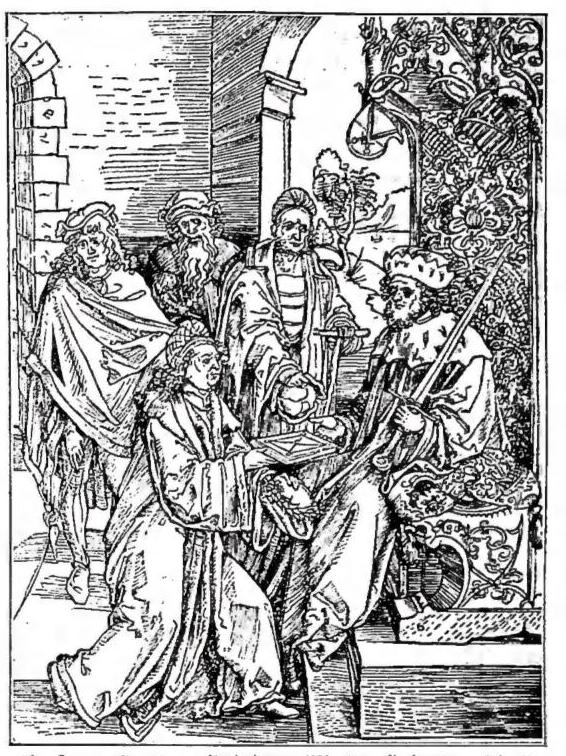
Her entire production, written in Latin and remaining unknown after her death, was discovered by the humanist Conrad Celtes toward the end of the fifteenth century in the Benedictine convent of St. Emmeram at Regensburg, and he published its first edition (Nuremberg 1501, with eight woodcuts by Dürer). Arranged chronologically in three collections, it comprises, in addition to a poem in hexameters on the deeds of Otto I up to 962 and an account, likewise in hexameters, of the origins of her monastery, eight sacred poems in leonine hexameters, six one-act plays in rhymed prose, and an appendix of 35 verses on episodes from the Apocalypse. Lost is the codex in which, according to the testimony of the monk Bodo, were contained the lives, also in hexameters, of the holy pontiffs Anastasius and Innocent.
LITURGICAL SCROLL - Exultet of the 12th century. The miniature depicts the Emperor (note that the miniature is oriented opposite to the writing) - Rome, Biblioteca Casanatense, cod. 724 B I 13.
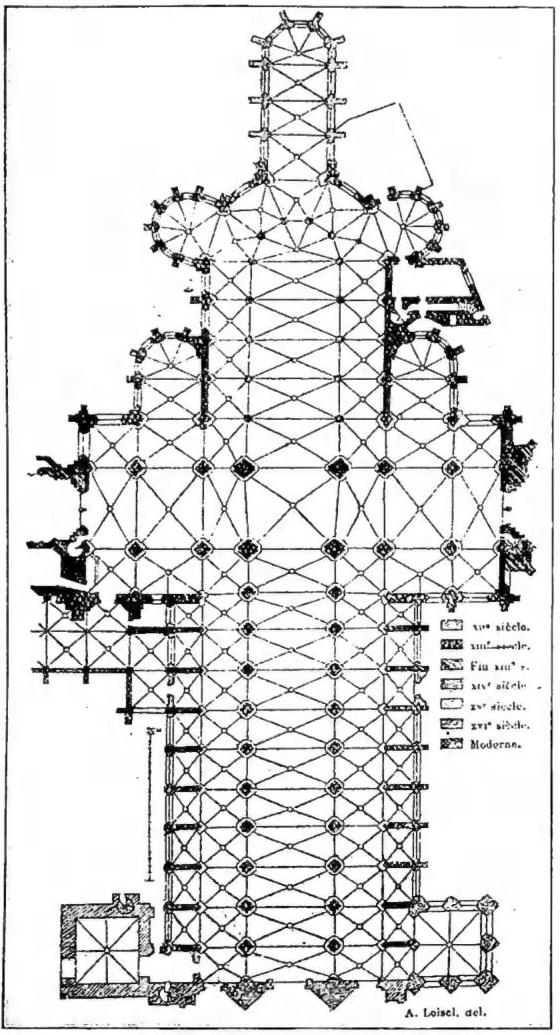
(from A. Loisel, La cattedrale de R., Paris n. d.)
ROUEN, ARCHDIOCESE OF - Plan of the cathedral of R.
the account from an eyewitness); the Conversio Theophili Vicedomini, judged by Ebert to be the oldest poetic adaptation of the Faust legend; Basilus, an account of a miracle of the Saint; the Passio s. Dionysii; the Passio s. Agnetis, which R. would take as a model for the heroines of her dramas. These, perhaps intended for performance in the convent, are Gallicanus I and II, Dulcitius, Calimachus, Abraham, Pafnutius, Sapientia, and were written, as R. says in the preface, to substitute for the sordid subjects of the comedies of Terence the «sacrarum castimonia virginum». The material is drawn from religious legends in the Acta Sanctorum, which are faithfully respected; only the plot is expanded with elements suited to enliven the atmosphere of the story, ranging from a tone of fervent drama to grotesque comedy. Nor are situations and expressions of some boldness lacking, but they are free from malice and suggested solely by the desire to give greater prominence to the virtue of the protagonists. R.’s theater is not yet the medieval sacred drama but, having begun with the imitation of classical models, remains something new because of the originality of its form and the sincere religiosity that pervades II.