
PAOLO della CROCE, saint. — Founder of the Passionists, in the world Paolo Francesco Danei, born at Ovada (Alessandria) on 3 January 1694, died at Rome on 18 October 1775. At the age of 19, on hearing a sermon by the parish priest, he was deeply moved and
resolved to devote himself entirely to the service of God: this was his “conversion,” as he called II. Seized by the desire to die for the faith, at 21 he enlisted as a volunteer in the army of the Republic of Venice, which was preparing an expedition against the Turks, encouraged and blessed by the Pope; but while praying in a church before the Blessed Sacrament exposed for the Forty Hours, he understood that other battles were those to which God was calling him. Returning to Castellazzo, where his family had moved, he undertook a life of extraordinary penance and prayer.
On 22 November 1720 he was clothed by Msgr. Francesco M. Arborio di Gattinara, bishop of Alessandria and his spiritual father, in the black penitential tunic that was to become the habit of the new Institute which God had called him to found. He then withdrew for 40 days into a poor little room adjoining the church of S. Carlo at Castellazzo and, in five days, wrote the Rules of the new Institute, without having previously read any others, but with such an abundance of heavenly light that it seemed to him that someone was dictating them to him.
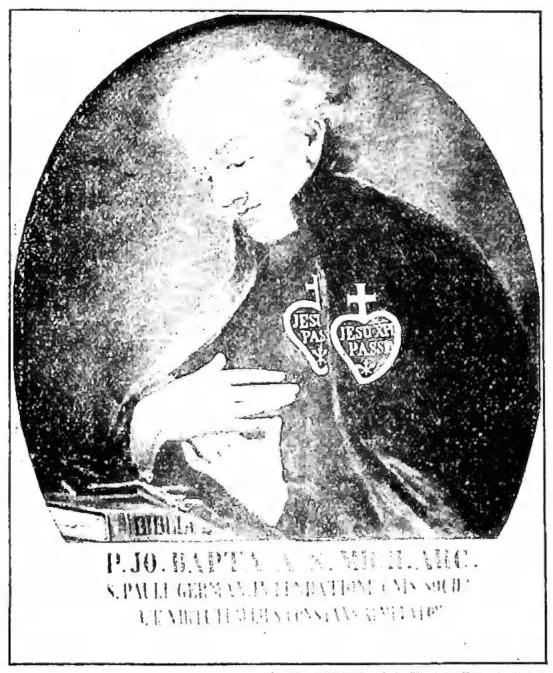
In 1721 P. went to Rome to implore Innocent XIII to approve the Rules, but, on seeing him so miserably dressed, a court official had him removed. P., returning to Castellazzo to take his brother Giovanni Battista, withdrew with him to Monte Argentario, which was to be the cradle of the new Institute, renewing there the penances of the ancient Thebaid. On feast days they descended into the villages below to instruct the faithful in Christian doctrine and to inflame them with holy exhortations, especially by reminding them of the Passion of Christ.
(courtesy of the Passionist Fathers)
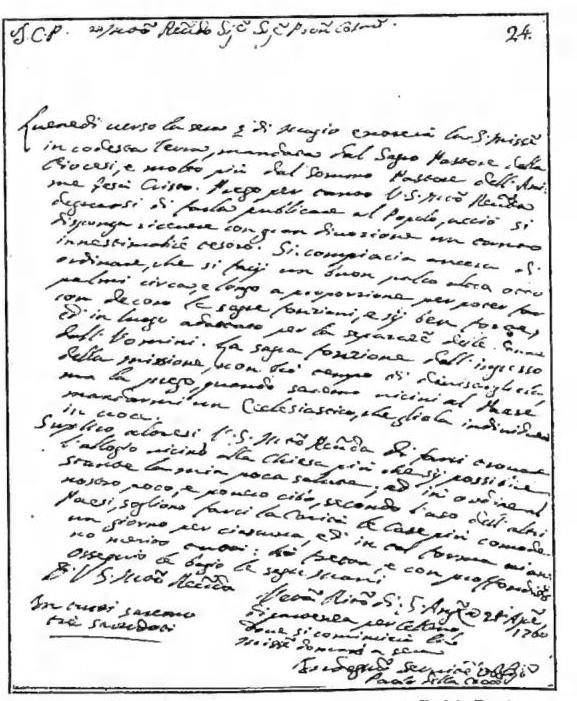
PAOLO DELLA CROCE, saint — Autograph letter of St P. della C., addressed to Bernardino Ruspantini, vicar forane of Grotte S. Lorenzo (Viterbo), retreat of S. Angelo, 24 April 1760 — Rome, General Archive of the Retreat of SS. Giovanni and Paolo.
and began their properly missionary life, preaching missions to the people and giving spiritual exercises to the clergy and religious communities, returning from time to time to solitude in order to renew their spirit through prayer and penance. God did not delay in sending them fervent companions, with whom P. was able to establish the Congregation of the Passionists that he had conceived. He saw the Rules successively approved by Benedict XIV, Clement XIV and Pius VI. Besides the Congregation of the Passionists (v. GESÙ CRISTO), he also founded a women’s institute of strict enclosure, Passionists (v.).
He deserves special consideration not only as a founder, but also as a missionary, mystic and spiritual director. As a missionary, for about 40 years he made his voice heard in the cities and villages of Tuscany and Latium, spiritually renewing entire populations.
As a mystic, he may be numbered among the Church’s most illustrious figures, as is already revealed by his diary, written at the order of Msgr. Gattinara during the forty-day retreat at Castellazzo in 1720. Three periods may be distinguished in his mystical life: from the age of 19 to 31 he passed through all the degrees of contemplation, until he was granted the spiritual “marriage”; from 31 to 76 he agonized in an interior martyrdom of darkness and terrible desolations, sharing in the abandonment of Jesus on the Cross; from 76 until his death his sufferings diminished and he began to foretaste the joys of Paradise. His union with Jesus Crucified was sealed by the instruments of the Passion impressed upon his heart. His continual prayers and tears for the conversion of England are noteworthy in his mystical life.
As a spiritual director, he led very many souls to high perfection, and the more than two thousand letters he left constitute a precious mine of teachings, suited to every kind of person, recommending above all, as an introduction to every degree of the mystical scale, the daily meditation on the sufferings of Jesus, since it is “the door that leads the soul to intimate union with God, to interior recollection and to the most sublime contemplation” (Lett., I, 582).
The reputation of holiness accompanied him throughout his life, not only among the common people, but also among bishops, cardinals and popes. Clement XIV called him “his dear little father” and visited him when he was ill at the retreat of SS. Giovanni and Paolo in Rome; Pius VI also visited him, and the Saint foretold to him the grave tribulations that awaited him.
He died in the aforementioned retreat at the age of 81. Pius IX canonized him on 29 June 1867. His body is venerated in the basilica of SS. Giovanni and Paolo. Feast day: 28 April.
Giacinto del S.mo Crocifisso