Machine translation of the 1948–1954 Italian original. The original text is authoritative.
GERARDO MAIELLA, Saint. - Redemptorist, born 23 Apr. 1726 in Muro Lucano (Potenza) of an artisan family, died at Materdomini 16 Oct. 1755. He was first a tailor in his hometown, then a servant to Bishop Albini in Lacedonia, upon whose death (1744) he returned home: he sought to enter the Capuchins and, being rejected, attempted the eremitical life for some time.
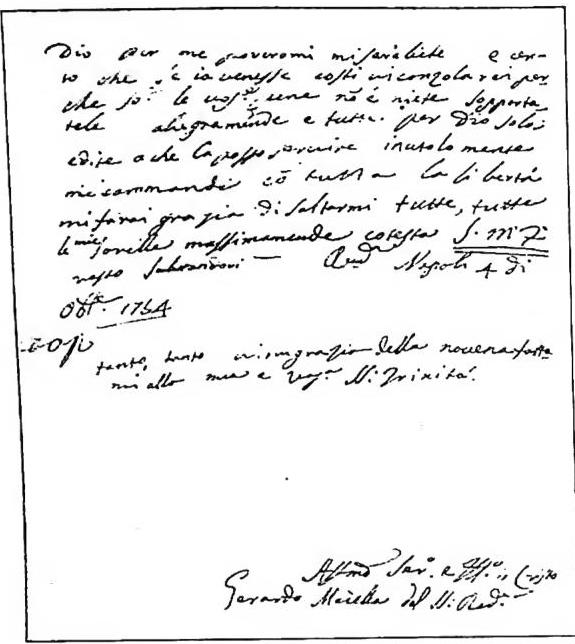
(from the folder of Fr. Gregorio Oreste) GERARDO MAIELLA, Saint - Ending of the autograph letter of St. G. M., Naples, 4 Oct. 1754, preserved in the hall of relics in Materdomini (Avellino).After insistent requests, in 1749 he succeeded in being admitted to the Congregation founded by St. Alphonsus, becoming one of its finest figures in the imitation of Jesus the Redeemer. Having completed his novitiate at Deliceto, he professed as a lay brother on 16 July 1752, making rapid progress under the guidance of the Ven. Fr. Cafaro. Emulating the mortifications of St. Peter of Alcantara, he made, like St. Teresa of Avila—to whom he was most devoted—the vow to choose what seemed to him most perfect. The charismatic gifts that had already made his life admirable among the people accompanied him with greater abundance in religious life, astonishing that rationalist era.
Except for brief stays in Pagani, Ciorani, and Naples, he lived in Materdomini (Avellino), filling the Sele valley and the villages of upper Irpinia, Lucania, and the Apulian Tavoliere with wonders, acclaimed everywhere as a vigorous peacemaker, father of the poor, and conqueror of sinful souls. Esteemed by the Ven. Sr. M. Celeste Crostarosa, he concerned himself with the taking of vows by pious maidens, providing them with a dowry: slandered by one of them who had left the convent, he did not excuse himself during the severe punishment inflicted upon him. Once the false accusation fell through the confession of the dying calumniator, the angelic innocence of G. was recognized, and he was able to resume his apostolate. And although he had barely studied grammar, he wrote several letters of spiritual direction, especially to the Carmelites of Ripacandida, and a Rule of Life, from which a remarkable spirituality transpires.
This mystic and thaumaturge of Southern Italy, beatified by Leo XIII in 1893 and canonized by Pius X in 1904, is invoked throughout almost the entire world as the patron saint of expectant mothers. The basilica of Materdomini, where he died, is even today a destination for pilgrimages, which sometimes take on a folkloric aspect. Feast day, 16 Oct.
BIBL.: G. Landi, Istoria della Congreg. del S.mo Redentore, ms. of 1782 in the General Redemptorist Archive; A. Tannoia, Vita del servo di Dio fra' G. M., Naples 1804; Murana seu Compsans beatific. et canoniz., ms. in the Archive of the Redemptorist General Postulation; C. Berruti, Vita del ven. servo di Dio G. M., Naples 1847; [F. Kuntz], Vita del b. G. M., Rome 1893; C. Benedetti, Vita di s. G. M., ibidem 1904; C. Petrone, Lettura gerardini, Materdomini 1932; O. Gregorio, Un pellegrinaggio a Materdomini, in S. Gerardo, 23-25 (1933-35); M. De Meulemeester, Bibliographie générale des écrivains rédemptoriens, II, Louvain 1935, pp. 265-66; III, ibidem 1939, p. 345; Pinuzzo da Bonea, Floretti gerardini, Materdomini 1941; O. Gregorio, Su le orme di s. G., ibidem 1948; id., Lettere e scritti di s. G., ibidem 1949. Oreste Gregorio
Cite this article
“GERARDO MAIELLA, SANTO.” Enciclopedia Cattolica, vol. VI (1951), p. 77. Azione Romana digital edition, https://azioneromana.com/article/gerardo-maiella-santo.