Machine translation of the 1948–1954 Italian original. The original text is authoritative.
GIOVANNI BATTISTA de' ROSSI, saint. — Born on 22 February 1698 at Voltaggio (Genoa) to Carlo and Francesca Anfossi, he died in Rome on 23 May 1764. At the age of ten he went to Genoa as a page in the noble Scorza family, where two Capuchins passing through on their way to Rome, impressed by his piety and innocent conduct, had him summoned to the Eternal City by an uncle, provincial of the same order, and by a cousin who was a canon of S. Maria in Cosmedin. He arrived there in 1711, at the age of thirteen, and remained for more than fifty-three years, leaving it thereafter only for brief periods and for nearby places such as Ariccia, Albano, Civita Castellana, and Tivoli.
Taking up residence with his cousin d. Lorenzo, he attended the schools of the Collegio Romano founded by Gregory XIII (Archiginnasio Romano), which at that time were attended by a great number of Italian and foreign secular youths, so that the Saint could say that there he had encountered the best of the Catholic world. Having completed courses in the humanities and sciences, always obtaining the highest marks, he earned a doctorate in philosophy by publicly defending his thesis with much acclaim. Upon beginning theology, he suffered a severe breakdown and the first attacks of epilepsy, from which he was afflicted throughout his life. The weakening came after an indiscreet penance in eating and drinking, which he had undertaken in order to correct himself of certain lapses of speech into which, owing to his cheerful and jesting character, he was accustomed to fall. This experience served to instruct others, since he subsequently recommended to young people that they not undertake excessive penances. Nevertheless, he did not interrupt his studies, but continued them more easily with the Dominicans of S. Maria sopra Minerva, who, using the Summa of s. Thomas as their text, did not require their students to endure the labor of taking written notes. In the meantime, the Saint continued attending at the Collegio Romano the Congregation called della Scaletta, which he had joined at the age of fourteen, where he held the office of sacristan, and where, under the guidance of the celebrated educator p. Francesco Maria Galluzzi S. I., he had learned devotion to s. Luigi Gonzaga. Fr. Galluzzi introduced him into the select group of the SS. Apostoli, and, having become his confessor for more than twenty years, launched him into the apostolate. Ordained a priest on 1 March 1721, G. B. made on that same day a vow never to seek any ecclesiastical benefice and never to accept one, unless it were imposed upon him by obedience; he also enrolled in the select group of priests that met at the Oratorio del Caravita. From then on he began a life wholly devoted to the priestly ministry, dedicating himself to the spiritual education of the poor at S. Dorotea near Ponte Sisto, at Palazzo Chigi, at S. Galla, and at Ripa Grande, visiting the sick in hospitals and preaching missions to the people. At the age of thirty-nine he was made a canon of S. Maria in Cosmedin, in place of his deceased uncle, and promptly sold and gave to the poor and to charitable works the entire inheritance he had received from him, moving to live at the Trinità dei Pellegrini. There he ended his days, after violent epileptic attacks. He was one of the most highly regarded confessors and counselors of the Roman clergy. He valued and recommended the ministry of confession as one of the most important; during the last twenty years of his life he devoted four to five hours every day, and sometimes eleven or twelve, to this ministry. The ordinary processes of beatification were begun in 1781 under Pius VI; he was beatified by Pius IX in 1860 and canonized on 8 December 1881 by Leo XIII. Feast day: 23 May.
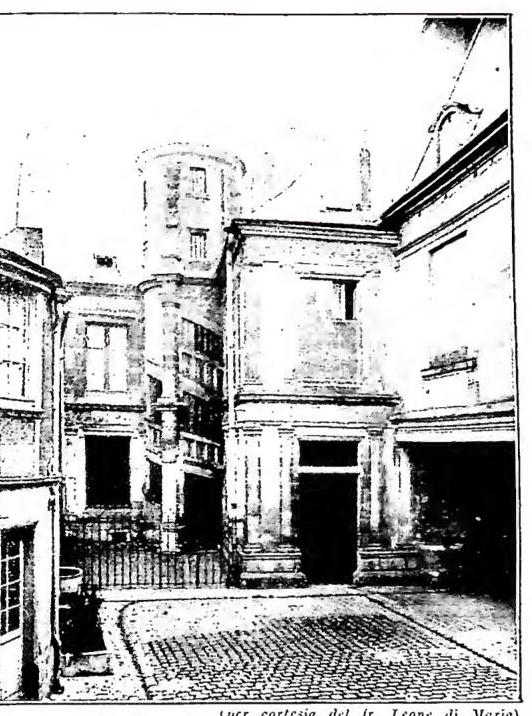
(courtesy of fr. Leone di Maria)
GIOVANNI BATTISTA de LA SALLE, saint — Interior of the house in which s. G. B. de la Salle was born at Reims, with its characteristic «tourelle».
BIBL.: G. M. Toietti, Vita del servo di Dio G. B. de R., Rome 1768; M. Tavani, Vita del b. G. B. de R., there 1867; [H. M. Cormier], Un ami du peuple. St Jean-Baptiste de R., there 1901; J. Baudot-J. Chaussin, Vies des saints et des bienheureux, V. Paris 1947, p. 457 ff. Arnaldo M. Lanz
Cite this article
“GIOVANNI BATTISTA DE' ROSSI, SANTO.” Enciclopedia Cattolica, vol. VI (1951), p. 385. Azione Romana digital edition, https://azioneromana.com/article/giovanni-battista-de-rossi-santo.