
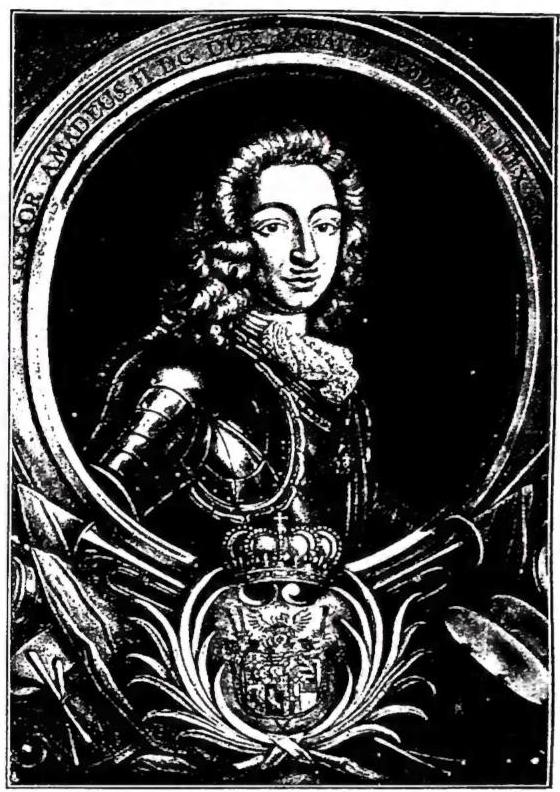
VITTORIO AMEDEO II, duke of SAVOIA and king of SARDEGNA. — Son of Carlo Emanuele and of Giovanni Battista di Savoia Nemours, b. in Turin on 14 May 1666, d. at the Castle of Moncalieri on 31 October 1732. The death of his father in 1675 left the young prince under the guardianship and regency of his mother officially until 1680, in fact until 1684, the year in which V. State.
In the solitude in which he had lived, he had devised turbulent plans for governmental reforms, pursuing a program of economies that would increase the State’s military capabilities. V. A. was deeply concerned about relations with the great European powers, above all because of the heavy preponderance that Louis XIV exercised over Piedmont, as master of Pinerolo since the Treaty of Cherasco and then, through sudden violence, also of Casale (1680). V. A. could not refuse the marriage to Anna d'Orléans imposed on him by the Grand Monarque, but he was impatient under the French yoke and awaited the opportune moment to recover his independence. The formation of the League of Augsburg (1686) enabled him to begin negotiations with France’s enemies; the Grand Alliance of 1689 gave the Duke of Savoia the opportunity to sign agreements with the various allied powers in 1690. Piedmont was then at war. The French generals’ assault against Turin was fierce, but the victories at Staffarda and Marsaglia did not make it possible to crush V. A.’s resistance. The Grand Monarque resigned himself to offering the Duke of Savoia the restoration of Pinerolo and the abandonment of Casale: the secret Treaty of Pinerolo (27 June 1696) and the subsequent Treaty of Turin (29 August 1696) led to the Agreement of Vigevano for the neutralization of Italy, and the Peace of Ryswick the following year recognized the decline of French predominance in the peninsula, thanks to V. A. But he,
who had been obliged to give his daughter Adelaide in marriage to the Duke of Burgundy, had once again entered France’s orbit and found himself in a difficult political situation when the question of the succession to Spain was about to arise. The Duke of Savoia did in fact enter the war as an ally of Louis XIV, but with the intention of distancing himself from him as soon as possible, to prevent his State from becoming an object of negotiation among the great powers. In response to the secret Savoyard-imperial negotiations, Louis XIV had the Piedmontese troops disarmed, but on 8 November 1703 V. A. signed the Treaty of Alliance with the Emperor, who promised him Monferrato and part of the Duchy of Milan with Alessandria, as well as Valsesia. From 1704 to 1706, fierce fighting again took place around Turin between the French and the Austro-Piedmontese, a war that culminated in the battle of Turin, won by V. A. and his cousin Eugenio di Savoia (7 September 1706). The basilica of Superga was erected to commemorate the Savoyard victory and the expulsion of the French from Italy.
The negotiations for the Peace of Utrecht gave V. A. the opportunity to pursue skillfully his policy, aimed at obtaining from the Empire the concessions promised in 1703; from France, the lands it occupied on the eastern flank of the Cottian Alps; and from the European concert, compensation for renouncing his rights to the crown of Spain, which derived from the inheritance of his grandmother Caterina, consort of Carlo Emanuele I. Thus Louis XIV ceded to the duke Pragelato, Fenestrelle, Exilles, Oulx, Cesana, Bardonecchia, and Castel Delfino, receiving in exchange the valley of Barcellonetta; the Empire gave him Monferrato, Alessandria, Lomellina, and Valsesia; for the Spanish inheritance, instead of the Duchy of Milan, the island of Sicily was assigned to the Duke, together with the title of King. V. A. therefore emerged from the great crisis triumphant both militarily and diplomatically. When English support failed him in the following years, however, in the Austro-Spanish conflict kindled by Cardinal Alberoni he was forced to surrender Sicily to Austria, receiving the Kingdom of Sardegna in exchange (8 November 1718).
When the wars were over, V. dream, the restoration of the State. A major period of reforms consequently began. His policy aimed at creating an absolute monarchy in which all class and corporate privileges would disappear. V. A. deserves credit for creating that regular, rigorous, and honest Piedmontese administration which in the nineteenth century was to serve as a model for the organization of the unified Italian State. V. A.’s relations with the Church are of considerable interest. A believer and deeply religious, he desired his subjects to share his simple religion, without meditations or discussions. The faith of the carbonaro, he would say. On the other hand, he was a determined defender of the State’s claims against what were called ecclesiastical interference and usurpations. He therefore had prolonged disputes with the Holy See, which indeed led to a complete rupture. Many episcopal sees in Piedmont remained vacant for years. Only in 1724 did Benedict XIII offer to enter into negotiations; the minister Ormea went to Rome to conduct them.
In V. A.’s reforming policy, the reconstitution of the University of Turin was of great importance; in the renewal of studies, two Sicilian jurists, Niccolò Pensabene and Francesco d'Aguirre, acted as V. A.’s advisers. Thus the legislative reform represented the crowning achievement of the State’s renewal. The Nuove Costituzioni were published in 1725, but V. A. subsequently reconsidered them, and only in 1729 did the new and definitive edition of the Vittorian Constitutions appear; in 1837 these gave way to the Albertine Code. In 1730, weary after such a long reign, so full of activity, V. A. abdicated in favor of his son Carlo Emanuele III and withdrew to Chambéry to live privately. Since he had already lost his wife, he now married Anna Teresa Canalis di Ciumana, widow of Count Novarina di S. Sebastiano, whom he made marchioness of Spigno. But he found none of the peace he sought in private life and, dissatisfied with the policy pursued by the new King, returned to Piedmont to resume power. To avoid a civil war, the old King was arrested and confined in the castle of Moncalieri, where he died. He was buried at Superga.