
GRATO, saint. — Bishop and patron of the diocese of Aosta, greatly venerated in the surrounding Alpine regions, he is identified with the presbyter Gratus who, in the name of the first Aostan bishop, Eustasius, signed the acts of the Synod of Milan of 451. He took part in the solemn translation of the Theban martyr St. Innocentius at Agaunum, described in an account from the end of the fifth century (cf. ed. B. Krusch, in MGH, Scriptores rerum Merovingicarum, III, Hannover 1896, p. 40). The year of his death is unknown; known instead is the day of his deposition, 7 September, from the funerary inscription (cf. P. Barocelli, Inscriptiones Italiae, vol. XI, Regio XI, fasc. I. Augusta Praetoria, Roma 1932, p. 24), a date that would become traditional in the liturgical books of Aosta, beginning with the oldest Aostan calendar (not properly liturgical), inserted in an eleventh-century missal: «VII id. Sept.: Augusta depositio sancti Grati» (cf. A.-P.
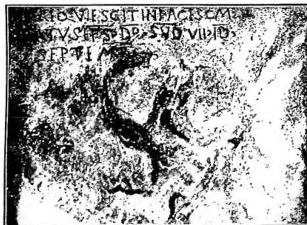
GRATO, saint — Funerary inscription (fifth century) — St-Christophe (Aosta), parish church.
Frutaz, Un missel noté du XIe siècle, in Revue grégorienne, 14 [1929], p. 134).
The cult of St. G. received a strong impetus in the thirteenth century with the translation of his relics from the Collegiate Church of S. Orso to the Cathedral, commemorated on 27 March in a Martyrology of the Cathedral dating from the end of the thirteenth century. He is venerated as protector of the countryside and its products. The Saint’s relics are preserved in the Cathedral in a sumptuous Gothic reliquary chest (v. tav. LXXI), in silver and gilded copper, with half-round figures, the work of the goldsmith Giovanni di Malines (1421–58).
The legendary and anachronistic account that the Aostan canon Giacomo de Curtis (d. 1285) inserted into the office of the Saint, composed at the request of the Cathedral Chapter, and which constitutes the source of all later accounts, deserves no credence. According to this account and the later amplifications, commonly accepted by local historians, St. G., of Greek origin, would have been bishop of Aosta in the time of Charlemagne (ca. 775–810) and would have taken part in the discovery of the head of the Forerunner in Palestine, bringing a substantial portion of it to Aosta.