
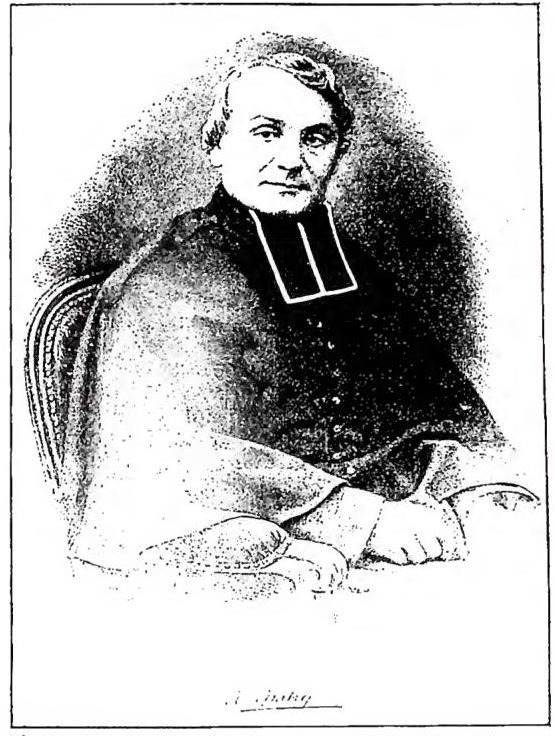
GRATRY, ALPHONSE. — Philosopher, born in Lille on 30 March 1805, died in Montreux on 7 February 1872. Having completed his secondary studies, he entered the «Ecole polytechnique». He was led to take this step by a firm determination to acquire the scientific preparation that would enable him effectively to undertake that program of the Christian restoration of thought which, after emerging from a period of intellectual crisis, his spirit had set before itself. Ordained a priest on 22 December 1832, after a period spent in Strasbourg together with other young priests under the direction of Bautain, he returned to Paris in 1841 to direct the Collège St-Stanislas.
Later he was appointed aumônier at the «Ecole normale supérieure», a position he held until the controversy with E. Vacherot, the school’s director, over the origins of Christianity, which arose from the publication of Vacherot’s own Histoire critique de l'Ecole d'Alexandrie, led him to leave the school almost simultaneously with his adversary. In 1851 he entered the Oratory, where he saw his dream of a priestly circle devoted to study becoming a reality. Here he elaborated his major works, De la connaissance de Dieu (1855), La logique (1855), and De la connaissance de l'âme (1857). But the ideal, owing to differences in outlook between G. and Pététot, a noble yet rigid and austere spirit, could not be fully realized. In 1861 G. withdrew from the Oratory, without abandoning his studies (Les sources [1862]; Les sophistes et la critique [1864]), though giving them a greater emphasis on more specifically religious subjects (La paix [1861]; La philosophie du Crédo [1861]; Commentaire sur l'Évangile selon St Mathieu [1863]; La morale et la loi de l'histoire [1868]). At the same time he devoted himself to practical activities, promoting (1867) the International League of Peace, which sought to bring together for this purpose men of differing religious and political views. In that same year he was called to the Academy.
G.’s thought is dominated by the conviction that one approaches truth “with one’s whole being”; in the abandonment of this method G. sees the reason for the dissipation of the philosophy of his time. Neo-criticism, positivism, fideism, but above all the neo-Hegelianism of Vacherot and Schérer, are expressions of an “isolated” mode of thought, which knows only “how to draw error from the spectacle of visible things, from the inner facts of the soul, and from the course of human events” (Conn. de Dieu, I, p. 21), and has forgotten that “the solid and healthy development of thought proceeds from the development of the whole soul and of the will” (op. cit., p. 41). Philosophy must therefore return to this integral method if it is to be truly life-giving and not a source of crisis. Philosophical inquiry requires a lofty and intense spirit, sincerely religious, together with knowledge of the world of the experimental and mathematical sciences, which, despite their particular character, are related to one another and indeed unified, insofar as mathematics gives metaphysics its lights and formulas, and geometry gives them to psychology. This unitary body of knowledge, which can be acquired only through the cooperation of select minds (the ideal and purpose of the Oratory), constitutes that comparative science which is an indispensable condition for philosophizing well. From this point thought will therefore proceed in order to address the most important questions, first and foremost that of God.
G. in fact begins his work with theodicy, convinced that “philosophy is wholly contained in theodicy” (op. cit., I, p. 71). It is precisely in his study of the problem of God that G., while affirming that he does not claim to offer new proofs of God’s existence but only to deepen and render irrefutable those already given, presents some of his characteristic theories, such as that of the dialectical procedure and of the divine sense. For G., the existence of God is reached not only through the classical proofs but also through the dialectical procedure. It is already operative at the outset in infinitesimal calculus and consists precisely “in passing, without any intellectual process, although following an impulse of reason that is more than legitimate, from the finite to the infinite, from the finite being that one is, that one sees, that one currently touches, to the infinite being really and actually existing, which the existence of the finite implies and presupposes” (op. cit., I, p. 59). Yet this procedure, in which the necessary distinction between the mathematical infinite and the metaphysical infinite is overlooked, is not sufficient to affirm the existence of God. “Will reason need the external data of the world in order to know the world, the interior data of the soul in order to know it, and need nothing in order to recognize God? Will it not rely on God in order to know him, and will it need no data of God in order to rise to God?” (Logique, I, p. 100). This is offered to us precisely by the “divine sense,” which G. defines as “the inevitable attraction of the supreme good in every soul” (Conn. de Dieu, I, p. 69). A living experience of God operating within us, which it depends upon us either to heed or betray, this divine sense is not, however, a mysterious sense that takes the place of reason; rather, it is ultimately clarified as an impulse, a stimulus of reason itself.
Whoever devotes himself to philosophical inquiry with his whole being, joining will and heart to reason, because “thoughts are great when the heart enlarges them” (Sources, p. 8), cannot fail to arrive at God; nor can he fail to crown his inquiry with adherence to the faith, which, by giving us possession of God, grants us a complete and lofty happiness that for G. almost becomes identified with the beatific vision. Prepared by natural faith in indemonstrable principles, intrinsic to reason itself and anticipated by it, supernatural faith appears as the legitimate crowning of our limited thought, which also recognizes the necessity of faith as an indispensable condition for avoiding spiritual decline. Union with God brings peace, makes us intensely human, and, through the aid of grace, truly free and capable of understanding, despite our sorrows, the living beauty of the universe, which is moving not toward death but toward a state of marvelous unity and stability, where present dispersions and changes fall silent, and where the blessed souls, united with their transformed bodies, have their dwelling. For immortality belongs not only to man but, in a different form, to the whole universe, intimately bound to our life as immortal beings.
G.’s thought unfolds with abundant vitality and richness of themes, though at times falling victim to an overly intense feeling and excessive symbolism. This is the case, for example, when he seeks analogies between the life of the soul and the life of the universe, and in his theory of language, in which G. follows the traditionalists in part, maintaining that speech arose through a collaboration of the activity of God, Adam, and things, and that it expresses the essence of things themselves. Nor is his theory of induction and deduction free from criticism, since it excessively accentuates the distinction between the two procedures; nor is the reduction of the principle of causality to that of sufficient reason, and of the principle of identity to the identity of substance.
Yet these positions too help to clarify G.’s true personality: alongside an imagination that was at times too fervent, he possessed a soul passionate for God and man, and an aspiration toward salvation and self-giving rich in educational power. G. knew how to speak to the people of his time; his teaching, Ollé-Laprune (v.), exercised an influence on nineteenth-century French religious philosophy, nor can it be said that it has been entirely extinguished.