Machine translation of the 1948–1954 Italian original. The original text is authoritative.
JULIAN THE HOSPITALLER, St. — Neither the date nor the place of his birth can be fixed; his biographical details are purely legendary, and the legend itself appears from the 12th century onwards in multiple versions.
He is said to have been born in France (Le Mans, Anjou), in Belgium (Ath), around the middle of the 7th century, or in Italy (Naples). He is alleged to have killed his parents as a result of a tragic mistake: upon learning of his crime, he came to Rome to seek absolution and built a hospital for pilgrims on the river Gardon in Provence or in the place called Isola on the banks of the river Potenza, near Macerata. His cult, initially private, spread to various liturgical books only at a very late date, as in the Aquileia Missal of 1519 (on 29 January). Even the dates of his feast vary: 13 January, 12 February, 31 March, 31 August. The Belgian national church in Rome is dedicated to him.
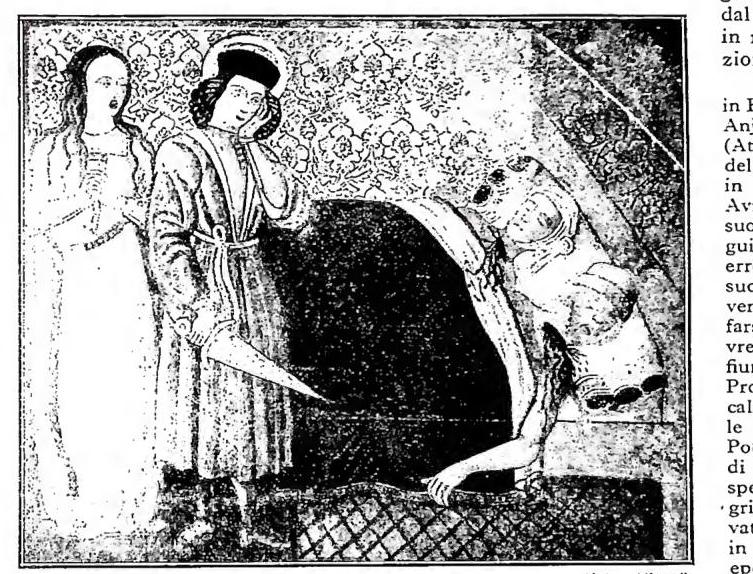
The legend of J. exerted a notable influence on art as well: among many works, mention may be made of the stained-glass windows of Chartres from the 13th century, the 15th-century triptych preserved in Burgos, the frescoes in the cathedral of Trent from the 14th century and in the Palazzo Comunale of Assisi (early 15th century), and the 15th-century wooden group in the chapel of St. J. at Boussoit-sur-Haine in Belgium.
BIBL.: The most recent and exhaustive study of St. J. is by B. Gaiffier, La légende de st. Julien l'Hospitalier, in Anal. Bollandiana, 63 (1945), pp. 145-219. A. Pietro Frutas
FOLKLORE. — The popular legend of St Julian would have arisen in the Middle Ages, probably in French or Belgian territory, and has vividly struck the imagination of the common people. He is invoked by those about to undertake a journey, to avoid bad encounters and ensure a good lodging. Besides being the patron of travellers, he is also protector of innkeepers and of the cities of Ghent and Macerata. Already in the Decameron (Second Day, Second Story) the Paternoster of St Julian is mentioned, which is still preserved in the oral tradition of various regions of Italy. St Julian has inspired popular poems, which follow the narrative as given in the Golden Legend; one of these, from Abruzzo, in 171 verses, was published by Percopo; another, in about thirty ottava rima stanzas, is preserved in incunabula of the Casanatense Library (no. 1764), the University of Bologna (no. 21) and the Marciana of Venice (Misc. 1945, 14) and continued to be printed in crude popular booklets until the 18th century. The principal episodes of the legend are concisely narrated in a popular “oration” in epic hendecasyllables, diffused from Calabria to Romagna. Flaubert took up the theme and developed it in a literary manner in one of his Trois contes (Paris 1886).
BIBL.: A. Tobler, Zur Legende vom heiligen Julianus, in Archiv für das Studium der neueren Sprachen und Literaturen, 91 (1898), pp. 339-64; 102 (1899), pp. 109-78; A. Graf, S. G. nel Decamerone e altrove, in Miti, leggende e superstizioni del medioevo, Turin 1893, pp. 205-19; 2nd ed. 1925, pp. 383-96; R. Magnanelli, Canti narrativi religiosi del popolo italiano, Rome 1909, pp. 150-73; G. Battelli, Le più belle leggende cristiane, Milan 1924, pp. 502-11; M. Oberziner, La leggenda di s. G. il parricida, in Atti del R. Istituto veneto, XCIII, 2 (1933-1934), pp. 253-309; P. Toschi, La poesia popolare religiosa in Italia, Florence 1935, pp. 113-15; C. Naselli, Diffusione e interpretazione del Paternoster di s. G. in Sicilia, in Atti del III Congresso di tradizioni popolari, Rome 1936, pp. 255-67; U. Gianciolo, Contributo allo studio dei cantori di regimento sacro, in Archivum Romanicum, 22 (1938, II-III), p. 47 ff.
Cite this article
“GIULIANO LO SPEDALIERE, SANTO.” Enciclopedia Cattolica, vol. VI (1951), p. 459. Azione Romana digital edition, https://azioneromana.com/article/giuliano-lo-spedaliere-santo.