
GIULLARI (joculares, joculatores). - In the Middle Ages, giullari were those who made a profession of entertaining the public of different social classes, from commoners to nobles, in squares as well as in courts. They were also called histriones, mimi, bufones, etc. These names were most often used generically and indifferently, because in reality a clear division was neither possible nor desirable regarding the repertoire or the different categories that formed the varied and multifaceted class of giullari. The term joculares, however, was preferably used to denote the higher categories of those who practiced poetry, song, and music.
The tradition of the giullari is continuously linked to the histrionism of classical antiquity and extends into the Renaissance.
Throughout this period, the activity of the giullari was intense in Western Europe, in Spain and Portugal as well as in England, France, Provence, and Italy. To entertain their audiences, giullari sang, played instruments, danced, recited dramatized monologues, often disguising and masking themselves; they acted as acrobats. They were indispensable at festivals, fairs, pilgrimages, and weddings. For the common people, they sang epic songs, fabliaux, or even amorous and playful songs in public squares or on street corners. Others, instead, frequented courts, some wandering from one court to another, others remaining for many years with the same lord; thus in Italy they were often called uomini di corte or milites de curia, sometimes blending, given their ill-defined functions, with actual courtiers. The giullari, together with buffoons and mimes, formed a large, varied, and restless throng that wandered from country to country, so much so that R. Menéndez y Pidal rightly insists on the “international character of guilleria”: thus, in Italy there were Breton, Norman, French, Provençal, and Italian giullari, while in Spain Italian giullari are found. Women also sometimes practiced the profession of giullari. From the mid-12th to the 14th century, the number of giullari in Italy was considerable, especially in the northern regions, where they found wide favor among the aristocracy of the courts and the flourishing bourgeoisie of the communes. Boncompagno da Signa, recounting a prank played by Guido Guerra on giullari who had gathered at his court, estimates their number at several hundred. The importance of their poetic-musical activity in the history of our early literature is greater than is usually acknowledged. “It was through the work of the giullari that the first literary elaborations of the vernacular language came about in our midst” (De Bartholomaeis): their nomadism served to unify the different dialects, or at least to mitigate their differences, and to create, in a sense, a common “vulgar culture.” The repertoire of the giullari can be gleaned, for Italy, from the Sirventese of the maestro di tutte le arti of Ruggero Apuliese of Siena (mid-13th century) and from the later Cantare dei cantari; for Provence, from the so-called Insegnamenti pe' giullari of Giraut Cabreira and others; for France, from the dit of the Deux bordeors ribants.
GIULLARI
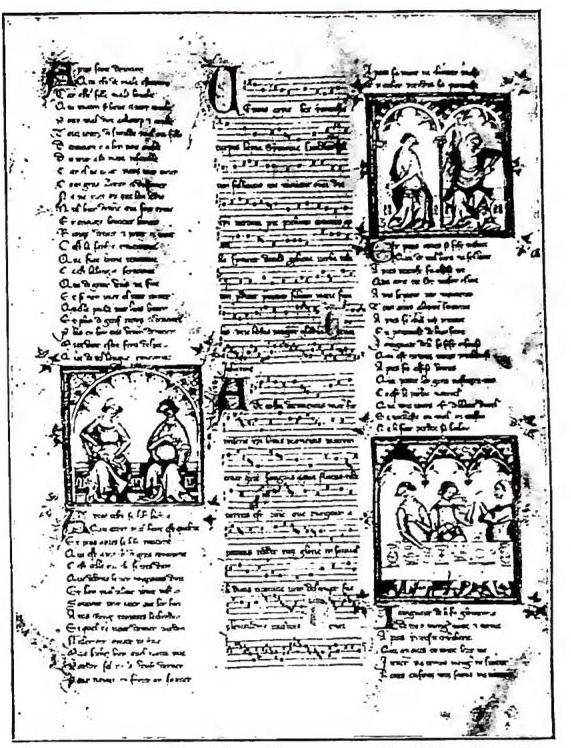
Illuminated page from the Roman de Fauvel with motets set to music: Veritas arpie and Ade Costa dormientis (13th century). Paris, Bibliothèque nationale, ms. 146 (PI), fol. 13v.
The term giullari (joculares, joculatores) in the Middle Ages referred to those who practiced the arts of mime and recitation. Some scholars interpret as giullareschi monologues various early poetic productions, such as the Ritmo cassinese and the Lamento della sposa padovana, the Canzone del Castra, etc. The giullari not only recited but also performed these works. The Church opposed the giullari for their histrionic, buffoonish, and often licentious and irreverent aspects; however, later it made use of their services for the spread of the cult of the Saints, in connection with pilgrimages and shrines. Without implying the existence of a special category of “giullari of God,” one must consider the rich poetic output of hagiographic character produced by the giullari, which left a mark on the origins of the Romance literatures.