Machine translation of the 1948–1954 Italian original. The original text is authoritative.
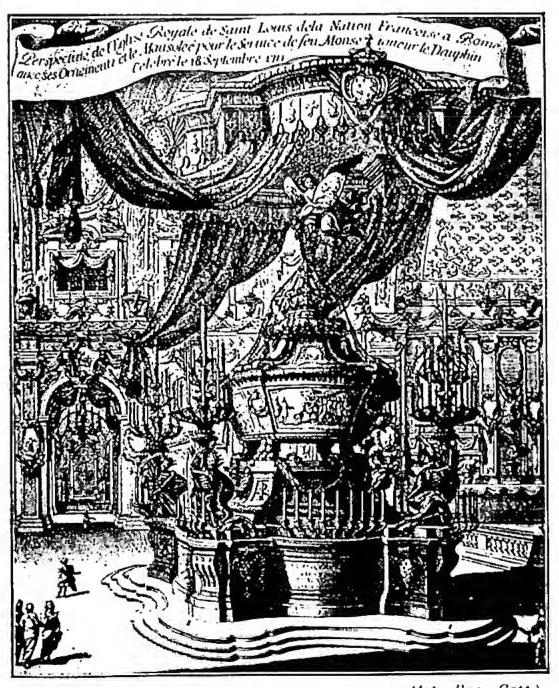
CATAFALCO. — For funeral services, a special structure is erected in churches, surrounded by candles, called tumulus, castrum doloris, or lectica mortuorum. It serves to support the coffin containing the body of the person for whom the office is being celebrated, or to suggest that the body is present.
When the body is absent, the funeral bier may consist of a simple black cloth spread, for the absolution, on the floor of the presbytery. On the catafalque, the bodies of the faithful are arranged with their feet facing the altar, whereas those of priests are placed in the opposite direction. On the cloth covering the coffin, or at the foot of the catafalque, the insignia of the deceased’s civil or ecclesiastical dignity may be placed. For clerics, there are admitted
(phot. Pont. comm. di arch. sacra)
CATACUMBAS, CEMETERY IN — Inscription, still in situ, of Ancozia with anchor and fish (3rd century) — Rome, cemetery of S. Sebastiano.
the characteristic insignia: the stole, the chalice, the biretta, the mitre. To cover the c. of innocent children, a white cloth and a crown of flowers are used; the latter may also be permitted to honor virginity.
BIBL.: P. Bayart, Le mobilier d'Eglise, in R. Aigrain, Liturgia, Paris 1931, p. 256 ff.; P. Lugano, s. V. ENOCH. Ital., IX (1931), p. 400 ff. Filippo Oppenheim
Cite this article
“CATAFALCO.” Enciclopedia Cattolica, vol. III (1949), p. 621. Azione Romana digital edition, https://azioneromana.com/article/catafalco.