
LORENZO GIUSTINIANI, saint. – Born in Venice to Bernardo Giustiniani and Querina Querini on 1 July 1381, died there on 8 January 1456.
At the age of twenty-one (1402), he went to the island of S. Giorgio in Alga, where for a short time some young priests, Venetian nobles, had been gathering to devote themselves to prayer and penance; with them, L. (already a deacon) founded in 1404 the Congregation of the Secular Canons of S. Giorgio in Alga. In the canonry he began a life of penance and prayer; he also loved to perform the humblest services (his “delight” was begging through the city). In 1407, at the age of twenty-six, having been ordained a priest, at the command of Gregory XII, a Venetian, he accepted the priory of S. Agostino in Vicenza together with that of SS. Rustico and Fermo in Lonigo; but after five years he renounced them in favor of his Congregation. In 1409 he was elected prior ad annum of S. Giorgio; and likewise in 1413, 1418, and 1421. At the end of the year of his third priorship (1419), he wrote his first work, Lignum vitae. In 1423, while
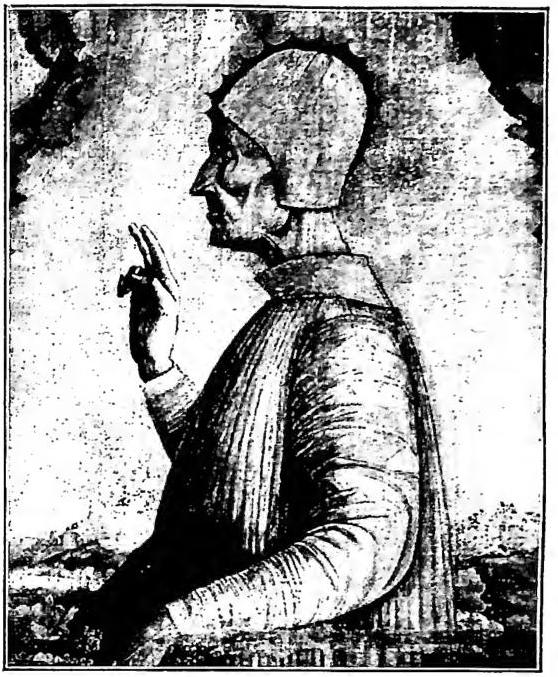
(phot. Assunti)
After completing his year as superior general, he withdrew into the solitude of S. Agostino in Vicenza, where he wrote the treatises De casto connubio Verbi et animae and De disciplina et spirituali perfectione; and in 1426 Fasciculus amoris and De triumphali agone Christi. In 1427 he had to assume the governance of the generalate once again; likewise in 1429, after a year’s interval, when he wrote the booklets De interiori conflictu and De complanctu christianae perfectionis. In 1431, at the request of the Carthusians of Montello, he composed the treatise De vita solitaria; the following year, the treatise De contemptu mundi. The “treatises” were followed, from time to time, on the principal feasts of the Lord, the Virgin, and the saints, by the “sermons” (thirty-nine of them have been handed down). Admiring L.’s life, Eugene IV, formerly his confrere at S. Giorgio in Alga, wished to appoint him to the see of Castello (Venice) on 11 May 1433. On 5 September 1433 L. was consecrated bishop; on the 18th he took possession. His private life, insofar as it could be compatible with his new dignity, did not differ from that of the cloister. He began with the reform of the discipline and morals of the clergy, convening in 1434 a diocesan Synod at which he issued wise constitutions. Four years later he promulgated a little code of forty constitutions, which he called Synodicon. He employed both gentleness and firmness, joined to the most prudent charity, with the nuns; and he succeeded. He regulated the Cathedral Chapter, especially with regard to residence and the plurality of benefices. For the adornment of the sacred functions he founded six new minor benefices. He established a perpetual College of twelve poor clerics under the immediate direction of a teacher of grammar and one of ecclesiastical chant. Against the immoderate luxury of the upper classes and the dress styles of the ladies, he published certain constitutions, which caused him no small amount of distress.
In 1447 (during the pestilence raging in Venice), without concern for his own safety, he devoted himself tirelessly to the plague-stricken (he also obtained from Nicholas V [18 August 1447] a special indulgence for priests, physicians, and the faithful for each day on which they assisted the plague-stricken). Around 1450 he wrote two books: De spirituali interitu animae and De ejusdem resurrectione spirituali; and the treatise De institutione et regimine praelatorum. Nicholas V, for the dignity of the Republic of Venice and for the honor of the Dominant City, by a bull of 8 October 1451 suppressed the patriarchate of Grado and the bishopric of Olivolo-Castello and established the patriarchate of Venice with all the rights and prerogatives of the suppressed patriarchate and bishopric, appointing L. the first patriarch of Venice (overwhelmed by the new responsibility of shepherding a larger diocese and of being metropolitan and primate, he wrote [1452] the treatise De humilitate, translated into the vernacular at his request, so that it might be understood by the faithful, by the Camaldolese Mauro of S. Mattia in Murano). He then set about convening the provincial council in order to eradicate a considerable number of abuses, when he was stricken by a long and serious illness. The Council, of which unfortunately little remains, was convened for the fourth Sunday after Easter (4 May) 1455. Meanwhile, the patriarch, still tormented by theories contrary to obedience, wrote the treatise De oboedientia and in 1455 put the finishing touches to the treatise De gradibus perfectionis. His last work was to be a cry of love, De incendio Divini Amoris.
He was canonized by Alexander VIII on 16 October 1690. Feast day: 5 September.