
UNGARELLI, LUIGI. — Barnabite, one of the first Italian Egyptologists, born in Bologna on 14 February 1779, died in Rome on 21 August 1845.
Having moved to Rome as master of novices and lecturer in theology of his Order, he had the opportunity to follow Champollion’s research and to advance in the study of Egyptian hieroglyphs, to which he had been introduced by his fellow citizen I. Rosellini (v.).
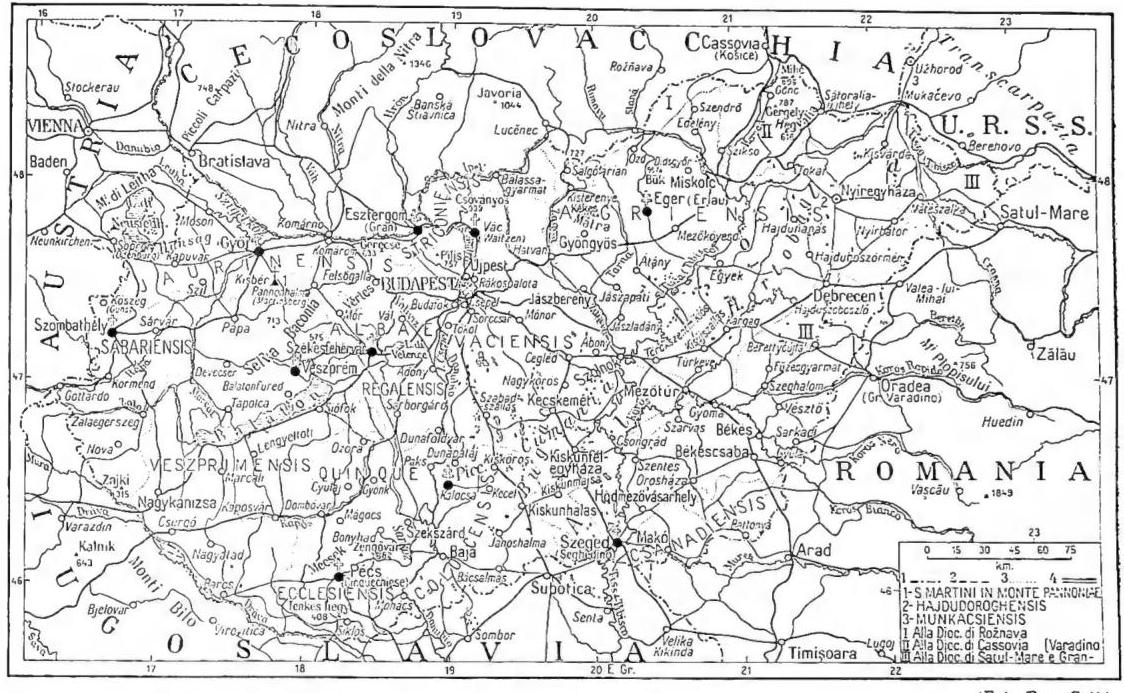
UNGHERIA — 1) State boundaries; 2) state boundaries in 1939; 3) ecclesiastical district boundaries; 4) railways.
pollion against the skepticism of many scholars. He was subsequently appointed to supervise the arrangement and scientific illustration of the Vatican Egyptian Museum, founded in 1839 by Gregorio XVI. Among his works, besides numerous articles concerning the Museum itself published in the Dissertazioni della Pont. Accad. di archeologia, mention should be made of the Elementa linguae Aegyptiacae (Rome 1837) and the Interpretatio obeliscorum Urbis (there 1842), with notable copper engravings. Upon the death of Champollion le Jeune, his brother Figeac insinuated that the aforementioned works of U. were plagiarized from unpublished manuscripts of the deceased, which had also been consulted, moreover, by his colleague and friend Rosellini. Only in 1928 was the complete scientific conscientiousness of both Egyptologists fully vindicated by G. Gabrieli on the basis of unpublished documents.