
MONTECASSINO. – Abbey in southern Lazio, founded around 529 by St. Benedetto da Norcia on the ancient acropolis that stood on the mountain, of which imposing sections of the surrounding walls still remain today. After the buildings of pagan worship had been demolished, St. Benedetto erected a chapel on Apollo’s altar in honor of St. Giovanni Battista and transformed the temple of the same god into an oratory dedicated to St. Martino. According to the testimony of St. Gregorio, the proportions of the new monastery were extensive; and thus they were more suited to the Saint’s new monastic ideal, which, having abandoned the Eastern-style coenobitism already established at Subiaco, instituted a more integral form to be practiced in a single, capacious monastery, materially and spiritually self-sufficient, as it appears from the Rule. After his death (547), the work was continued by his successors, of whom very little is known. St. Gregorio Magno mentions the prestige attained by M. in so short a time, and confirmation of it may also be glimpsed in the few names that have come down to us of certain learned monks of that period: Marco the poet, author of verses in praise of St. Benedetto; Sebastiano, who wrote a life of St. Girolamo; and the abbot Simplicio. This first development was violently cut short, little more than thirty years after the founder’s death, by the destruction of the monastery at the hands of the Lombards of Zotone. The monks—all of whom escaped the massacre, as St. Benedetto had foretold—took refuge in Rome with their abbot Bonito, and Pope Pelagio II assigned them a residence near the Lateran.
Meanwhile, only a few solitaries lived on the mountain, when the Brescian Petronace went there around 717, driven by a desire for solitude and encouraged by Pope Gregorio II. The revival of the abbey and of regular life, to which the monks of S. Vincenzo al Volturno and the strong personality of St. Willibaldo contributed in some measure, was also favored by Pope Zaccaria, who recognized Petronace’s community as the heir of that of the sixth century, returned to M. the autograph of St. Benedetto’s Rule, as well as the measure of bread and wine, and presented it with several precious manuscripts of Holy Scripture. In 748 he himself wished to consecrate the church erected over the tomb of St. Benedetto. The Beneventan duke Gisulfo donated lands near the abbey and established the first nucleus of the vast Cassinese patrimony, which later expanded to cover more than one hundred thousand hectares, with two outlets to the sea, ports, warehouses at Amalfi and Salerno, a small fleet of ten ships for trade with Ancona, Ravenna, Dalmatia, and Puglia, and mines in Sardinia. Among the many vocations worthy of mention are those of the two abdicated kings, Carlomanno of the Franks and Rachis of the Lombards. The number of monks increased so greatly that as early as 748 some departed for Germany at the request of the duke of Bavaria, Utilone; others went to Brescia in 759; and still others to France at the request of Carlomagno, addressed to the abbot Teobaldo (778–97). Within a few decades of its restoration, M. had become a center of monastic life to which, among others, founders of monasteries from various parts of Europe flocked: Sturmio of Fulda, Pirmino of Reichenau, Ludgero of Werden, Anselmo of Nonantola, and Adalardo of Corvey. Its importance increased further in the time of Carlomagno, who regarded the abbey as an advanced outpost of his policy in southern Italy; he therefore granted it immunity and received it under the imperial defensio. Its greatest distinction, however, came from its school, developed and perfected by Paolo Diacono. There were taught not only the sciences of the trivium and quadrivium but also the Greek language; much attention was devoted to writing and to the illumination of manuscripts, and the script known as “Beneventan” or “Cassinese” gradually took shape, of which M. was from that time the most important center. This intellectual activity was matched by building and artistic activity.
Bassacio and Bertario were abbots as well. Bassacio, together with the abbot of Volturno, Giacomo, also led an embassy to the Emperor to appeal for help against the devastation wrought by the Saracens; but his successor Bertario devoted himself to this cause still more assiduously. He met several times with the emperor Ludovico II and proposed a defensive league against the invader among the principalities of southern Italy. At the same time Bertario organized the monastery’s holdings and gave them a definitive arrangement for that period, while fortifying strategic points. Nevertheless, such activity did not prevent the Saracens from destroying M. in 883, with Bertario himself and many monks being killed. No better fortune befell the monks who escaped that massacre in the small monastery of Teano, when it was burned in 896: together with many codices and diplomas, the autograph of the Regola also went up in flames; only a small part of it survived until the French devastation of 1799. A relaxation of discipline followed, becoming even more pronounced in 914, when the monks, through the intrigues of the princes of Capua, transferred there. The return to M. took place in 949
through the efforts of Abbot Aligerno, who during his long government restored new life and prestige to the monastery. Alongside regular observance, he re-established and reorganized the monastery’s holdings, directing them toward greater productivity through contracts and grants of land to colonists, and through the impetus he gave to commerce among the abbey’s dependencies. Toward the end of the century, new monasteries were founded through the work of the Cassinese monks: in Zara, Poland, and Hungary; five monasteries arose in Tuscany, among them that of Florence. It is no wonder that saints and great monastic reformers flocked to M.: Guglielmo di Dijon, founder of Fruttuaria; Giovanni di Gorza; Nilo di Grottaferrata; Odilone di Cluny; and Adalberto di Praga. Intellectual activity had also regained momentum with the monks’ return to M., as attested by Erchemperto’s Historia Langobardorum, the sermons and lives of the saints by Lorenzo, and the further perfection of the «beneventana» script, which spread as far as Dalmatia. Nor should the illuminated codices be forgotten, including those from the Capuan period, which already foreshadow the ornamental perfection of the Desiderian period. The flourishing of the Cassinese scriptorium, which even the crisis caused by the violent intrusion of the unworthy abbot Mansone at Aligerno’s death in 986 had failed to halt, grew ever stronger despite the struggles of the 11th century. Caught between pope and emperor, necessarily bound up with the policy of the Capuan princes, and viewed with suspicion and greed by the neighboring lords, the great abbey nevertheless managed to preserve its independence. Thus, at first, it suffered the anger of the emperor Enrico II because of the alliance that Abbot Atenolfo (1011–22) had formed with the Byzantines; then it endured the intrigues directed against Abbot Teobaldo (1022–38), elected in the presence of the Emperor and Pope Benedetto VIII and therefore loyal to the Empire, by the prince of Capua, who wished to restore the powerful monastery to his principality; and later it had to defend its position and holdings against the abuses of the Normans, chiefly through the efforts of the Bavarian abbot Richerio (1038–57).
The Investiture Controversy found Desiderio (1057–87) occupying the abbey seat; under him M. became a true artistic and cultural center, while collaborating with the papacy in defending the rights of the Church. Desiderio renewed the monastery buildings, making it one of the most beautiful in the whole of the West. The church, rebuilt with the participation of Byzantine artists, was consecrated with great solemnity by Alessandro II in 1071. Desiderio’s work was continued by his successor Oderisio (1087–1103), who should also be remembered for the assistance he gave to the First Crusade. The series of illustrious men of the abbey during this period is a long one: Federico of the house of Lorena; Alfano, later archbishop of Salerno; Costantino l’Africano; the poet Guaiferio; Alberico ALBERIGO (v.), later a cardinal; Giovanni di Gaeta, Gelasio II (v.); Pietro di Teano, perhaps the compiler of the collection of Lombard laws; Leone Ostiense, author of the monastery’s chronicle, later continued by Pietro Diacono, who also composed hagiographical and historical writings; Amato (v.), historian of the Normans and poet. In this age many cardinals, legates, and bishops emerged from M., as did, within the space of sixty years, three popes: Stefano IX, Vittore III, and Gelasio II; while other popes sought refuge or tranquility there amid their adversities: Niccolò II, Alessandro II, Gregorio VII, Urbano II, Pasquale II, and Callisto II. In the Investiture Controversy, the monks and abbots of M. supported the cause of the Church and the papacy. Forced to take sides for one or another of the principal contenders—the pope, the emperor, or the Norman king—M. often saw its holdings damaged by the various armies: during the schism of Anacleto (1130), the struggles between Ruggero II and the Germans (1136), and later between Ruggero and Pope Innocenzo II (1146), and still more during Guglielmo il Malo’s struggle against Pope Adriano IV, when the abbey, having become a fortress, saw its monks expelled (1156). Abbot Rainaldo di Collemezzo (1137–66) took advantage of a brief period of tranquility to restore monastic life, so much so that a few years later the king of Sardinia, Barisone, requested twelve monks from the abbot for the monastery of S. Nicola de Gurgo, asking that among them there be men suitable for holding important offices in his kingdom and for being appointed bishops and ambassadors to the imperial or Roman Curia.
Abbot Roffredo dell’Isola (1188–1210), a vigorous defender of the monastic holdings but animated by an excessive warlike spirit, allowed himself to become involved in the struggle for the succession to the kingdom, first taking the side of Tancredi and then of Enrico VI; as a result, he suffered exile and caused a harsh siege of the monastery. Innocenzo III, who stayed at M. for several days in 1208, entrusted him with safeguarding the rights of the kingdom against the Germans; in his final years, he was also entrusted with reforming the abbey of S. Paolo in Rome. Among the century’s distinguished visitors was s. Bernardo di Chiaravalle, who, together with the emperor Lotario III, attended the election of Abbot Guibaldo (1137) and on that occasion delivered an address to the community.
After two sieges suffered in 1229 and a not brief vacancy of the abbacy, in 1239 M. was reduced to a fortress by Frederick II, while almost all the monks took the road into exile. Only upon the death of Manfred (1266) could the abbot Bernardo Aiglerio, author of an Expositio della Regola, already appointed by Urban IV in 1263, take possession of II. Even before him, the abbey had been distinguished by the learning of Pietro d’Atina, later chancellor of the Church, who composed the Glossae ad Decretum Gratiani, Pandolfo da S. Stefano, Riccardo, Bernardo da Castrocielo, Alessandro, author of an Exameron in Latin verse, and above all Erasmo, of whom several theological treatises and a few sermons remain. A few decades later than Bernardo were the two jurists Nicola di Frattura, later abbot of S. Vincenzo al Volturno and subsequently professor at Naples, and Riccardo di S. Angelo, both authors of commentaries on the Regola of s. Benedetto. The Celestines, introduced into M. by Celestino V, remained only briefly; but in 1322 Giovanni XXII erected the abbey into a bishopric: the abbot, theoretically still elected by the monks, became bishop of the diocese, while the monks formed its cathedral Chapter. In fact, however, the bishops were always elected by the pope; indeed, they were not even monks and lived far from the abbey, facilitating the abuses and revolts of the vassals, foremost among them that of Jacopo da Pignataro who, having installed himself as master in the monastery, squandered its patrimony and drove out the monks, thus completing the destructive work of the Hungarians shortly before. The ruin became total, materially as well, with the earthquake of 1349, which left very little of the work of Desiderio and his successors.
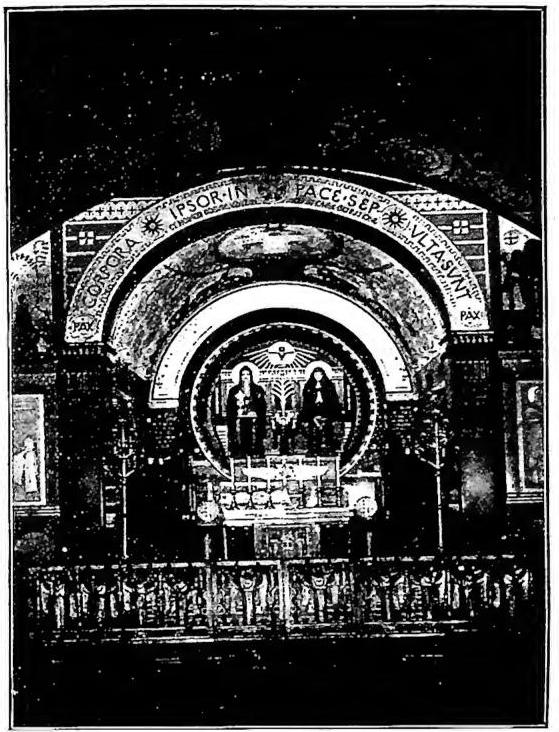
A period of peace and
(phot. Fotocicero – Turin)
MONTECASSINO - Crypt of St. Benedict with decorations by the Beuron school (19th century).
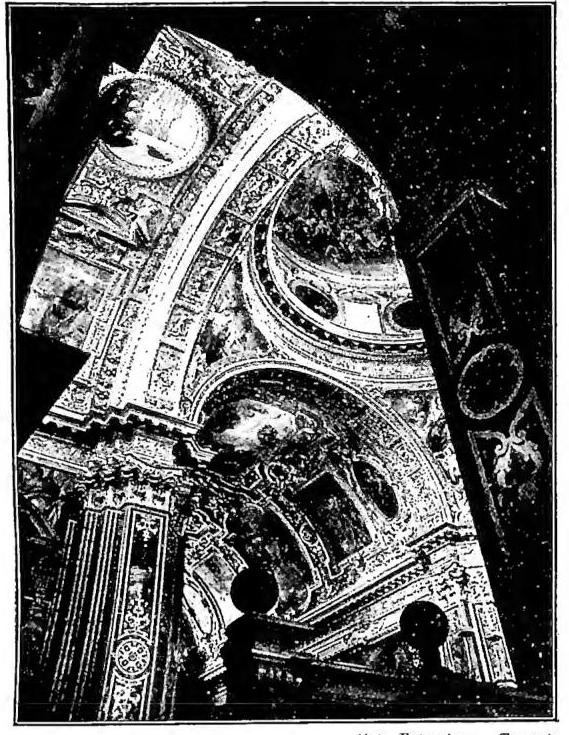
and recollection, and in the following three centuries disturbances were rare. With regular observance, restored according to the statutes of the Congregation, studies and building and artistic activity developed. In the latter, Ignazio Squarcialupi stood out above all at the beginning of the sixteenth century, and, several decades later, Angelo de Faggis, known as il Sangrino: it was above all to the latter that the appearance assumed in that century by the Cassinese buildings, and preserved until their destruction in 1944, was due. Il Sangrino, known for his learning, took part in the Council of Trent; an elegant Latinist, he also received important assignments from the popes of the time. Alongside him, other Cassinese men of letters should be remembered: Onorato Fascitelli, Leonardo Sforza degli Oddi, Giovanni Battista Mormile, Benedetto dell'Uva. In the same century the jurists Gregorio da Viterbo and Benedetto Canofilo, the theologians Benedetto da S. Germano and Crisostomo di S. Gemignano, who was also invited to take part in the Council of Trent, and the monastery’s chroniclers and archivists Placido Petrucci and Onorato de' Medici flourished. M. was one of the places of study for the young men of the Cassinese Congregation. In addition to the many pilgrims, s. Ignazio di Lojola, who stayed there for several days with Pietro Ortiz, s. Filippo Neri, and Torquato Tasso visited M. in this century. The abbot Domenico Quesada (1650–53) began the rebuilding of the church according to a design by Cosimo Fansago; the cupola had already been raised by the architect Orazio Torriani in 1613; as early as 1545 the crypt had been constructed beneath the church, later decorated with paintings by Marco di Siena. Artists of the Neapolitan school, including Luca Giordano, Francesco Solimena, De Matteis, De Mura, and Sebastiano Conca, decorated the Church, consecrated by Pope Benedetto XIII in 1727. But the most illustrious artist at M. during the Renaissance was Antonio da Sangallo il giovane, author of the monument to Pietro de' Medici; the two brothers da Bassano, who composed a large painting in the monks’ refectory depicting s. Benedetto che distribuisce la Regola, should also be mentioned; Belisario Corenzio frescoed the cupola.
The following belong partly to the seventeenth century and partly to the next:
Erasmo Gattola, known for his works on the history of the abbey; the brothers G. Battista and Placido Federici, representatives of the tradition of erudite studies; and Casimiro Correale.
M. suffered looting and devastation in 1799 at the hands of the soldiers of the French general Championnet, and the damage was only partly repaired with the help of Pio VII; shortly afterward (1806), however, King Giuseppe Bonaparte suppressed the abbey, put its property up for sale, declared it an “establishment,” appointing the abbot its director and the monks its custodians, in secular dress. Nor did the evils end with the Bourbon restoration: adherence to the idea of Italian unity brought M. suspicion and threats from the Neapolitan government, which first prohibited the publication of a periodical with a national character, L'Ateneo italiano, and then ordered the printing office closed. Italian unification found intellectual activity at M. still vigorous, especially through the efforts of Luigi Tosti, author of many historical works. Ottavio Fraja Frangipane and Sebastiano Kalefati also distinguished themselves through their studies. Tosti exerted all his strength to prevent the suppression of M. in 1866, but the law was nevertheless published two years later. It was possible, however, to have the abbey declared a national monument, and the monks were entrusted with its custody. Deprived of political power and impoverished by the loss of its patrimony, M. nevertheless preserved its moral prestige, with a renewed monastic spirit. Studies flourished again through the publication of documents from the Archive, teaching in the schools of the diocesan Seminary and the lay College, and the establishment of the Meteorological and Geodynamic Observatory. The publications were produced within the abbey itself by the printing office and the chromolithography workshop. Other scholars worthy of mention were Anselmo Caplet, Andrea Caravita, Oderisio Piscicelli-Taeggi, Giuseppe Quandel, Ambrogio Amelli, and Luigi Vaccari. Artistic activity was not neglected meanwhile: in 1880 the sanctuary of the tower of S. Benedetto was consecrated; the artist-monks of the abbey of Beuron worked on its decoration and subsequently, always under the direction of d. Desiderio Lenz, completely redecorated the crypt in their style; it was consecrated in 1913. Not even the final total destruction caused by the aerial bombardment of 15 February 1944 succeeded in definitively breaking the energetic monastic activity at M. Reconstruction, already begun under the abbot Gregorio Diamare (d. in 1945) with the assistance of the Italian government, has already progressed considerably in these last few years. An examination of the relics of s. Benedetto and s. Scolastica was carried out on 2 August 1950 on the initiative of the abbot Ildefonso Rea.
More than 1,000 codices and 40,000 parchment documents escaped destruction from the Library and Archive, together with the entire collection of printed works, including 250 incunabula.
The cultural activity of the monks of M., so intense in the Middle Ages, has not ceased in modern times. Publications now famous include I codici e le arti a M., by A. Caravita (3 vols., 1869–71); the Bibliotheca Casinensis (5 vols., 1873–96); La paleografia artistica di M. (2 vols., 1876–77) and Le miniature nei codici cassinesi (1887) by O. Piscicelli-Taeggi; and the Codicum Casinensium manuscriptorum catalogus, by M. Inguanez (3 vols., 1915–41). The series Miscellanea Cassinese, which had reached vol. XXVI in 1950, and Tabularium Casinense, which includes, in addition to the Codex diplomaticus Cajetanus by A. Caplet, 4 Regesti cassinesi published by Inguanez, are highly esteemed by historians and scholars of diplomatics.
LA DIOCESI DI M. - Si venne costituendo man mano, come avvenne per altre abbazie, con i territori che vennero aggiudicati al monastero. Su di essi l'abate esercitava infatti la cura spirituale in grazia anche del privilegio di esenzione dall'autorità dell'Ordinario, ottenuto dall'abbazia stessa. Quando Giovanni XXII elevò M. a diocesi questi diritti si consolidarono ed assunsero un aspetto che non andò perduto nemmeno con la soppressione del vescovato. Ora M. è abbazia nullus. All'antico territorio nel 1698 il papa Innocenzo XII annesse quello dell'abbazia di S. Vincenzo al Volturno, il cui passaggio effettivo si ebbe però nel 1700; nel 1834 fu unita alla diocesi cassinese anche la prepositura di Atina. In tal modo l'attuale diocesi di M. si estende negli Abruzzi, nel Molise, nel Lazio, nella Campania.
Ha una superficie di 1000 kmq. con una popolazione di 110.000 ab. distribuiti in 70 parrocchie servite da 75 sacerdoti; ha 22 istituti religiosi, 18 istituti di educazione di cui 15 asili e 3 orfanotrofi, 1 seminario maggiore e 1 minore con 38 alunni. - Vedi tav. XCII.