
CARAFA, FAMIGLIA. – The C. family of Naples is a branch of the Caracciolo, whose progenitor was GREGORIO Caracciolo, who lived in the first half of the 12th century and was surnamed C., perhaps because he held the concession for the wine tax. The princely title was granted on 24 May 1594 to FABRIZIO I, who distinguished himself greatly in the defense of Roccella against Hassan Cigala.
Another important branch was that known as della Stadera, represented in the coat of arms by a crossed balance, whose head in the 15th century was ANTONIO, nicknamed MALIZIA because of the acumen he displayed in diplomacy. From him descended Cardinal Oliviero, who purchased the county of Ruvo for his brother Ettore; the family subsequently acquired the duchy of Andria.
Other branches of the family are the counts of S. Severino and Traetto, the lords of Mariglianella, and the counts of Maddaloni, whose most illustrious figure was Gian Pietro, of the dukes of Montorio, later Paul IV.
After the collapse of the C. family upon the death of Paul IV (1559), the lineage was further distinguished by cardinals, archbishops, viceroys of Naples, warriors, and scholars, among them VINCENZO (1542–1611).
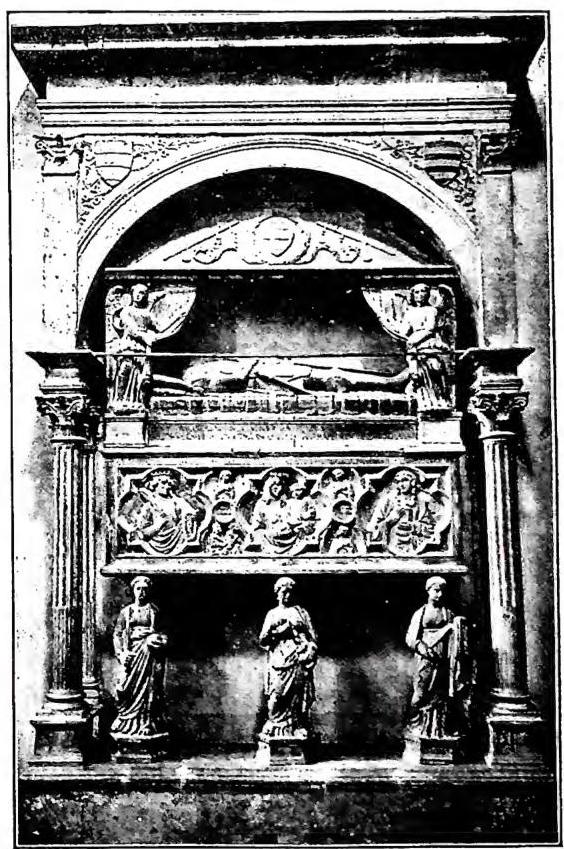
The cardinalitial dignity entered the Stadera line with OLIVIERO, born in 1430, doctor of both laws, canon and then archbishop of Naples on 29 Dec. 1458. He was highly esteemed by King Ferdinando, who had ascended the throne precisely in that year and appointed him counsellor on the royal Council and his representative in Rome. He was created cardinal by Paul II on 18 Sept. 1467, and was therefore called the Neapolitan cardinal. In 1472 Sixtus IV placed him at the head of the naval expedition that was to operate in the Aegean against the Turk, and it was not his fault that, after occupying Smyrna and forcing the port of Satalia, he was unable to achieve the successes that would have been necessary to curb the latter’s arrogance.
Alexander VI placed him at the head of the reform commission, which in fact was able to accomplish nothing. He built the palace on the Quirinal which, later enlarged, became a papal residence; in the church of the Minerva he erected the chapel of S. Tommaso, which he had painted by Filippino Lippi. He also carried out works at S. Lorenzo al Verano (cf. V. Forcella, Iscrizioni, XII, Rome 1878, p. 514, n. 575). In Naples he erected the Sapienza building, which he intended for study; in the cathedral, the chapel of the Soccorso, in which he was also buried; he further had the relics of s. Gennaro transferred from Montevergine to Naples. Highly esteemed by the finest men of his time, he d. in Rome on 20 Jan. 1511.
BUL.: Eubel, II, passim; Pastor, II, III, passim; P. Paschini, Il carteggio fra il card. Marco Barbo e Giovanni Lorenzo, Vatican City 1948, p. 15 and passim.
Among those who worked around Paul IV, his nephew Cardinal CARLO C. stands out, the son of Giovanni Alfonso, the Pope’s brother, born in Naples ca. 1517, d. in Rome on 4 March 1561. He initially served in Italy and beyond the Alps; when Paul IV was elected pope, he was in Rome and decided to enter the ecclesiastical state. He succeeded in convincing his uncle of his good intentions, and the latter created him cardinal of the diaconal title of SS. Vito e Modesto on 7 June 1555, keeping him beside himself as cardinal-nephew and entrusting him with the cares of governing the State, while attending personally to the reform of the Church and the Inquisition. The cardinal, thinking of the Pontiff’s advanced age, set about securing an eminent position for himself. He obtained the regency of the Chancery, the legation of Bologna, and, in particular, a free hand in political relations. Since Paul IV was hostile to Spanish influence and to the Habsburgs, precisely when their power in Germany was passing through a critical moment, C. took advantage of this to ally himself with France, to which he was sent as legate on 11 May 1556, and he was responsible for the war with Spain fought around Rome, which placed the city itself in danger. It ended with the Treaty of Cave (Sept. 1557), to which C. had secret agreements added, concealed from the Pope, in order to regulate the interests of his own family.
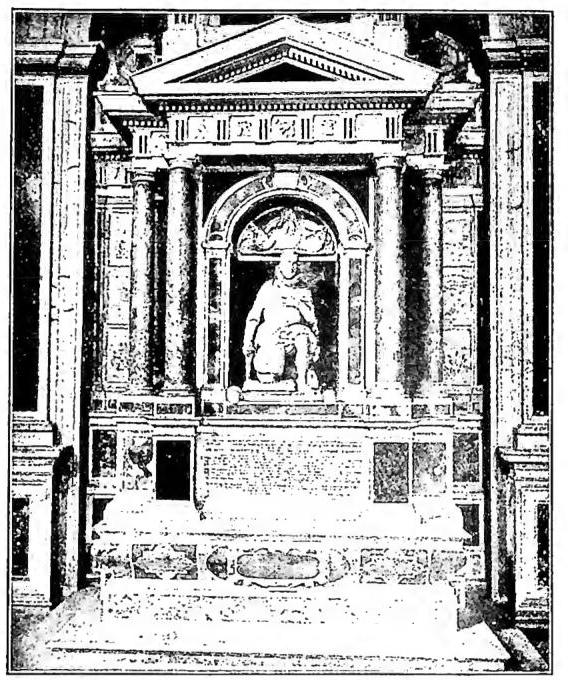
(Alinari photograph)
CARAFA, FAMIGLIA - Monument to Vincenzo C., prior of Umberia (d. in 1611) - Naples, church of SS. Severino and Sosio.
1561. Pius V, who had been protected by Paul IV, wished the trial of the C. to be reviewed, at least partly restoring their reputation and bringing to light the grave irregularities of the trial of 1561.
The elder brother of Cardinal Carlo was GIOVANNI, count of MONTORIO, who exerted himself greatly with the Pope to obtain the cardinalate for his brother Carlo. Although he was appointed captain general of the Church, he had to yield precedence to his younger brother and had no opportunity to exercise either military or political activity.
He received the duchy of Paliano when the Colonna were dispossessed of it; but he did not obtain the lordship of Siena, as had been negotiated when the cardinal drew closer to Spain in 1557. Involved in his brother’s downfall and subjected, like him, to the trial of 1561, he was forced to confess his guilt in the murder of his wife Violante d’Alife, whom he had unjustly accused of adultery, and was sentenced to decapitation.
The third brother, ANTONIO, marquis of MONTEBELLO, received command of the papal guard; yet he had even less part than his brother Giovanni in public affairs, and did not have to suffer condemnation in the trial of 1561. His son was ALFONSO, born in Naples in 1540: because of his gentleness he was greatly beloved by Paul IV, who created him cardinal at the age of eighteen on 15 March 1557, with the diaconal title of S. Nicola in Carcere; then, on 19 April of that year, he also gave him the archbishopric of Naples, and in December 1558 appointed him regent of the Apostolic Camera.
He remained with Paul IV, retaining the Pope’s favor even after the condemnation of his two uncles; he passed to the title of SS. Giovanni e Paolo and was appointed librarian of the Vatican at the beginning of 1559. Under Pius IV he was involved in the downfall of his family on the unjust accusation of having removed valuable objects from the chamber of the deceased Paul IV at the time of his death; he was deprived of his honors and offices,
fined 100,000 gold scudi, imprisoned in Castel S. Angelo on 7 June 1560, and was in danger of a more severe punishment. Pardoned in 1562, he took refuge in Naples, of whose see he had not been deprived, and governed it, holding a synod there and beginning the reform of the monasteries; he finally died there on 26 August 1565. He was buried in the Duomo, where, almost as compensation for the wrongs he had suffered, Pius V had a magnificent tomb erected for him.
Related to the foregoing, but belonging to the branch of the dukes of Ariano, was Cardinal DIOMEDE C., born in 1491 and died in Rome on 12 August 1560. Appointed bishop of Ariano by Julius II at the age of twenty in 1511, he governed that see for 50 years; Paul IV created him cardinal of the presbyteral title of S. Martino ai Monti on 20 December 1555, together with his relative Alfonso. In Ariano he restored the Cathedral, the episcopal palace, and the crumbling abbey of S. Andrea, and had also begun to embellish the church of his title, which he obtained permission to have raised to the rank of a Lenten station. A man of moderate sentiments, he always lived far from the Neapolitan court; he was buried before the high altar of the church of S. Martino ai Monti.
From the branch of the marquises of Montenero, on the other hand, came ANTONIO C., born in Naples in 1538, canon of the Vatican and cupbearer to Paul IV. At the time of the downfall of his relatives he resigned his canonry and withdrew to Naples, where he devoted himself to study, especially Greek, making use of what he had learned under Guglielmo Sirleto, with whom he thereafter remained bound by a warm friendship. He was created cardinal by Pius V on 24 March 1568, who intended in this way also to rehabilitate the memory of the C. He was a member of the new Congregation for the implementation of the Council of Trent and, upon Sirleto’s death, also became librarian of the Vatican.
A man of great learning, he devoted himself to the correction of the Vulgate desired by the Council of Trent; but Sixtus V made use only in part of the critical work Antonio C. had prepared, and in 1588 published the Sistine edition, which was promptly withdrawn. His principal work was the critical edition of the Greek Bible known as that of the Septuagint, with an accompanying Latin version (Rome 1587). He also directed the critical edition of the Corpus iuris canonici sponsored by Gregory XIII, as well as that of other texts. His Catena explicationum veterum Patrum in omnia tam Veteris quam Novi Testamenti cantica (Padua 1565) should also be remembered. He died in Rome, widely mourned, on 13 January 1591 and was buried at S. Silvestro al Quirinale.
These sixteenth-century cardinals were followed in the next century by another group of cardinals who pursued their careers through ecclesiastical diplomacy, carrying out their entrusted task with zeal and honor.
DECIO C., born in Naples in 1556 and died there on 23 January 1626, was educated by Mario C., archbishop of Naples; having come to Rome, he was enrolled among the prelates of the Curia. On 16 March 1598 he was appointed by Clement VIII apostolic collector in Portugal. Subsequently appointed by Paul V archbishop of Damascus on 17 May 1606, he went as nuncio to Flanders and in 1607 to Madrid. On 7 August 1611 he was created cardinal by Paul V, and, having returned from Spain, was assigned the presbyteral title of S. Lorenzo in Panisperna on 7 May 1612. On 7 January 1613 he was elected archbishop of Naples, where he devoted himself with great diligence to the governance of the diocese. He received votes in the Conclaves of 1621 and 1623. Loved by all, he was buried in the Duomo upon his death.
CARLO C. seniore was appointed bishop of Aversa on 16 July 1616. On 14 April he was sent by the new Pope Gregory XV as nuncio to Emperor Ferdinand II so that, with the Protestants by then defeated at White Mountain near Prague (8 November 1620), he might restore order in Bohemia, which had been religiously and politically disrupted. Carlo C. remained in Bohemia until 1628 and assisted the sovereign in his undertaking with great prudence and energy. He returned to Aversa in 1629 and was not employed in any other nunciatures. He died in 1644 and was succeeded by his nephew of the same name.
He composed the Commentaria de Germania sacra instaurata, which were printed in Cologne in 1639 and continued through 1641 in a second edition from Frankfurt; the work still retains its value today. Earlier, Carlo C. had compiled (1628) a Relazione dello stato dell'Imperio, which was in effect a summary of his nunciature.
CARLO C. iuniore, born in Rome around 1612; doctor of both laws and referendary of the Signatura, he became bishop of Aversa at the age of 33, on 13 July 1644. He was vice-legate in Bologna, nuncio in Switzerland on 18 January 1653, and from there went to Venice on 31 October 1654; then, on 13 August 1658, he was sent as nuncio to the Emperor. He was created cardinal by Alexander VII on 14 January 1664 and immediately sent as legate to Bologna. He died in Rome at the age of sixty-eight and a half, on 19 October 1680; he had resigned the bishopric by 1665.
PIER LUIGI C., cardinale, figlio del marchese Ottavio, n. a Napoli nel 1581, m. a Roma il 14 febbr. 1655. Fu vice-legato a Ferrara, nel 1614 governatore di Fermo; il 29 marzo 1624 successe al fratello Diomede nel vescovato di Tricarico; ma già nel maggio veniva nominato nunzio a Colonia e nella Germania inferiore dove rimase sino al 1634, rialzando le sorti del cattolicesimo nel paese, acquistandosi la stima dei cattolici e dei dissidenti. Ritornato a Tricarico, restaurò il Duomo e fondò il seminario. Fu creato cardinale da Innocenzo X il 6 marzo 1645 ed il 10 giugno ebbe il titolo di S. Martino ai Monti; nel genn. 1646 rinunciò al vescovato. Il 3 luglio 1651 fu nominato legato a Bologna, ove, per causa di salute, restò ben poco; quindi ebbe la prefettura della Congregazione del Concilio e fece parte di altre Congregazioni. M. mentre era chiuso nel Conclave in cui fu eletto Alessandro VII, e fu sepolto nella chiesa del Gesù.
Non sostenne invece incarichi diplomatici un'altra scialba figura di cardinale che visse pure nel sec. XVII: FORTUNATO C., fratello del gran maestro di Malta Gregorio, n. il 16 febbr. 1631, m. improvvisamente a Napoli il 16 genn. 1697. Fu creato cardinale con sorpresa di tutti da Innocenzo XI il 2 sett. 1686 mentre era vicario generale dell'arcivescovo di Messina suo zio ed era venuto a Roma per presentare al Papa la chiesa a nome del re di Napoli. Fu nominato vescovo di Aversa il 7 luglio 1687, partecipò all'elezione di Alessandro VIII e fu legato in Romagna (G. Novaes, Elementi della storia de' Sommi Pontefici ecc., XI, Roma 1822, p. 59).
Nel sec. XVII fecero carriera quasi esclusivamente in Curia: PIER LUIGI C. iuniore, n. nel 1677 dei principi di Belvedere; fu nunzio a Firenze nel 1713-17, poi segretario della Propaganda, quindi, nel 1724, della Congregazione
dei vescovi e regolari. Fu creato cardinale il 20 sett. 1728; il 19 apr. divenne vescovo d'Ostia e decano del S. Collegio; m. il 16 dic. 1755 e fu sepolto a S. Andrea delle Fratte.
FRANCESCO C., n. il 29 apr. 1722 a Napoli, fu segretario della Congregazione dei vescovi e regolari; fu creato cardinale da Clemente XIV il 19 apr. 1773 col titolo di S. Clemente donde passò a S. Lorenzo in Lucina il 15 sett. 1788 ed ebbe in commenda S. Lorenzo in Damaso il 3 ag. 1807. Fu presidente di S. Spirito in Sassia nel 1800. M. il 20 sett. 1818.