
CALCONDÌLA. - I. DEMETRIO. Greek humanist, grammarian, and philologist, b. in Constantinople, of an Athenian family, in 1423 and d. in Milan in 1511. From Athens, where he spent his youth, he went to Rome in 1447. Teodoro Gaza was his patron and teacher of Latin, and introduced him to Cardinal Bessarione. C. taught Greek at Perugia from 1450 and took part in the controversies between Platonists and Aristotelians. He was summoned by Venice to teach Greek at Padua in 1463. There he had among his pupils Giano Lascaris, Varino Favorino Camerte, Antonio Campano, and Giovanni Lorenzi, later librarian to Innocenzo VIII, who preserved eight letters from C. In 1466 C. was engaged in transcribing and emending the Antologia Planudea. When his Padua appointment ended in 1472, he returned to Rome and, after hardships and difficulties, recommended by Filelfo, in 1475 obtained in Florence the chair formerly held by Argiropolo. C.’s most significant work during this period was the editio princeps of Omero (1488); C. also assisted in the revision of Ficino’s Platonic translation. Among his pupils were Poliziano, Lorenzo de’ Medici’s sons Pietro and Giovanni, the future Pope, Bernardo Nerli, and Reuchlin, who preserved two letters from him. Summoned by Lodovico Sforza, in 1491 he moved to Milan, where among others he had Castiglione and Trissino as pupils.
In 1494 he published the Erotémata, a Greek grammar in dialogue form; in 1493 he prepared the editio princeps of Isocrate, and in 1499 that of Suida; a Latin translation of Galen’s minor works appeared posthumously. He possessed the virtues and defects of the humanists; in the emendation of texts, “penetrating,” Sandys calls him, “though not free from arbitrariness.”
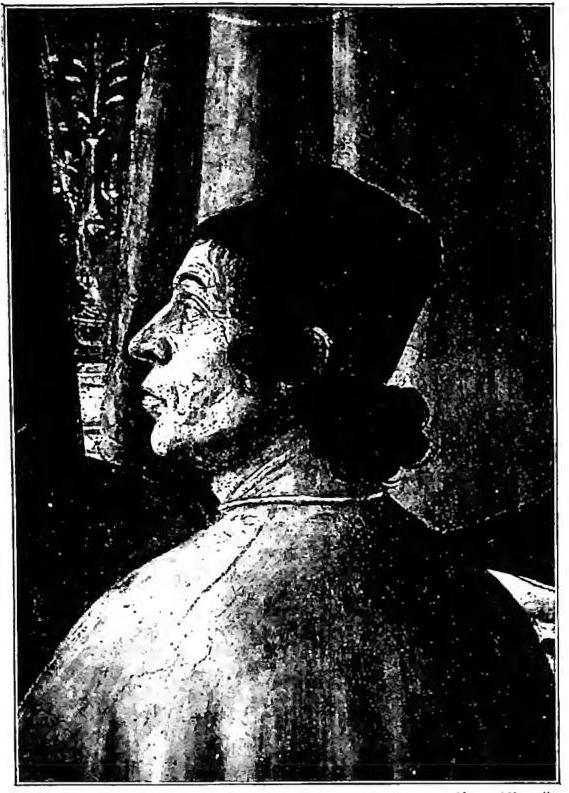
(phot. Alimeri)
CALCONDÌLA, DEMETRIO — Portrait in Zaccaria’s fresco in Ghirlandaio’s Temple (1490) — Florence, church of S. M. Novella.
on D. C., in Mélanges d'archéol. et d'hist., 7 (1887), pp. 472–500; E. Motta, D. C. editore, in Archivio storico lombardo, 20 (1893), pp. 143–66; G. Cammelli, Manuele Crisoloro, Florence 1941; id., Giovanni Argiropulo, there 1941; P. Paschini, Un ellenista veneziano del Quattrocento: Giov. Lorenzi, in Archivio veneto, 73 (1943), p. 141 ff. Raffaello Prati
II. LAONICO. Historian, a relative of the preceding, born in Athens around 1430 to Giorgio C. and died after 1480. Following the Turkish conquest of the Peloponnese (1461), C. took refuge in Crete, becoming a priest and protopapas of Chania, while also teaching and revising his history entitled Dimostrazioni storiche in dieci libri.
In this work, which covers the period between the year 1298 and 1464, L. C., affectedly imitating the style of Herodotus and Thucydides, describes the reasons for the triumph of the Turks, enemies of Greece, and also extends the account beyond the borders of his homeland, particularly to Italy.
The work, not free from chronological and factual errors, is often obscure, ponderous, and monotonous.