LORENZO IL CORAZZATO, BEATO

**LORENZO THE CORAZZATO, Blessed.** — Monk and hermit, born at Fanello near Foggia, died at Subiaco on 16 August 1243.

After an involuntary homicide, he went on a penitential pilgrimage to Santiago de Compostela; upon his return in 1209, he became a monk at Subiaco on 6 December and devoted himself to the eremitical life in a cave near the grotto of St Benedict, where he lived for 33 years, nourished by herbs and the occasional piece of bread given to him by shepherds. His austerities were extraordinary: he wore chains and iron rings around his body and, over them, a kind of "cuirass"; on his head he wore a helmet entirely fitted with iron spikes. He learned to read and write and composed a *Liber orationum*. At the insistence of Cardinal Ugolino (later Gregory IX), he mitigated the harshness of his penance. By command of the Blessed Virgin, he built a larger church on the ruins of one previously erected by St Benedict (1226) and a house where he later lived with his disciples. He was endowed with the gifts of prophecy and miracles. Already by Martin V, he is referred to as "saint" in a privilege granted to the monks of Subiaco in 1426. His feast is celebrated on 17 December in the Benedictine Order.
BIBL.: Acta SS. Augusti, III, Venice 1752, pp. 302-309; BHL, 713; L. W. Gnandt, *Vita s. Cleridoniae, C. Laurentii anachoretae, necnon et servi Dei Hippolyti Pugnenti monachi*, Innsbruck 1602; id., *Liber Orationum b. Laurentii Loricati*, Paderborn 1903; A. Zimmermann, *Kalendarium benedictinum*, II, Metten 1934, pp. 580 and 582.

Ambrogio Mancone

Article illustration
**LORENZO DI CREDI**

b. S. Maria degli Angeli; in 1402 he is recorded as having also gone to Rome.

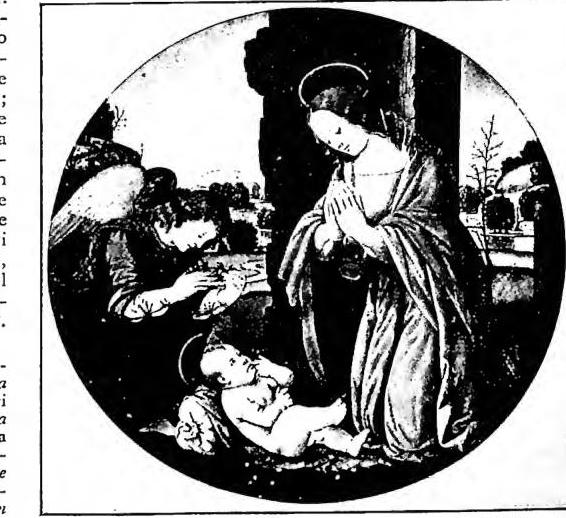
Of openly Sienese upbringing, in Florence he came under the influence of the Orcagna brothers, but towards the end of his career he was more strongly affected by the currents of International Gothic. The miniatures with half-length figures of saints recently attributed to him (A. M. Ciaranfi, *L. M. miniatore*, in *L’arte*, 1935, pp. 265-317) already display that fusion of Sienese and Florentine elements which is characteristic of his art. Among his most notable works are: *The Virgin with Saints* in the Pinacoteca of Siena; the *Madonna Enthroned with Saints and Angels* in the Berlin Museum (c. 1402-1403); the *Pietà* in the Accademia of Florence (1404); the *Madonna with Four Saints* in the Duomo of Empoli (dated 1404); and the *Virgin of Humility* in the Berenson Collection (dated 1405), which reveal a search for plastic consistency that diminished over the years as the painter indulged in a more pronounced Gothic style. Among the paintings of this later period are *The Agony in the Garden* in the Louvre (1408), the miniatures in Choir Book 3 of the Laurentian Library, the altarpiece for Monte Oliveto (now in the Uffizi, 1406-10), the *Coronation of the Virgin* in the Uffizi (1413), and the altarpiece and frescoes depicting *Stories of the Virgin* in the Bartolini Chapel in S. Trinita (c. 1420-22).

One of the most important painters at the transition from the 14th to the 15th century, he influenced many of the Florentine artists of his time. — See pl. CVII.

BIBL.: W. Suida, s.V. in Thieme-Becker, XXIII (1920), pp. 391-393; G. Pudelko, *The stylistic development of L. M.*, in *The Burlington Magazine*, 1938, pp. 237-49; ibid., 1939, pp. 76-81; E. S. Vavala, *Reconstruction of a predella*, in *Art in America*, 1939, pp. 104-111; M. Davies, *L. M. ‘Coronation of the Virgin’*, in *La critica d’arte*, 1949, pp. 202-10; W. M. Milliken, *Miniatures by L. M. and Francesco del Cherico*, in *The Bulletin of the Cleveland Museum of Art*, 1950, pp. 43-46.

Gilberto Ronci