
PONDICHÉRY, ARCHDIOCESE of. — In the colony of P., founded by French merchants in 1674, the Capuchins of Madras established themselves in 1677; they also founded missionary stations in the French colonial territory, which expanded during the eighteenth century.
In 1686 several French Jesuits, expelled from Siam, joined them; they subsequently gave rise to the flourishing mission of the Carnatic. From 1689 the Paris Foreign Missions also established themselves in P., transferring their general seminary in 1769 to Virampatnam near P. After the suppression of the Society of Jesus in 1773, their Carnatic mission passed in 1776 to the Paris Foreign Missions, and at the same time the Capuchin superior was appointed apostolic prefect for the Europeans and Creoles of the French colony. Out of consideration for the bishop of S. Tommaso di Meliapore, no separate apostolic vicariate was created, and the Superior of the Paris Foreign Missions, although a bishop, bore the title of «Superior missionis». In 1778 the jurisdiction of this Superior was extended to the former Jesuit missions of Madura and Tanjore, and in 1785 also to those of Mysore. On 8 July 1836 the mission of the Paris Seminary was constituted an apostolic vicariate under the name of the Coast of Coromandel, with the exception of Madura, which was once again entrusted to the Jesuits as the apostolic vicariate of Madura. The Capuchin prefecture for the white population in P. had already passed to the Congregation of the Holy Spirit in 1828 and was suppressed only in 1886, with the establishment of the hierarchy. On 3 April 1850 the apostolic vicariate of the Coast of Coromandel was divided into three vicariates: P., Coimbatore, and Mysore. In 1884 the apostolic vicariate of P. was declared exempt from the jurisdiction of Goa, and on 1 September 1886 it was
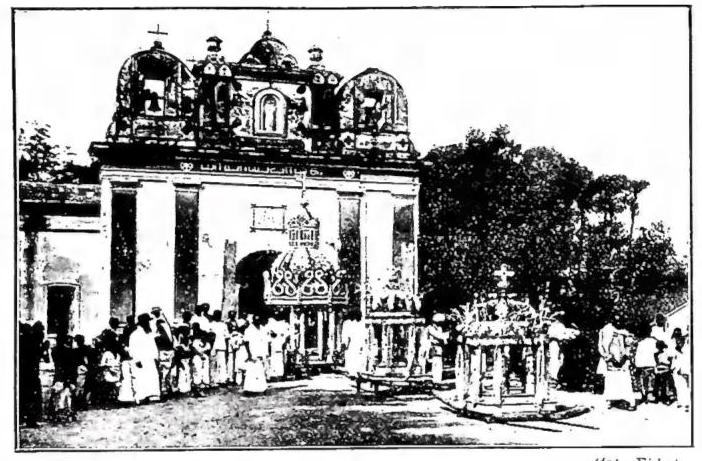
It has an area of 15,000 sq. km. The population reaches 3 million, of whom 152,000 are Catholics, 11,000 Protestants, 2,655,000 pagans, and 100,000 Muslims. The diocesan territory is divided into 45 districts or forane vicariates, 48 parishes, 2 primary stations, and 724 secondary stations. There are 94 churches and 200 chapels. The Indian priests number 66, while the foreign priests (all members of the Society of the Foreign Missions of Paris) number 44. Also working there as teachers are 17 Brothers of S. Gabriele di Monfort, nearly all indigenous. The work of the missionaries is supported by 328 sisters. There are 188 elementary schools; 7 secondary schools; 3 vocational schools; 2 teacher-training schools; and 1 catechetical school. Charitable institutions are numerous (13 orphanages, 3 shelters, 2 hospitals, and 4 workshops). The archdiocese also possesses a printing press where several periodicals are printed. The minor seminary has approximately 40 students; at the major seminary in Bangalore, 25 young men are preparing for the priesthood. Confraternities, pious associations, and Catholic Action organizations flourish in all the parishes of the archdiocese.