
TELEVISIONE. — It consists in the transmission and reproduction at a distance of moving images by means of electromagnetic waves.
I. TECHNICAL ASPECTS AND HISTORICAL NOTES
The process by which this transmission and reproduction takes place consists first of all in breaking down the image into a very large number of small elements, each of which contains a specific value of luminous flux, converted into a corresponding electrical value by means of a photoelectric cell. The current thus determined is sent over a distance in the order in which the image is divided into elements, as a modulating wave of electromagnetic waves of extremely high frequency. At the receiving station, the electrical impulses are once again converted into elementary luminous fluxes proportional to the current itself; these are rearranged in space, in synchronism corresponding to the order in which the elements succeed one another in the transmitted image, so that the visual impression of the reconstructed image is produced. The speed at which the images succeed one another does not reach 1/25 of a second; that is, the images follow one another at intervals shorter than the persistence of visual impressions on the retina of the human eye, namely 1/15 of a second. Today a speed of 1/50 of a second has also been attained. In receiving the transmitted image, therefore, one has the impression of continuity.The major dates marking the progress of the discovery, improvement, and utilization of television are relatively recent. In 1880 M. Leblanc conceived of scanning with vibrating mirrors; in 1883 P. Nipkow invented the disk named after him; in 1889 Weiller introduced the mirror wheel; in 1907 Rosing laid the foundations of the method using the cathode-ray oscillograph; but television became possible only with the improvement of the photoelectric cell and the electronic tube. Subsequently, television was progressively perfected, especially once the transition was made from mechanical television, which was unstable and lacking in detail, to the more perfect form used today, owing to the facilitation provided by the iconoscope invented by Vladimir Zworykin, whose first results in 1923 were perfected in 1938. In 1939, through the work of Jams and Rose, the orthiconoscope was developed; it was perfected in 1946 by Rose and Weimac.
Meanwhile, in 1935 the first transmitting stations were inaugurated: in Berlin-Witzleben and at the Eiffel Tower; and experimental television and cathode-ray analysis installations began multiplying in the United States, England, and Italy. In 1937, regular transmissions were being made in various cities of Europe and America. In Italy, excellent experimental broadcasts were carried out in 1939–40 by the EIAR (now RAI), from the Torre del Parco in Milan and from Monte Mario in Rome, using apparatus constructed in Italy. In 1949, the National Research Council established a special Study Commission for television, and today RAI, the universities, and industry are engaged in its revival.
After the 1939–45 war, television services were resumed in England by the B.B.C. in 1946. In the United States too, after the war, the public service inaugurated in 1941 by a station in New York was resumed. In 1946, a connection was established between Washington and New York. From 1948 onward, television spread increasingly through the multiplication of transmitting stations, the improvement of programs, and the reduction in the cost of receiving apparatus. By the end of 1948, more than one million sets had already been sold; today the figure has reached many millions, and more than 150 stations are transmitting, over a hundred of them with regular broadcasts.
According to information from U.N.E.S.C.O. dating from the end of 1952, there were 19 million receivers in the United States; 100,000 in Canada, with 2 stations; 5 stations and 1,500,000 receivers in England; 2 stations and 40,000 receivers in France; and 3 stations and 60,000 receivers in the U.S.S.R. Experimental broadcasts are being carried out in Italy, Germany, Denmark, Holland, Czechoslovakia, Japan, Yugoslavia, and Spain. In many other countries, installations for television are being prepared. The Vatican City too has a station, donated to the Holy Father Pius XII by France.
At present, projection of transmitted images is possible on screens for household use, with a surface area of 1 sq. m. or slightly more; but the eidophor, devised by Fischer of Zurich and studied by Thiemann, employs a process for amplifying light, and already provides an image of approximately 10 sq. m. with quite good average brightness and excellent detail. It nevertheless remains to be made more practical. The transmission of the television image today takes place by radio, using ultrashort waves and microwaves. It is possible to broadcast specially produced programs or scenes from real life, and there is mobile equipment that makes it possible, by means of radio links, to cover events taking place on a very large scale. For practical reasons, it is often advisable to record the scene and retransmit it at the time most suitable for the observer, generally in the evening, when he is better able to watch II. This is done by means of cinematography, but it is a more difficult and costly process. Films can also be transmitted by television. Experiments have been conducted in the transmission of color images. In America, England, and France, attempts to carry out stereoscopic transmissions are still at the experimental stage. The method of stratovision is also under study, employing relati stations installed on aircraft flying at approximately 9,000 m. in predetermined circles around the transmitting stations.
II. PROBLEMS AND OBSERVATIONS OF A MORAL NATURE
It is easy to understand what delicate problems arise from the fact of the diffusion of t., which brings into the home, also by means of vision, the multifaceted life of the world. They are problems of a psychological nature, because of the inevitable repercussion that television projection has on the faculties of man (intellect, will, imagination, sensibility), because of the ease with which he is informed about events and becomes acquainted with people, because of the direct influence that things and people exert on the formation of his mentality, on his opinions and habits, and on his very customs and way of life. Problems of a cultural nature, because of the new and wonderful contribution that t. makes to the spread of knowledge and experience in every field of culture, for the benefit of all (to the extent that it becomes more accessible to all), and because of the powerful influence exerted by the visual element in facilitating knowledge or aesthetic appreciation, and in arousing desires and inquiries. Problems of a social nature, because of the new and great impetus given by t. to mutual knowledge and hence to the drawing together of people, to the formation of public opinion, and to the invigorating of social and international consciousness.But the most serious problem is the moral one, that is, with regard to the good and evil that may derive from t., especially if one considers that t., at least today, concerns largely a family audience, which it grasps in the hom-
(courtesy of hand, A. P. Frutar)
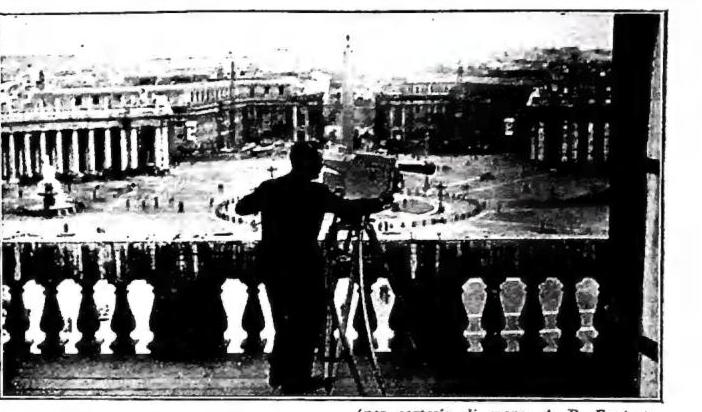
TELEVISIONE - Television set on the terrace of the Vatican Basilica.
2) As regards programs, it is therefore established that everything extremely frivolous, obscene, or indecent is to be excluded from broadcasts, as is every word that could lend itself to ambiguity, on the basis of a list of such words to be prepared by the Commission charged with revising the Code. Attacks on religion and on the various religious beliefs are not permitted. The name of God and his attributes must always be pronounced with due reverence. Religious rites, even when they occur outside the appropriate programs, must be adequately presented, so that the minister, priest, or rabbi who appears in them loses none of his dignity. Care must be taken to prevent commercial criteria from prevailing over qualitative ones, even in contests organized among the public. Full respect shall be maintained for the sanctity of marriage and for what the home represents. Divorce may not serve as the basis of the plot, nor be justified as a solution to the marital problem. Illicit sexual relations shall not be presented as recommendable, and every representation of sexual and unnatural crimes must be excluded. The same criteria of caution must be followed with regard to illegal narcotics, alcoholic beverages, gambling, sporting events, the suffering and physical defects of particular persons, astrological, phrenological, numerological, palm-reading, etc. exhibitions, tragic plots, medical and legal advice, etc., spectacles that arouse cruelty, ambition, or selfishness, the presentation of crimes, and everything that may provoke excessively intense emotions. Every, even apparent, justification of crime must be avoided, whereas the law shall be exalted and its representatives presented with respect and dignity.
3) Duties toward children. Present a proper vision of the world, avoiding everything that may arouse the violence of the instincts. Prepare programs adapted to them, and take every precaution, especially during the hours of the day when they may watch the programs. Through television, instill in them moral and social ideals, and concepts of submission to and respect for parents and authorities.
4) Decency and propriety. Every effort must be made to maintain the utmost dignity in the presentation of figures, as regards anatomical parts, clothing, attitudes, and movements, especially in dance. Good taste and delicacy must be observed in everything that in any way relates to sex.
5) Duties toward the community. The television producer and his staff must remember that they perform a function on behalf of the community and must seek the good of their fellow citizens.
6) Political news and commentaries. True news must be broadcast, with commentary distinct from the news report and marked by a pronounced balance; the broadcasting of alarming and inflammatory news, especially in the criminal sphere, shall be avoided. Commentaries must serve to supplement and complete the public’s knowledge.
7) Public controversies. — 8) Political T.
9) Religious programs. They must be given their proper place, while avoiding attacks on any religion; the utmost respect must be observed throughout the program; worthy persons must be employed; strictly religious truths must be emphasized above partial or polemical viewpoints not closely connected with religion and morality; and broadcasts prepared by the various beliefs must be given a proper proportion.
10) Announcements. — 11) Acceptance of announcements for pharmaceutical products. — 12) Presentation of gifts. — 13) Rules and procedures to be followed for the application of the Code.
These noble aims must be translated into reality, never placing economic or commercial criteria before ethical ones, as the public, in its overwhelming majority, demands.
III. T. AND THE CATHOLICS. — The importance that T. may have as a weapon of the apostolate is evident. Catholics have in fact sought to make use of it and to be present in order to guide its work, according to the ethical requirements mentioned above. Important achievements have been realized in various countries, but especially in the United States of America and France. Work in this field is particularly directed and promoted by the Association Catholique Internationale pour la radiodiffusion et la télévision, UNDA, whose origins date back to 1928. Its central headquarters are in Fribourg (Switzerland), and it has a network of centers and correspondents throughout the world. Its program is to coordinate Catholic activities in the fields of radio and T.; promote the establishment of Catholic organizations concerned with radio and T.; cooperate with other institutions sharing the same spirit; and prepare programs for radio and T. Its president is Fr. J. B. Kors, O. P.
Catholic activity in this field takes many forms: religious broadcasts for parishes, teleclubs, schools for the training of qualified personnel, work within families, the press in the service of T., education in the critical evaluation of T., influence on programs, etc., all of this on an international plane where T. can be a valuable factor in the unity of the world. It should also be added that attendance at Mass by T. does not fulfill the obligation of attending Mass on Sundays and holy days. Papal blessing, on the other hand, is valid when received by T. (AAS, 31 [1939], 277).
QUETE, Unda MISSIO; Bulletin e Revue: UNDA 19, Bois de Pérolles, Fribourg, Switzerland. Raimondo Spiazzi