RADIOCOMUNICAZIONI. –
I. BEGINNINGS
The scientific basis of this means of transmitting various forms of communication is found, as is well known, in Maxwell’s prediction of the possibility of producing electromagnetic waves that propagate at the speed of light (v. ELETTROLOGIA; MAXWELL, JAMES CLARK) and in their experimental realization by H. Hertz. But the technique required to pass from theory to practical needs involved such foreseeable difficulties that no one dared undertake it until certain conclusive experiments by the twenty-one-year-old G. Marconi decisively demonstrated that those difficulties were, at least to a considerable extent, surmountable. Indeed, after Hertz’s results, small devices for producing electromagnetic waves and observing their propagation had been constructed in all the physical laboratories of the world; their range was generally limited to the space of a classroom or a corridor. But no one had been imaginative enough to think that systematic methods of long-distance telegraphy could be founded upon that weak phenomenon. Indeed, even during Marconi’s first experiments, distinguished experts in electromagnetic waves spoke categorically against that possibility when it was put before them.The principal difficulties that generally stood in the way of the idea of passing from delicate laboratory experiments to practical applications consisted: 1) in the fact that the energy density of radiation propagating in spherical waves, centered on the transmitting device, diminishes very rapidly, that is, in proportion to the square of the distance; 2) in the fact that waves tend to propagate in straight lines and therefore cannot follow the curvature of the earth.
But already in the experiments of 1895, through the ingenious insertion of the oscillating electrical device between an antenna, consisting of a long straight vertical conductor, on the one hand, and the earth on the other, and through the analogous arrangement in the receiving device, Marconi had reduced those difficulties to a minimum. The waves, no longer spherical but predominantly cylindrical around the antenna, diminished in energy density only in proportion to the distance; moreover, they propagated while remaining, in a certain sense, with their base attached to the earth’s surfaces; they therefore followed its curvature and irregularities. Thus Marconi was able to demonstrate that, with this arrangement, signals could also be received behind a hill and at distances of several kilometres. Radiotelegraphy was therefore possible.
II. THE ERA OF GREAT WAVELENGTHS
In the experiments mentioned, the adoption of the antenna and of the earth connection in transmitting and receiving systems, by increasing their capacitance, had automatically brought the wavelengths from the customary values on the order of one metre to values on the order of one hundred metres. Progress in this direction led, at the end of 1901, to the celebrated first transmission of the letter a of the Morse telegraphic alphabet (three dots) from the station at Poldu (England) to S. Giovanni di Terranova. It demonstrated unequivocally that, with waves of suitable length, the curvature of the earth did not constitute an insurmountable obstacle to transmissions.From then on, attention was devoted everywhere not only to perfecting the individual parts of transmitting and receiving systems, but also to constructing installations with ever greater wavelengths (up to 20,000 km.) and ever higher antennas (up to more than 300 metres), to which naturally corresponding radiation powers had to be associated. Yet the practical results, although already considerable, never matched the hopes, because, in transmissions over very great distances, there still existed mysterious uncertainties that prevented the regular operation of radio services.
It was again Marconi who shed some light on the serious question. As early as 1902, while conducting experiments, he had observed that no differences in intensity were found in signals received by day and by night when they came from distances of less than 800 km., but that during the day signals from distances greater than 1,000 km. disappeared entirely, whereas at night they arrived normally from distances of up to 2,500 km. and were still decipherable from distances of 3,500.
It was therefore sunlight that caused the disturbances. At that same time he had observed that, over a distance of 244 km., night signals could be transmitted with a 12-metre antenna, whereas to obtain daytime signals of equal intensity an antenna no less than 185 metres high was required. Finally, noting that a ship was often unable to communicate with a nearby station while communicating regularly with a distant one, he discovered the existence of what are now called zones of silence.
And it was precisely on the basis of these experimental findings, applying the Galilean criterion, that it became possible to reach at least an approximate understanding of what occurs in the upper layers of the atmosphere. Some of these, at an altitude of approximately 100 km., become strongly ionized under the action of ultraviolet rays from the sun and cosmic rays, and become conductive; they therefore strongly absorb, like any other conductor, long waves, while they absorb shorter waves only slightly and consequently reflect them. The mysterious facts were thus clarified; but while most technicians thought that, in view of the natural phenomenon reported, nothing could be done except to take it into account when undertaking commitments to transmit telegrams, Marconi took the most decisive step for the future of radiotransmissions: that is, he returned to experimenting with short-wave transmissions, which he and the technicians had neglected, and soon became certain that only with these could all the difficulties be resolved. In communicating the new discovery, he said verbatim: «I was mistaken, and so were all the others who followed me. Nevertheless, I shall be the first to retrace my steps, abandoning long waves for short waves, on which the future of r. will be founded».
III. MEDIUM WAVES AND RADIOTELEPHONY
Before proceeding to give some indications of the characteristics of short-wave transmissions, it is appropriate briefly to consider the technique of medium waves, by means of which ordinary broadcasting is predominantly carried out everywhere. First of all, it should be noted that these no longer involve telegraphy, that is, the simple transmission of conventional signals, but telephony, that is, the transmission of sounds, which is considerably more difficult. Yet the already highly advanced technique succeeded in rapidly overcoming the difficulties. Let the transmitting station be adjusted to emit electromagnetic waves of a given wavelength λ, for example, 300 m. Naturally, its frequency ν will be such that the product λν equals the speed of light; ν will therefore equal 1,000,000 periods or alternations per second, so closely spaced that, unless particularly specialized devices are available, they give the impression of a continuous flow of electromagnetic energy. The emission of a Morse telegraphic signal corresponds to a simple opening of this radiation, as brief as possible for the dots and somewhat longer for the dashes. To transmit a particular sound, for example, an A-sharp of 435 periods, the said electromagnetic flow must instead undergo 435 alternations per second; in other words, the acoustic frequency of the sound to be transmitted must be superimposed on the extremely high electromagnetic frequency, which is achieved through suitable technical devices. Thus the waves propagating through the ether always have the fundamental frequency ν of the transmitting station, but modulated by the acoustic frequency of the note, and can be detected only by a receiver tuned to the frequency ν, giving rise to the sound corresponding to the modulation, whether in a telephone or in a loudspeaker. All these transformations take place while preserving not only the frequency (the note) but also the timbre of the sound being transmitted, which makes possible the transmission not only of music but also, and much more difficultly, of speech.IV. SHORT WAVES
This is now the designation given to waves whose wavelength lies between 100 and 15 m., reserving the designation ultra-short waves, or that of microwaves, respectively for those whose wavelength lies between 15 and 1 m., and for those shorter than 1 m.Among the useful properties of short waves, besides their being almost insensitive to the harmful effects of sunlight, and that perhaps still more useful property of being equally insensitive to atmospheric conditions, there is the highly valuable and by now extensively exploited property of being fairly easily directed; modern radio applications are essentially based on this property.
Short waves, quite apart from the fact that they are generally produced in the Hertzian manner, that is, with a transmitting device not connected at one end to the earth, already show a marked tendency to propagate in a straight line, like light waves, which are incomparably shorter. This property makes it possible to produce them, as Marconi said, in beams, even of small cross-section, which do not tend appreciably to spread either during propagation or upon reflection, and which can be directed from the moment of emission toward a predetermined direction. This direction is chosen so that, upon reflection within the aforementioned spherical ionized—and therefore conducting and reflecting—layer, the beam itself will strike precisely at the desired location. Naturally, if the distance is very great—for example, when one wishes to telegraph to the antipodes—a single reflection will not suffice; but it will then be possible to arrange the initial direction so that the reflected light beam strikes a location (generally the sea), from which it is again reflected toward the upper layer, so that, with one or several further reflections, it reaches its destination exactly. It is clear that this theoretical procedure must be supported by suitable technical aids and controls; the fact remains, however, that in the relatively short period of a few years it has become possible not only to telegraph, but also to telephone, as far as the antipodes. It is interesting to note that beneath the reflections of the upper layer there are large zones of absolute silence, analogous to the less absolute zones also observed in the case of long waves, which are very useful for avoiding excessive publicity of transmissions. Equally interesting and useful is the fact that the entire transmission process takes place exclusively through successive electronic phenomena and motions, without material mechanisms, which would inevitably introduce delays owing to their inertia. It was precisely this absence of delays that made it possible to achieve in telegraphy a transmission speed even greater than the already extremely high speed attained by telegraphy through conductors. Economically, too, there is the great advantage of an enormous saving of energy, since short-wave and beam transmissions require installations of very limited power, with the additional merit that they do not interfere with one another.
Ultra-short waves do not differ sufficiently from the preceding ones to have particular applications. Microwaves, on the other hand, though even less dissimilar—albeit still very far removed—from their optical sisters, are already of great scientific and technical interest. In particular, they are now used in radar applications (ν. RADAR) and increasingly in the various visual applications (ν. TELEVISION).
BIBLI.: D. E. Ravalico, Il radiolibro, Milano 1950 and many other edd. Paolo Straneo
V. LE R. E I CATTOLICI. - The Church could not remain indifferent before the problems arising for consciences from the good or bad use of r. as a means of propaganda, and before the need to employ r. as an apostolic weapon.
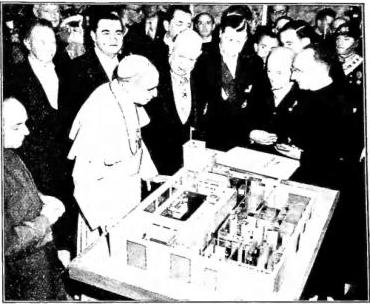
1. Le r. e la S. Sede. - The Holy See established the first radio station in Vatican City in 1931, under the direction of the very inventor of radio, Guglielmo Marconi, and Pope Pio XI began in that year those radio messages which, during his pontificate and especially that of his successor, would carry the Church’s thought and the exhortations of the Supreme Pastor to every part of the Catholic world, with a speed and breadth hitherto unknown, while also transmitting news, celebrations, and religious instruction in the principal languages.