
FABRICS. - The most recent excavations demonstrate that the art of weaving dates back to the most remote Stone Age. Discoveries made in Egypt, as well as in Nordic countries—particularly in the pile-dwelling centers of Switzerland and Lake Constance—reveal that human civilization addressed the technical problem of weaving from its very beginnings. Already in the Paleolithic era, alongside simple plaited fabrics, true woven textiles are found.
It is impossible to determine how much of the material was imported into individual countries. Egypt initially preferred linen; the Nordic countries of the Bronze Age seem to have favored wool, though in earlier periods they too appear to have preferred linen. These fabrics, even in the earliest Stone Age, were worked or had rich borders. Twill-woven fabrics (serge) have even been found among the pile dwellings. Fabrics were originally worked on looms, as deduced from representations in the tomb of Mehentutze in Thebes (ca. 2100-2000 B.C.), where a weaving workshop with two horizontal looms is depicted. Representations of vertical looms appear frequently in later periods, though the horizontal loom was still in use. The vertical loom, in fact, was primarily employed for the production of tapestry fabrics. Even Penelope’s loom, according to a vase painting from the 5th century B.C., was a heavy loom used for the manufacture of brocaded fabrics or tapestries. Weaving was primarily done by women, as recounted by Homer. Similar information is provided by Pliny (Hist. nat., VII, 74). Particularly fashionable were embroidered ornaments, the invention of which is attributed to the Phrygians. Little of the original fabrics from classical times has been preserved. The finds in Crimea provide some idea of their appearance. They were largely executed with the finest tapestry techniques; similar fabrics were also found among the Romans, produced on both horizontal and vertical looms. A notable source for the study of fabrics from the early Christian era is provided by the discoveries at Dura-Europos, destroyed around 250 A.D. Among these, a series of important examples of silk fabrics are found, some still of classical type, others with techniques and decorations already known from Egyptian tombs. Another famous site of discoveries is Palmyra, where partly similar techniques and types are observed. The materials used were primarily wool and linen, with cotton being rare. Most precious were silk fabrics (serica), which came from China partly as finished textiles, partly as thread or raw silk. Generally, they were combined with linen, cotton, or wool thread (subserica); the weft was of silk. Fabrics made entirely of silk were those dyed with purple, the color of which was derived from two types of mollusks: that of Tyre was considered the best. Very rare were gold-woven fabrics, the invention of which Pliny attributed to King Attalus (Attalica peripetasmata). These precious fabrics were called aurata vestis. Remnants of such gold-woven fabrics are found in the National Museum of Budapest.


Regarding their origin, it is known from the Liber Pontificalis that during the early Middle Ages, fabrics largely came from the East: there are indications of silks from Syria (de tyreo), Byzantium (de blati bizanteo), Alexandria (pannum alexandrinum), and toward the end of the Middle Ages from Cyprus (de opere Cyprensi), Asia (de panno tartarico), and Syria (diapro de Antiochia). Even if many of the names of such fabrics be—
(fol. Biblioteca Vaticana)
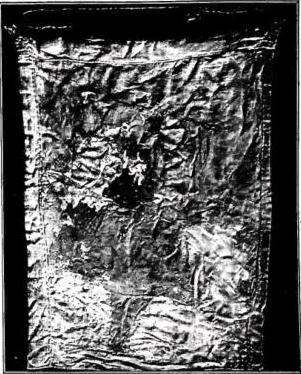
STOFFE - Paleochristian brandeum with traces of blood, an object of great veneration in the Middle Ages: a very worn white damask linen fabric sewn onto another damask linen fabric—Vatican Sacred Museum, Treasury of the Sancta Sanctorum.
the names later became generic, originally they certainly indicated the place of manufacture. Knowledge of the various workshops remains highly uncertain, making it difficult in many cases to determine the fabric's country of origin. Indeed, weavers moved with great ease from one locality to another, carrying their decorative motifs with them. In the late Empire (4th–6th centuries), the major centers were Egypt, with Alexandria and Antinoopolis; Byzantium; and Syria, with Tyre and Berytus. Particularly in Egypt, the ancient Hellenistic tradition persisted until the 5th century, with geometric motifs and simple colors, as seen in the figurations of the classical period. Egyptian products appear in many Western treasuries, such as those in Sens, Aachen, and the Treasury of the Sancta Sanctorum, possibly woven in Antinoopolis, as excavations in that city have demonstrated. The attribution of damask fabrics to Syria is not yet entirely certain, but it is highly plausible when comparing the motifs of these fabrics with those found in the mosaics of Antioch, Apamea, and even Palestine. A fine example of the classical type is the large fabric in S. Ambrogio in Milan, featuring knights and lions (vol. I, col. 987); another is the fabric of the Nereids in Sion or the story of Joseph in Sens. From the 7th–8th centuries date the five-colored fabrics with a red background, such as the Annunciazione (v.) and the Natività or the Sansone (v.) of the Sancta Sanctorum. These are made of red, purple, brown, green, and white silk, with a serge weave and a double-threaded warp. In them, particularly in the ornaments, a certain relationship with Sassanian art can be discerned.
The highly sought-after market for raw silk that flourished in Persia during the Sassanian period (226–632) is not yet well understood. Of the few remaining Sassanian fabric pieces—such as the dragon fragment in London, the pheasant in the Vatican Sacred Museum, or the boar in Berlin—the date is unknown, and even the place of origin remains uncertain. Nevertheless, even after the Arab conquest of Persia, it seems that local weavers did not immediately alter their style and technique, as demonstrated by the fabric with roosters from the Sancta Sanctorum. A large group of fabrics featuring two confronted animals within circles still clearly shows
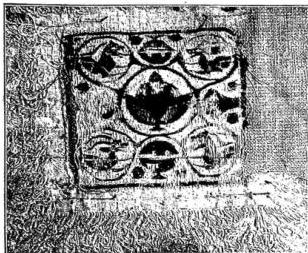
Fabrics - Wool-on-linen textile in brown, black, red, yellow, pink, and green, with a central vase of fruit, originating from Ahmim Panopolis (4th century) - Vatican Sacred Museum.
The influence of Sassanid fabrics is evident, as seen in the fine cloth from the Sancta Sanctorum, which, due to its color, design, and technique, may be believed to have been produced in one of the great centers of Asia Minor. The treasuries of Sens, Huy, Liège, Sion, and Nancy preserve other examples of this type.
Constantinople also appears to have imitated, in addition to Syriac fabrics in the Hellenistic style, those from Persia. Some of these imitations are so perfect that they suggest Persian weavers were transferred to Constantinople: thus the "Emperor" of Mozac in Lyon, the king "Yazdegerd" in Berlin, and the "horsemen" in Sant'Ambrogio in Milan. Alongside these silk fabrics, simpler wool and linen textiles are found, especially in the numerous cemeteries of Egypt. In terms of technique, most of these fabrics are woven in the characteristic Coptic manner; however, among the Hellenistic fabrics dyed with purple (kermes), some are woven in knots. Among the fabrics from the 6th-7th centuries, ornaments in linen worked in various colors or even in pure purple can be seen.
With the Arab conquest of Egypt (640), this technique did not cease immediately but continued for a long time alongside that used for Islamic fabrics. The greatest discoveries were made in the large cemeteries of Ahmim-Panopolis, Antinoopolis, Crocodilopolis, and Saqqārah. The first systematic excavations were conducted by Napoleon (1798-1801), and the related findings largely enriched the Museum of Turin. Major museums, such as those in London, Paris, Lyon, Berlin, Brussels, Florence, Cairo, etc., also possess collections of Coptic fabrics of considerable value. Ecclesiastical vestments, such as the one found in Berlin, are very rare. Generally, these are simple tunics and cloaks that covered the dead in their tombs.
With the advancement of Islamic civilization, a new flourishing of textile art is observed: but it only slowly leads to a transformation of motifs. The taste of Byzantium and the art developed in Egypt, Syria, and Persia—the great textile centers—still predominate. Eastern sources report a series of production sites, which, moreover, the woven inscriptions in these precious fabrics help to localize. It is still primarily reliquaries that reveal magnificent examples, partly woven with gold. Egypt is the most important production center, and Ibn Jubayr, who traveled from Sicily to Mecca in 1183, already describes such fabrics decorating the Ka'bah there. The main commercial emporium was Alexandria, while the factories were primarily in Damietta and Tinnis, with a royal manufactory; there were also factories in Dabīq, Dumyāṭ, and Tūna.
Commanders of ships particularly favored gold-flowered fabrics (dabīqī) and those depicting hunting and battle scenes. Especially prized in Egypt were the fine linen and cambric fabrics. Gold-woven fabrics were produced primarily for the caliphs. The ornaments were arranged in a manner reminiscent of Coptic ornamentation. Beautiful examples are provided by the necropolises of the Fatimid period with their findings from Upper Egypt.
Under the Norman kings, the manufactory of Palermo (Regium Ergasterium) became an important center of textile art. The gold-woven galloons, such as those still found in many miters in Anagni, Capua, Monza, Bamberg (mitra cum aurifrisi), and in Mass vestments, such as in Ascoli Piceno, were primarily intended for export. The most beautiful piece from these manufactories is certainly the mantle with Arabesque decoration, executed in Palermo in 1133 for King Roger II. Interesting in this fabric is the mixture of Arab and Byzantine motifs. Sicilian textile art flourished greatly when, after the Norman campaign of 1147, Greek workers settled near Palermo, although the Arab element still prevailed. The magnificent fabric with peacocks in Saint-Sernin of Toulouse shows this interesting blend of elements. Though the works of the Sicilian school are not as numerous as Falke still believed, it nevertheless exerted a considerable influence on the formation of Italian schools, especially the school of Lucca with its splendid gold and silver brocades. Through fabrics adorned with inscriptions, such as that of the caliph al-Muqtadir Billāh (908-932) of Baghdad, the one in Autun of a minister of Córdoba, or that of the Seljuk sultan Kayqubād in Lyon from Konya, one sees in the most varied centers of the Islamic world a flourishing of textile workshops whose style remains interconnected.
Analogous heraldic paired animals, such as lions, eagles, peacocks, or griffins, hunting or battle scenes, are found even in western Persia and Central Asia. The second important center of textile production in the early Middle Ages is Byzantium. Here too, alongside literary sources, one can rely only on the knowledge of pieces still found in church treasuries or that have passed from these to the great museums of Europe and America. The most important workshops were those of the imperial court in Constantinople, and already Bishop Liutprand of Cremona reports how the export of purple fabrics was strictly prohibited. But large manufactories also existed in other parts of the Empire, and Rabbi Benjamin of Tudela (1160-1173) states, for example, that in Thebes a large number of Jewish textile workers were employed. Moreover, fabrics also came from the provinces as tribute to the capital. Rabbi Benjamin further reports that fabric merchants flocked to Constantinople from all over the world, in turn spreading Byzantine fabrics throughout the East. Alongside these merchants, the Venetians played a predominant role in the diffusion of Byzantine fabrics, which were also introduced into major Italian ports such as Amalfi. Thus, the Liber pontificalis records how Gregory IV (844) purchased a fabric depicting the emperor (velum habens historiam imperatoris). These fabrics reached the West in large quantities, especially with the Latin conquest of Constantinople (1204). A good example of such figured textiles is offered by the large silk fabric from Bamberg, originating from the tomb of Bishop Gunther (d. 1064), depicting the Emperor riding between ancient and new Rome. A fragment of an imperial representation was also found in a reliquary from Verdun (now in London). Otherwise, the preserved pieces mostly show representations of animals—eagles, griffins, lions, or horses—mostly enclosed in circles (orbiculi). The fabrics are colored, and the most precious, from the imperial manufactories, have a purple background (blattia, imperialis purpura).
After a certain decline in textile art during the 6th and 7th centuries, workshops began to flourish again from the 8th to the 12th century. The extent of commercial relations and the diffusion of goods at that time was never again equaled. Old motifs were reworked, and new ideas came from the East, especially from Persia, as clearly demonstrated by the imperial mantle originating...
The most recent excavations demonstrate how the art of weaving dates back to ancient times. The imperial mantle from Mozac or the winged horses among scrolls in Hanover often feature a single animal enclosed in a roundel, as in the magnificent silks (stoffe, S.) with elephants on Charlemagne’s casket in Aachen. These silks differ from Persian ones due to their even greater stylization and stronger colors. Without medallions are the splendid large lions on two silks from the casket of Anno in Siegburg, fragments of which also survive in Deutz, Düsseldorf, and Berlin. The first of these silks dates to 921–931 and bears the names of the emperors Romanos and Christopher; the second to 976–1025, with those of Basil II and Constantine VII. Equally precious were the purple silks with eagles, without circular framing, from Brixen and Salzburg. Very well-woven are the satin silks with ornaments enclosed in pointed oval fields, such as the mantle of Otto I in Merseburg or the chasuble of Bishop Willigis (d. 1011) in St. Stephen’s in Mainz. Particularly prized were silks worked with small circles, squares, or stars. These display a double warp with colored-thread weft. Unfortunately, almost nothing has survived of the famous Byzantine embroideries of the early Middle Ages. The so-called dalmatic of Charlemagne in St. Peter’s in Rome already belongs to a later period (v. vol. II, coll. 1680–90), though the veils of Castellarquato with the Communion of the Apostles still show the rigid style of the earliest works (v. vol. X, tav. XLV). Embroidery was widely used at the time, especially for vestments such as sakkoi, omophoria, epimanikia, epigonatia, mitres, and cinctures. Particularly sumptuous in later periods were the epitaphia, embroidered cloths that covered Christ’s tomb on Good Friday, such as the one from Ohrid bearing the name of Andronikos Palaiologos (1282–1328). Frequent examples are found in Balkan monasteries, especially on Mount Athos, Putna, and Zolkma.
Influenced by the East and Byzantium are also the oldest medieval silks in Italy. It is certain that after Manfred’s death, many textile workers left Sicily and brought their art to Lucca and Venice. Thus, a blend of Byzantine and Saracen motifs is also evident here, though Venice turned more toward the East. These are mostly two-colored fabrics, such as yellow on a dark, often red, background, with figures of confronted animals set freely on the surface. Thus, the galloon on the chasuble of Blessed Bernardo degli Ubertini (d. 1133) in Santa Trinita in Florence could be considered a product of Venetian workshops, renowned for their surifrisia, while the dalmatic found in the tomb of Benedict XI (d. 1304) in Perugia recalls silks from the Far East. Magnificent embroideries have been preserved in Anagni, whose vestments may perhaps be identified with the silks that, according to the papal inventory of 1293, were connected to Cyprus, while the dossal preserved there reveals affinities with the Roman school of painting of the time. A still primitive ornamentation inspires an altar cloth from the Sancta Sanctorum in the Vatican Museums, in white embroidery. More advanced is the design of the cloth of Blessed Benvenuta Boiani in San Pietro in Cividale (d. 1292). Such works appear identical to embroideries in opus Theotonicum. Venice visibly exerted its influence also on the workshops of southern Germany, among which the principal was that of Regensburg, and already Wolfram von Eschenbach praises the zendel, workshops of this city. Given the high cost of raw silk, German weavers used linen thread for the warp, so that these fabrics have a certain stiffness. For the weft, especially for figures, gold threads wrapped around thin gilded gut were widely used. Two groups of these silks can be distinguished: one with saints and scenes from the New Testament, such as the altar frontal from Regensburg Cathedral with the figure of Bishop Henry II (1277–96) or that from Waltburg with the Nativity of Christ. The other consists of smaller pieces, very numerous, with griffins, falcons, lions, and eagles that stylistically relate to Italian silks. Ancient motifs such as the apotheosis of Alexander are also encountered. A very Byzantine-style silk with this theme is also preserved in Würzburg. It is interesting to note how the use of these half-silk fabrics from Regensburg was prohibited at Cluny.
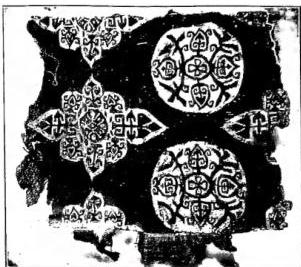
Fabric - Wool-on-linen weave in red and white. Long strip with lateral borders, attached to white cloth; originating from Egypt. The stylized leaves, branches, and palmettes reveal an advanced degree of decorative art. Likely attributable to the Arab period (8th-9th centuries) - Vatican Sacred Museum.
(«Statutum est ut nullus scarlatas, aut barracanos, vel preciosos burellos, qui Ratisponi hoc est apud Raines-bors fiunt, sive picta quolibet modo stramina habeat»: Statuta Cluniacensis, by Pietro il Venerabile, 18: ed. M. Marrier, Bibliotheca Cluniacensis, Paris 1614, col. 1359: PL 189, 1031).
With the Gothic period, in the 14th century, Lucca and Venice assumed primacy in the silk industry. Soon, throughout Europe, the demand for these precious fabrics grew, and consequently, important workshops arose in Genoa, Milan, Ferrara, Bologna, and especially in Florence. Bruges was one of the main centers for the trade of Italian silks, where Scandinavian countries, England, and Russia made their purchases. Even today, brocades and velvets can be found in many great cathedral treasuries, such as those once in Danzig, Aachen, Sens, Conques, or Andechs, and in museums in Rome (Museo d'arte industriale and Vatican Sacred Museum V. VATICANO), Florence, London, Berlin, Cleveland, etc. Particularly beautiful fabrics are also seen reproduced in paintings. Typical of Lucca are the diaspri with a lustrous ground and opaque design, reminiscent of the so-called diasperate maiolica. Except for the Palermitan fabrics, the influence of Chinese silks is now clearly evident, even in the weave, partly even copied outright. The division into pointed ovals is still recognizable only by thin tendrils; within the interior of branches bent into spirals or forming circles, animal figures, palmettes, and flowers are contained. Gradually, the vines transformed into trees rising from the earth and rocks. The fabrics of Lucca sometimes feature figures imitating Arab models, along with feudal castles, pavilions, ships, and human figures. In the second half of the 14th century, the representations become more animated. Animals play and fight among themselves, and hunting scenes recall the ivories of the period. For ecclesiastical purposes, religious motifs are also used. Venice, in contrast to Lucca, shows few Chinese motifs but mostly animals of European design, depicted calmly, as in Italian paintings. In the 15th century, even some great artists such as Antonio Pisano or Jacopo Bellini prepared fabric designs.
The influence of China is even more evident in Persian fabrics of the 14th-15th centuries. Their characteristic is the thick thread that stands out in relief on the colored weft of silk thread. They retain the large central motif in the field in the form of a pointed oval, in which pairs of animals are depicted. Good examples are found in the Treasury that was once in Danzig. From Turkestan likely come the magnificent fabrics of the tomb of Cangrande in Verona (d. 1329), with
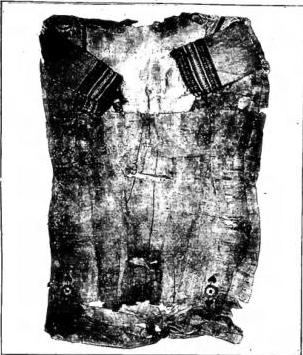
Fabrics - Child’s tunic from Egypt (4th-5th centuries). Woven wool on linen in resso, yellow and green. Note the small clavi with red lines and the orbiculi on the shoulders and knees. Vatican Sacred Museum.
Arabic inscriptions. Similar to these are the Egyptian fabrics of the 14th century, found at el-Azam and Dronka near Assiut. In Spain, especially in the Kingdom of Granada, fabrics with arid motifs were produced during this period. Nor did such fabrics disappear immediately in the Alhambra style after the conquest of Granada (1492).
Embroidery also reached great flourishing in Italy. Here too, Oriental art and especially Byzantine art exerted considerable influence, as demonstrated by the antependium of Santa Maria in Zara. This technique was also in vogue for the adornment of mitres, of which good examples are preserved in Urbino and in San Pietro in Vincoli in Rome. However, the most valuable pieces seem to have been imported into Italy from England, and numerous chasubles in opus anglicanum are found in cathedral treasuries, such as that of Boniface VIII in Anagni and the Lateran, the cope of Pius II in the Museum of Pienza, and another in the Vatican Sacred Museum. As early as 1098, the Fathers of the Council of Bari admired an embroidery of English origin, and from the 12th to the 14th centuries, the popes sought English fabrics. Thus, Eugene III (1145-50) received a cope from Lincoln, and Adrian IV (1154-59) another fine embroidery. After 1350, however, a decline in this needlework art is observed in all Nordic countries, which must be connected to the advancement of Italian silk fabrics. Embroidery was also frequently used for tapestries: in imitation of the Bayeux tapestry, they were arranged around the frieze, one above the other, as in the Tristan tapestry (Wienhausen). During the 15th century, these embroideries were scarcely used by the Church for the altar but served mainly as borders and ornaments for chasubles. Particularly famous in this genre were the works from the manufactories of Cologne, Flanders, and Burgundy.
With the Renaissance and the 15th century, the richness of fabrics reached, especially in Italy, an even higher point. While in the 14th century the production of fabrics still concerned exclusively the guilds and industrial art, now even great artists, such as Antonio Pollaiolo, Botticelli, Sassetta, Leonardo, and Bellini, engaged in designing their patterns. Florence, Siena, and Venice were the centers of this art; but alongside these, others arose, such as Milan and Genoa. While the design and technique changed very little, textile art dedicated itself especially to the production of sumptuous velvets that were no longer smooth but featured primarily the pomegranate motif. The most beautiful pieces, with enameled colors, were manufactured mainly in Venice, where velvet weavers had been granted by the Great Council the faculty to form their own guild as early as 1247. The new designs were then used in the 15th century also for other fabrics such as damasks and brocades. It can be said that there is no cathedral treasury or museum where magnificent examples are not found. Thus, in the Museum of the Opera in Siena, Orvieto, Spoleto, Montefiascone, Gandino, or in the museums of London, New York, Boston, Paris, Lyon, Berlin, Milan, Rome, etc., precious collections of such velvets are still found, partly dated by the coats of arms of their donors. Painting also provides good datable examples, especially in the Venetian school with Crivelli and Bellini. From the mid-century, alongside the pomegranate motif, others appear. Thus, Florence produced gold fabrics with colored outlines or two-colored silk fabrics with bands of tendrils, palmettes, and coats of arms. Characteristic of Florence are especially the figured fabrics with scenes from the New Testament, mostly in two colors. These were used as trimmings for Mass vestments, as on a dalmatic in the Treasury of Halberstadt. Gold thread, used in the 15th century, disappeared at the beginning of the 16th century, when a finer and more compact silver thread appeared instead. Among the most precious products of this school are the panels with the story of St. John the Baptist in Florence Cathedral, designed by Antonio Pollaiolo between 1466 and 1473. Magnificent also are the embroideries of the antependium of Santa Maria Novella, said to be designed by Domenico Ghirlandaio. Certainly dated (1475) is the antependium in San Francesco in Assisi, donated by Sixtus IV, in the center of which St. Francis is seen kneeling. Equally precious is the gold-woven chasuble for King Matthias Corvinus, bearing his coat of arms (1458-90). In the Nordic countries during the 15th century, figured fabrics held an important place. The great series commissioned by Louis I of Anjou in Paris for the chapel of his castle at Angers, completed around 1470, constitutes the first testimony of a genre of which Arras became the main production center. The four representations taken from the lives of Sts. Piat and Eleutherius, executed in 1402 in the workshop of Pierrot Feré for Tournai Cathedral, belong to the capital works of the early days of this art. Most of the tapestries ordered by the dukes of Burgundy were also executed in Tournai. This art is magnificently represented by the series of four large tapestries with hunting scenes owned by the Duke of Devonshire. Alongside these are representations taken from Nordic mythology, as in the tapestry of Palazzo Doria in Rome, from 1459. The most splendid and famous series is constituted by the tapestries of the lady with the unicorn (ca. 1510), from the castle of Boussac, now in the Cluny Museum in Paris.
With the end of the 15th century, the workshops of Brussels began their production, examples of which are found throughout Europe: in Florence, Milan, Madrid, and Paris. Smaller but very beautiful tapestries were also produced by Rhenish workshops such as Mainz (Cathedral Museum), Strasbourg, Basel, Constance, and in some cases also by workshops in central Germany, such as Nuremberg (Germanic Museum).
In the 16th century, production extended also to Italy, where it became somewhat more industrial, although its fabrics continued to be among the finest in Europe. Alongside Florence and Venice, large factories now appeared in Milan, Como, Reggio Emilia, Bologna, Genoa, and Catania. But the fabrics of Venice continued to be among the most sought-after and were even imitated in Russia. On the other hand, Venice in turn copied Persian and Oriental motifs. Italian factories were then the main suppliers to all the princely courts of Europe, and Henry IV of England, as well as the Queen of France, placed substantial orders in Florence. Magnificent examples are also found for this period.
in all the great treasures of the cathedrals in Rome, Florence, Cortona, Perugia, Siena, San Gimignano, Venice, Milan, and Vercelli—to mention only some of the most important locations—as well as in the great collections of the principal museums. Here too, the paintings of the great masters, especially in portraits, provide excellent reproductions of fabrics. It suffices to recall the works of Pontormo, Bronzino, Tintoretto, and Paolo Veronese. With the spread of Spanish fashion, which involved rich pleating, it became necessary to seek fabrics with minute patterns, while for upholstery and wall fabrics, larger motifs were employed. Above all, the pomegranate motif was transformed in the Renaissance style and occasionally replaced by vase forms. A symmetrical arrangement still remains, to be sure, but the large masses generally expand, and an intertwining of curved branches covers the entire surface. Amid the tendrils, quadrupeds and birds also appear, sometimes even monograms and coats of arms. Larger motifs are found in the great wall fabrics in velvet and silk, depicting trophies of arms, vases, musical instruments, or grotesques. These large wall fabrics include borders with animals, hunting scenes, or intertwining branches. However, for the adornment of sacred vestments, special fabrics with Christian figurations were produced, especially in Florence.
In these sixteenth-century fabrics, Italian weavers employed the most varied techniques. Alongside velvet brocades, there are damasks with similar designs, as well as brocades in silk and half-silk. A characteristic type of fabric still preserved in numerous originals and in many paintings—especially for tablecloths and handkerchiefs—are simple linen fabrics with woven animal designs, often paired and facing each other, or also with vases and flowers. Perugia, in the fifteenth and sixteenth centuries, was the major production center for these fabrics, though similar types appear to have been produced in Germany as well.
In the Near East, too, the sixteenth century saw a revival of the textile arts. While the influence of Venice on these manufactures is clear, one can also observe in Italy a resurgence of Oriental and Turkish motifs. Under the rule of the Safavids, the arts flourished once more, and several manufacturing centers are known, among which Isfahan, with its court manufactories, seems to have been preeminent. Notable also are Kāfān and, for velvet production, especially Yazd in southern Persia. Magnificent gold and silver brocades, silks, and velvets from these manufactories are known. These were used primarily for garments, but wall fabrics also existed. Figurative representations with pairs of lovers or single figures with ornamental motifs were repeated across the fabric's surface. Embroidery in silk with extremely lively scenes, reminiscent of contemporary miniatures, also flourished. During the Ottoman era, in Turkish textile art, strong Persian influences are noted in Bursa and Scutari. The velvets and brocades from these manufactories were sought after in Europe. The characteristic motif of these precious fabrics, seen in countless Venetian paintings, consists of three large moons arranged heraldically, palmettes, and pointed ovals with pomegranates. These fabrics were mostly used for clothing and are found today in almost all major museums. In China, too, velvet production appears to have been introduced from Persia, though it developed only in the seventeenth century, while under the Ming dynasty (1368–1644), silk weaving flourished above all. The export of these fabrics to Europe, however, became significant only later, under Kangxi (1662–1723) and Qianlong (1736–95), and they widely influenced Italian and French production.
The strong export of Italian fabrics in the fifteenth century, both to Northern countries and the East, not only continued but increased in the sixteenth century, so that the manufactories of Florence, Lucca, Genoa, Bologna, Milan, and especially Venice became extraordinarily flourishing. Local factories in these countries imitated motifs originating from Italy. The pomegranate motif remained the most fashionable in this period, but its pointed oval contour was transformed into
ornamental scrolls. Vases from which flowers and fruits protrude also appear, as do new motifs from the East, which in turn employed Italian motifs. Particularly sought after were brocades and velvets, which, with their combination of gold and satin, catered to the splendor of Renaissance courts. Damasks, silk fabrics, and half-silk fabrics were also highly prized. Cotton and wool were used alongside silk, especially for linings. Fabrics for clothing featured smaller designs, while brocades and velvets intended for ecclesiastical use retained the ancient large-scale patterns. The most important wall hangings, made of velvet or silk, imitated architectural motifs with trophies, vases, and floral designs. From the late sixteenth century, but especially in the seventeenth century, the demand for wall fabrics continuously increased, both for homes and primarily for churches (coverings for pillars). Thus, alongside the great factories of Venice and Genoa, smaller workshops also actively operated. The old pomegranate motif was still preferred as ornamentation, but the design was often executed in a simplified manner, using hot-iron printing, to reduce the cost of the goods. Alongside large motifs, smaller ones soon came into fashion, and one or two orders in different colors gave velvet fabrics a touch of color. In brocades and damasks, designs now extended across the entire width. Similar fabrics, inspired by Italian models, are also found in Spain during the sixteenth and seventeenth centuries, where the pomegranate motif dominated. However, ancient Moorish motifs evidently still exerted their influence. Here, ornaments were raised by the weft on a satin and brocade background, with gold and silver loops to achieve a more sumptuous effect.
From the time of Louis XIV, the triumphant rise of French silk weaving began, and the factories of Lyon occupied an important place in Europe. Above all, the fashion for color helped enrich and perfect designs, to which great artists like Daniel Marot also contributed. Fabrics for women and men can be clearly distinguished, as smaller motifs such as scattered flowers were preferred for men's clothing, while the wide skirts and long trains of women's gowns required large motifs. The designs of lace also had a notable influence on silk fabrics, an industry widely encouraged especially by Colbert. However, in the second half of the eighteenth century, all symmetry disappeared from designs, and vegetal ornaments were scattered irregularly across the entire surface. Particularly in vogue, as in architecture and porcelain, were the so-called "chinoiseries." The introduction of such motifs was largely due to the influence of Madame de Pompadour, who ordered the importation of Chinese goods from the East India Company. Even more richly decorated were furniture coverings, wall fabrics, and curtains. The first excavations of Pompeii (1748) and the interest they aroused in classical art also influenced textile artists. Furniture wall fabrics in a classicizing style drew particular inspiration from them. Landscapes, small pictures, and putti enlivened pilaster-like stripes. One of the greatest masters was Philippe de Lasalle (1723-1803) of the Pernon silk manufactory in Lyon, who worked for the courts of France and Russia. Jean Revel is one of the best-known motif designers. After the Revolution, Napoleon revived the textile industry in Lyon, and J. E. Bony (d. 1825) became one of its finest designers. However, textile art declined with the mechanization of technique by C. M. Jacquard, who introduced the mechanical loom in Lyon in 1805.
Despite strong French competition, Italy maintained its production in the seventeenth and eighteenth centuries. Venice and Genoa continued to produce their famous velvets and silks; Venetian factories also became celebrated in this period for their red velvets, dominated by the large pomegranate motif. Particularly sought after, both in Italy and abroad, was Genoa's red velvet on gold. Smaller factories in Piedmont, Emilia, and Lucca also produced magnificent fabrics, especially those with floral designs. For clothing and ornaments, as in France, fabrics with smaller designs were mostly used. In the eighteenth century, the influence of French textile art became even clearer, especially in Turin and Genoa, where Chinese influences were also evident once again. Venetian fashion was made known through the paintings of local artists such as Tiepolo, Vittore Ghislandi, and others, but magnificent examples of large wall fabrics can still be found today in the palaces of Venice, Genoa, or Palermo. For Italy, too, the great era of textile art ended with the Napoleonic Kingdom.