
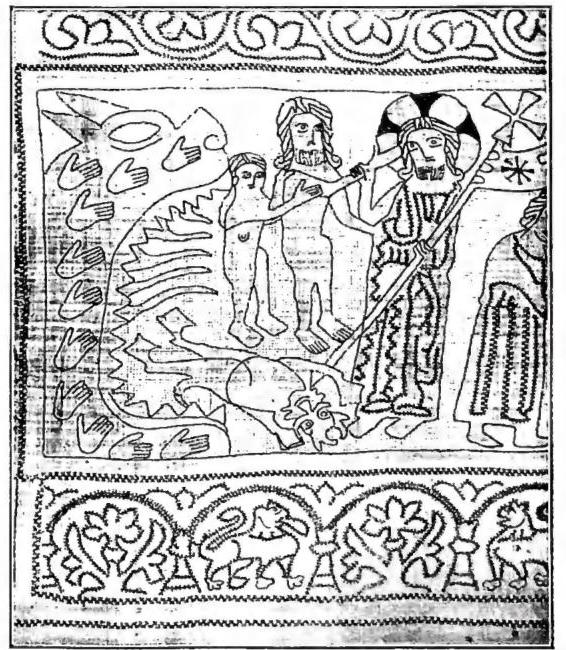
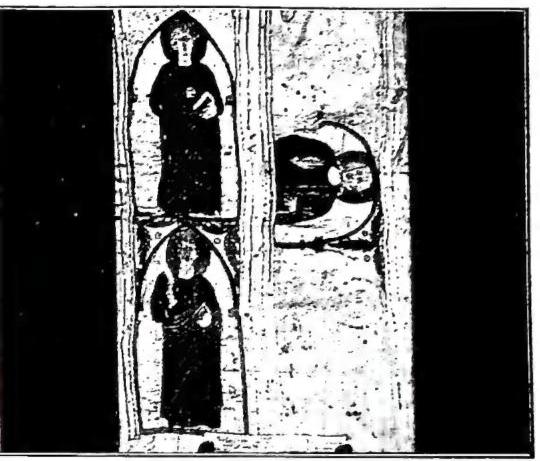
EMBROIDERY. - Needlework on a pre-existing ground, clearly distinct from lace or needle-lace, whose ground is worked after the ornaments in order to hold them together. The thread used for embroidery is of linen, wool, silk, cotton, silver, gold; the stitches are very numerous.
The stitch itself (point couché), which covers the fabric with threads of silver and gold, securing them with silk in an almost invisible way, is among the oldest and also among the most widespread up to 1100, together with the running stitch and the chain stitch, the latter being very easy to execute and therefore used to depict garments, architecture, animals. In the 14th century it was customary to lay the gold of the ground without the interruption of the silk thread in order to imitate the effect of miniatures, creating a smooth surface. The split stitch, in which the needle divides the thread, serves to render the modelling of faces. From the middle of the 14th century onward a new stitch came into use which the French call or nué, used for the most precious embroideries where the entire ground of the fabric is covered with gold wholly veiled by silk threads so as to obtain the delicate effect of softening its gleam. Of this stitch, called by us "veiled," Italy offers a admirable example in the parament of St. John in the Museum of the Opera del Duomo in Florence. At the end of the 14th century the "closed stitch" was in use, which imitates weaving and tapestry and is of great perfection and regularity.
Of the origin of embroidery there is no certain information, but its existence is documented by very ancient writings, sculptures, graffiti, etc. of the greatest civilizations of the East — the Assyro-Babylonian, the Persian, the Syrian, the Egyptian. Among the oldest known examples is the Egyptian band of the Museum of Antiquities in Turin, earlier than the 12th century B.C.; of probable Greek origin and perhaps dating to the 4th century B.C. is the figured embroidery on purple-dyed wool in the Hermitage in Leningrad. Both in Greece and later in Rome tradition, based on Pliny, holds that embroidery arrived through the Phrygians. Among the oldest embroideries are also counted the Chinese ones, with symbolic motifs; from them the Japanese embroidery later derives, which from the 7th century onward is adorned with an exceptional variety of motifs and liveliness of colors. From the 6th century are the Coptic embroideries, in which the influence of classical art is manifest, today scattered somewhat throughout all the museums of Europe, coming in good part from Alþmim, the city that has yielded the greatest number of these celebrated needleworks. Important, even if small, is the group of the Vatican Sacred Museum, donated by the Franciscan Missions of Egypt.
For the art of embroidery the Middle Ages mark the moment of greatest development, documented by admirable works; even then, as already in the most remote times, the East is the richest center of propagation of this most refined art, and the Oriental dyes, too, are for the most part technically perfect, the dyes with which the dazzling silks were colored. The most important examples of Byzantine embroidery are found among church vestments; one of the best known is the vestment of St. Caesarius at Arles in the church of Notre-Dame-de-la-Major (501-542). Treasures of this art of clearly Byzantine derivation are the liturgical embroideries preserved in Moldavia, in the monastery of Putna; precious is the embroidery found in the tomb of Gunter, bishop of Bamberg (1062), now preserved in the Treasury of that Cathedral, depicting Constantine on a white horse between two symbolic figures of queens, in a composition worthy of a Byzantine mosaic.
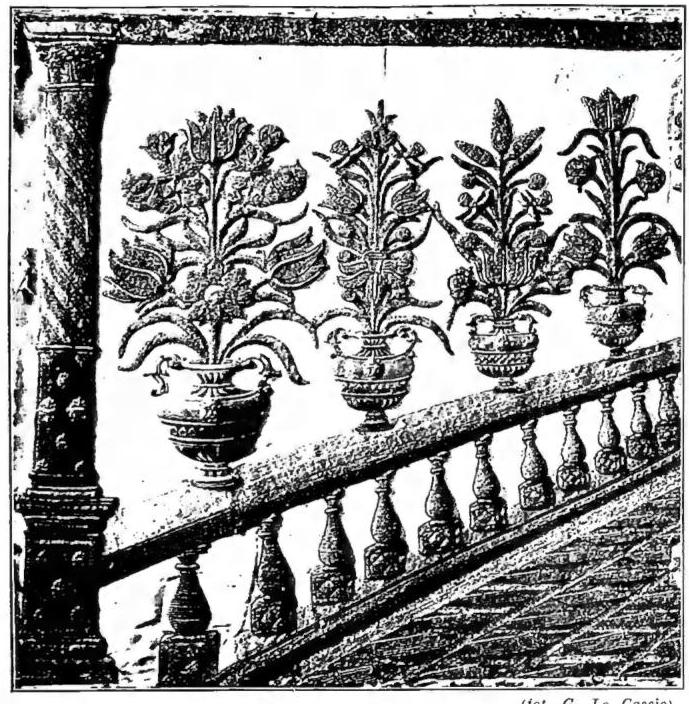
(phot. G. Lo Cascio)
Of great value for the purity of design inspired by painting are the needleworks of other regions of Italy; from central Italy, the embroidery of the Museum of Orvieto, which with a crude technique traces a most delicate design by a probable Sienese painter; the admirable altar frontal of the Treasury of Anagni with the Virgin and stories of saints, designed by a painter akin to Torriti or to Cavallini (Toesca); and, from the 14th century, but still strongly Byzantine in style and of a majestic purity of motifs, that masterpiece of the art of embroidery which is the dalmatic of Charlemagne in the Museo sacro vaticano.
From England in the 13th and 14th centuries come the embroideries known as "opus anglicanum"; on linen fabrics the embroideries in silk, gold and silver narrate episodes of the New Testament and lives of saints, drawing austere figures within interlaced quatrefoils (copes of Sion and of London), within circles (cope of Anagni), within pointed arches (copes of St. John Lateran in Rome, of Pienza, Bologna, Toledo, etc.). Somewhat later is the style of the English cope of the Victoria and Albert Museum in London, in red silk with the Tree of Jesse, for which a rich flora serves as background to the figures, replacing the customary architectural motifs.
In the embroideries of Germany known as "ad theuthonicum" the characteristic features are the strongly marked outlines in black, the use of dedicatory and explanatory inscriptions on long bands, the abundance of minute ornaments. The design is treated in an elementary manner without any search for shadows or relief. Many precious examples of this manner are preserved, in use especially in the "tobalae" (altar vestment of the Museum of Cluny, Halberstadt, Rubesberg, Lüne, Wienhausen, Prague (altar frontal of Anagni)). An example of singular medieval embroidery is the mantle known as that of St. Henry from the Treasury of Bamberg; the origin of the embroiderer, a certain Ishmael, is uncertain.
The luxury of Oriental embroideries spread to France with the Crusades; the most glorious period is the 13th and 14th centuries (altar frontal of the Hôtel-Dieu of Château-Thierry), but the 15th century too has most beautiful examples (embroidery of the cathedral of Angers). From the 15th century onward relations and exchanges with Italy become frequent. Charles VIII brought with him expert Italian embroiderers, and so did Catherine de' Medici, who summoned to France the famous author of patterns for embroidery, the Venetian Federico Vinciolo; with the 16th and 17th centuries a vast production of volumes concerning embroidery flourishes and this art develops more and more, passing from the church also to the palaces, while sacred symbols are replaced by profane, mythological subjects; the use of floral motifs is accentuated and classicizing motifs of faces within ornaments not infrequently reappear. One of the most important examples of profane art nevertheless remains the famous medieval embroidery of Bayeux, in which the story of the conquest of England by the Normans is narrated, almost seventy meters of canvas embroidered with naive Romanesque realism, which tradition holds to have been executed entirely by Matilda, for her spouse William the Conqueror.
Flanders too has given admirable works, issued especially from the workshops of Bruges; particularly linked to works of painting (cope of the Treasury of Vienna, inspired perhaps by Van Eyck himself; vestment of Grunbergen of the Musée du Cinquantenaire in Brussels). Spain, under Arab influence, is distinguished for richness of ornaments, of golds and of pearls; famous is the "mantle of the Virgin" of the Sagrario.
From the 15th century onward numerous names of celebrated embroiderers have come down to us, among them Giacomo Rainaldo da Mantova, Geri di Lapo da Firenze (altar frontal with stories of saints at Manresa in Catalonia, in "opus florentinum"), the Veronese Paolo di Bartolomeo (altar frontal of St. John in Florence), Antonio di Giovanni Fiorentino, the Venetian Piero di Giovanni; among the women, Antonia Peregrina, Caterina Cantona, the venerable Tommasina Fieschi. Embroiderers, like master glassmakers, had recourse to other artists whose designs they translated more or less faithfully; among the most active designers of patterns are Baldinucci, Alessandro Paganino, Niccolò di Aristotele, even Iacopo Bellini. The designs of many embroideries are owed to great artists such as Pollaiolo, Botticelli, Raffaellino del Garbo, Raphael, Nicolò dell'Abbate, Pierin del Vaga, Gian Lorenzo Bernini.
With the 18th century France occupies the first place in the art of embroidery; the minute graces of the rococo accomplish miracles of preciousness especially in feminine and masculine attire and in domestic furnishings: among the most famous are the petits points de St-Cyr. French supremacy lasts until the Empire, then Italy takes back its place, repeating 16th-century motifs. In the 19th century, although this art became industrialized with machines (the first dates to 1830 at St. Gallen in Switzerland), local schools flourish again with a particular regional character in Italy and abroad, and embroidery becomes an exclusively feminine occupation. - See plates XLV-XLVI.
in Romania. I r. liturgici, Roma 1945; F. Morris, English embroidery, in Art News, 13 (1945-1946), p. 17; G. Brett, Some Elizabethan embroideries, in The Burlington Magazine, 1947, p. 100. Luisa Mortari