
PLANETA (Planeta, casula, amphibolus). - An ecclesiastical vestment proper to priests in the celebration of Mass. At present, for two or three centuries, it has consisted of a two-flapped scapular (the back panel measuring 65-75 cm. wide and 1.05-1.15 m. long, the front panel shorter).
Four types of planetae are distinguished: a) Roman: the two flaps are sewn together on the chest; the opening for the head is trapezoidal; the back ornament is a vertical strip called a “column,” the front one a T-shape (a cross with joined arms); b) German: the flaps are sewn at the shoulders; the opening is round; the back ornament is a cross, the front one a simple “column”; c) French: the flaps are sewn at the shoulders; the opening is like the Roman type but less deep; the ornamentation is similar to the German; d) Spanish: the flaps are sewn at the shoulders; both front and back ornaments are only “columns”; the width increases toward the bottom. From the mid-19th century a form resembling those of the 14th and 15th centuries was restored; it is inaccurately called the Gothic planeta, or the planeta of St. Bernard or St. Charles Borromeo.
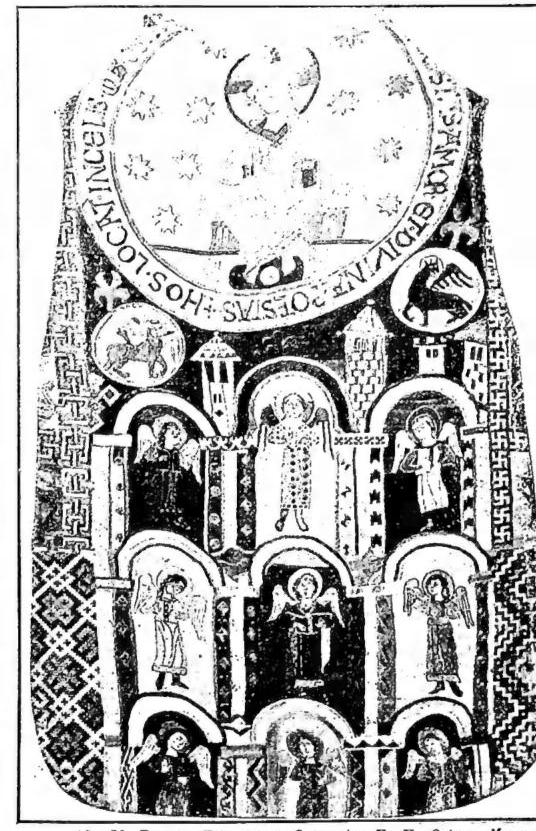
PIANETA — An embroidered planet in silk featuring Christ in majesty, the symbols of the Evangelists, and angels. Work of the Benedictine Abbess of Göss (Styria), Cunegonda II (1239–69) — Vienna, Museum of Applied Arts.
The etymology of the term “pianeta” (from the Greek πλανᾶσθαι, “to wander,” according to S. Isidore, Etym., XIX, 247) is unclear; instead of the word paenula, the term appears in the fifth century and is already in liturgical use in that same century. In Spain it was in use before the Fourth Synod of Toledo in 633 (canon 28). Outside Rome it was worn only by bishops and priests; in Rome it was worn by all clerics, including deacons, subdeacons, and acolytes. From the twelfth century it became a vestment proper to priests at the celebration of Mass; in other functions the cope was used.
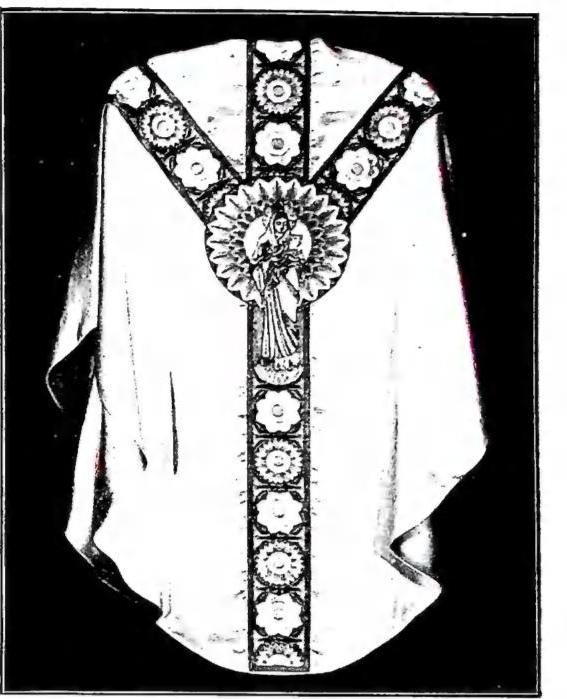
In antiquity, secular paenulae were adorned with two vertical purple clavi. As decoration for the liturgical planet, monuments show a simple gallooned border around the neck opening. Beginning in the eleventh century, a vertical band divided at shoulder height into two oblique arms (in the shape of a Y; sometimes the vertical band extended up to the neck) was used to join on the chest and descend to the lower hem; all embroidered with ornamental designs or figures of saints. This purely ornamental motif was later interpreted as a cross; indeed, from the thirteenth century in England, France, and Germany a cross with horizontal arms was placed on the back panel (while the front panel bore a simple “column”). Today ornamental types vary, sometimes inspired by themes or symbols of the ecclesiastical year.
Only since the last century has there been a prescription—though to confirm a centuries-old practice—to use silk for the planet; half-silk fabrics are no longer permitted. Wool, linen, cotton, and even leather or straw-woven planets are preserved in museums and sacristies of cathedrals, including some from the Thirty Years’ War. Yet as a rule precious fabrics were used, sometimes imported from the East (in antiquity the renowned workshops of Alexandria, Damascus, and Byzantium; in the Middle Ages the Saracen workshops of Sicily and Spain; precious damasks, brocades, and velvets from Genoa, Lucca, Milan, and Venice). Until the twelfth century, fabrics of a single color or pattern prevailed; subsequently, fabrics with some geometric or floral design were preferred, especially the pomegranate (perhaps in reference to Ex 28:33), or with figures of real or fantastic animals. These designs were not specifically Christian but derived from the East.
Because the planet is placed over the shoulders, it is regarded as a symbol of the Lord’s yoke, and as the priest puts it on he says: “Domine, qui dixisti iugum meum suave est….”
P. piegata (Folded Planet) — On days of mourning and penance, sacred ministers, instead of the dalmatic or tunicle, use the folded planet; that is, the front part of the planet is wrapped in front of the chest or even cut off just before the middle. The subdeacon, before the reading, lays aside the folded planet, to resume it afterward; the deacon, however, from the Gospel to Communion, lays aside the planet and dons the so-called stolone in order to be freer in serving at the altar.
In Rome, the catacombs of S. Ponziano, etc., already document the existence of the P. as an essential part of liturgical vestments. About twenty bell-shaped P.’s are preserved in Germany, including those at Mainz, Munich, Erfurt, Iburg, Würzburg, Niederaltaich, Deutz, Xanten, Brauweller, and in Italy at Castel S. Elia. The shortening process can be traced in the collection of P.’s in the Treasury of Halberstadt Cathedral, while Castel S. Elia, in the Roman countryside, offers a complete series of P.’s in various stages of development.
Among medieval P.’s, the oldest, belonging to the 11th century, are two in the Treasury of Bamberg Cathedral and the famous one from S. Stephen’s in the Hungarian Crown Treasury at Pressburg; all three are worked in gold on a silk ground. Other notable P.’s from the 12th–13th centuries include those from S. Paul in Carinthia; Erfurt Cathedral; Fermo Cathedral (attributed to S. Thomas Becket); the P. of Bl. Bernardo degli Uberti (1133); Florence in S. Trinita, akin to that of Pistoia Cathedral; the Treasury of Anagni, of English workmanship, also entirely embroidered like the preceding ones. At Anagni, too, there is another P. of Cypriot workmanship, perhaps Palermitan, in red jasper embroidered in gold, with the usual Byzantine motif of confronted parrots. Roman school embroidery is found in the P. of Benedict XI (d. 1304) from Velletri Cathedral, and central Italian figures of the Apostles appear in the P. of S. Corona in Vicenza. The P. of S. Domenico in the Treasury of Toulouse Cathedral features Gothic inscriptions amid oriental scrolls and figures of phoenixes and peacocks, of Palermitan type. Closely tied to Umbrian and Tuscan painting of the 15th century are the sacred motifs of the P. from the Bishop’s Seminary in Montalcino, with the scene of the Adoration and angels supporting an inscription on a canopy. Numerous P.’s in brocade and damask from the 14th century survive in the church of S. Maria in Danzig. At the close of the 15th century, an example of exuberant decoration appears in the P. from Orvieto Cathedral. The 15th century also yields the P.’s from Montefiascone Cathedral, the parish church of Prosto di Piuro (Chiavenna), the parish church of Busto Arsizio, and the splendid one with angelic figures in hexagonal compartments and representations of the Baptism and the Transfiguration in the Vienna Court Museum. Attributed to the 16th century, and designed by Raphael and executed by Antonio Peregrino, is the P. with the symbols of the Evangelists in the Siena Opera Museum; also from the 16th century is the P. of Julius II in Savona Cathedral, to which the P. in the Perugia Opera Museum of Cardinal Armellini is linked by its ornamental design. Many well-preserved examples of P.’s from the 16th–17th–18th centuries survive today (e.g., the Passerini P. with the emblems of the Evangelists and the Borgia coat of arms in the cathedral of S. Francesco in Cortona, said to have been worn by Leo X in 1515; that from the end of the 16th century in Recanati Cathedral with the usual pomegranate and stylized oak-branch motif. Flowering-branch motifs in red and gold appear in the P. of the church of S. Donato in Siena, while other variations of this style are seen in the so-called P. of Archbishop Giuliano de’ Medici in Pisa Cathedral). Other designs from the mid-17th century include the rich velvets of the P. from the church of S. Francesco in Castiglione Fiorentino and from Aosta Cathedral. Notable in Rome is the collection in the church of S. Maria della Vallicella. The fineness of design in a P. from the art museums of the Sforza Castle and another from the church of S. Antonio Abate in Monreale seems to imitate the wonderful lacework of the 18th century, as does the exquisitely fine P. of S. Raimondo al Rifugio in Siena. P.’s with horizontal striped decorations from the late 18th century (church of the Purgatorio in Venosa) foreshadow the Empire style. The 18th-century brocade P. of the church of S. Andrea in Siena is of unmistakable oriental influence. — See pls. LXXXV–LXXXVI.