
RICASOLI, FAMIGLIA. — Originally, it was a branch of the Firidolfi, which took its name from a castle enfeoffed to RANIERI in 1187.
In the 14th century LUCA (d. 1383) supported the Ciompi uprising. ANGIOLO (d. 1403) was bishop of Sora, then of Aversa, and in 1370 of Florence, an office which he had to relinquish in 1383 because it was barred to magnates. He was finally appointed bishop of Faenza. In 1393 the R. were obliged to become popolani and abandon their name, calling themselves Bindacci, then Fibindacci; they resumed their name in 1434. In general, the R. followed the fortunes of the Medici. BETTINO (1433–86) fought against the Aragonese in the war of 1478 between Florence and Sixtus IV. SIMONE (1460–1527) accompanied Cardinal Giovanni de' Medici to Rome and was appointed by him, after he became Leo X, papal treasurer. BINDACCIO (d. 1524) was a disciple of Marsilio Ficino. GIOVAN BATTISTA (1504–72), a canon of the Florentine metropolitan church, became bishop of Cortona in 1538. The duke sent him as ambassador to Charles V, Henry II, and Paul IV, who, after initially being hostile to him, later requested him as resident ambassador in Rome. In 1560 he was appointed bishop of Pistoia, an office in which he was succeeded by his kinsman SIMONE (d. 1597). PANDOLFO (1581–1657), a man of very broad learning but of dissolute morals, which he sought to dispute through heretical distortions of Catholic doctrine, was condemned by the Inquisition to perpetual imprisonment (cf. G. Spini, Ricerca dei libertini, Roma 1950). ORAZIO CESARE (1604–74) was among Galilei’s favorite pupils. GIOVANNI FRANCESCO (1618–73) was a galley captain and knight of the Order of Malta; MATTEO (1626–71) was an admiral of the Order of St. Stephen. ANTONIO GIUSEPPE (1740–83) was a friend and collaborator of the bishop of Pistoia and Prato, Scipione de' Ricci. In the 19th century, LEOPOLDO, a supporter of the Catholic press, ORAZIO, who took part in the campaigns of 1848 and 1849, VINCENZO, who, in addition to those campaigns, fought in the Crimea and in the wars of 1859–60, and finally the more celebrated BETTINO (v. appresso), minister of the Kingdom, deserve mention.
BETTINO R. - Tuscan statesman, born in Florence on 9 March 1809, died at the castle of Brolio (Siena) on 23 October 1880.
A man of action rather than of thought, of authoritarian character, extremely strict with himself and others; in politics he was always a moderate liberal; sincerely religious, he nevertheless harboured some ill-defined tendencies toward a "reform" of Catholicism.
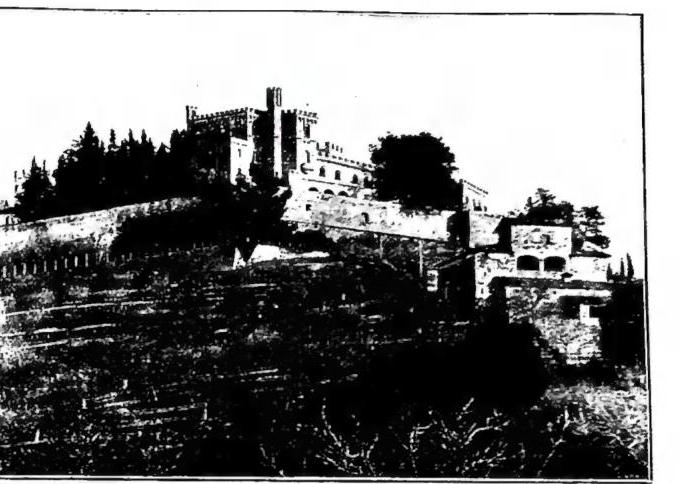
(fot. Alinari)
The RICASOLI FAMILY - Castle of the Barons R., since 1141. Rebuilt in 1484 - Brolio (Chianti).
After the death of his wife Anna Bonaccorsi (1852), he returned to agricultural-industrial enterprises, particularly in Maremma. In 1855, he openly professed his faith in the unity of Italy under the House of Savoy. With a national vision, he collaborated with the Committee of the Civil Library of the Italian (1857-59), but on the eve of April 27, 1859, fearing a demagogic revolution, he participated in the last-ditch attempts by the moderate group to salvage the Lorraine dynasty. Once the regime fell, he became Minister of the Interior in May and, with imperious will, strove to overcome his colleagues' hesitations regarding the union of Tuscany with Piedmont. Having assumed the direction of the government after Villafranca, he did not alter his policy and thus achieved the desired union with the plebiscite of March 1860.
After Cavour's death, he became Prime Minister and, in addition to addressing administrative reform in a centralizing sense, attempted to resolve the Roman Question. The King's antipathy for Ricasoli's moral rigorism and the anticlerical spirit of the time contributed to creating an atmosphere of distrust around him. He resigned in 1862. Returning to power again in 1866, he anxiously followed the unfortunate war campaign, then resumed negotiations on the Roman Question, deluding himself that solving the problem would spark a regenerative movement within the Catholic Church. Having failed once more, he definitively resigned in 1867.