
SEVEN SLEEPERS, saints. — According to the most widespread legend, a group of young Christians (their number varies from three to eight), during the persecution of Decius (249–51), took refuge in a cave near Ephesus. When their hiding place was discovered, the Emperor ordered that they be walled in alive.
Under circumstances that are not clearly defined, they awoke and, still fearful of the persecution, sent one of their number into the city to buy food. It was then that the miraculous fact of their sleep, which had lasted three centuries, was discovered.
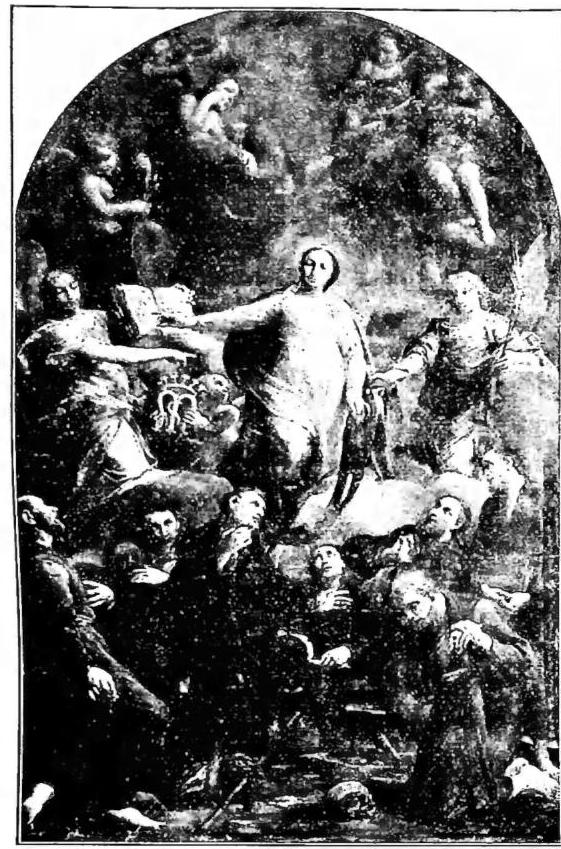
The earliest Eastern literary testimony to this legend is found in a Syriac text of the 5th century cited by Dionysius of Tell Maḥrè and James of Sèrg (d. 521), who reworked the legend poetically. In the West, the cult of the Seven Sleepers had already reached Gaul in the 6th century. Gregory of Tours (538–94) knew the legend in two forms (cf. MGH, Script. rer. Merov., I, pp. 550–52 [Glor. mart., 94], 848–52 [the Passio]). Over their cave in Ephesus, Theodosius II (408–50) is said to have had a basilica erected.
No one, apart from some devout hagiographers, defends the historicity of the account. The pious romance of the Seven Sleepers gradually passed from the sphere of literature into that of the liturgy; nevertheless, their cult, in its origin, “is not the continuation of a religious fact belonging to Greek polytheism” (cf. H. Delehaye, op. cit. in bibliography, p. 177 ff.). The Seven Sleepers Maximian, Malchus, Martinian, Dionysius, John, Serapion, and Constantine are commemorated in the Roman Martyrology on 27 July. Basil’s Menologion commemorates them on 23 October, but instead of Malchus and Serapion it has Iamblichus and Antoninus.
The Qur’an (sūrah 18, 8 ff.) and the ḥadīṯ (= tradition) designate the Sleepers by the terms: aḥl al-ḥahf, aṣḥāb al-ḥahf, that is, “the men of the cave.” Their legend is used to prove the truth of the resurrection of the flesh, as in Christian doctrine. This sūrah is recited every Friday in the mosque. An ancient tradition teaches that this weekly recitation repairs the breaches made in the wall of Gog and Magog (cf. Cor. 18, 93; 21, 96) by the barbarian hordes bearing those names, whose invasion is to bring about the end of the world. This is an eschatological event of which the rest of the sūrah sets forth the precursors, and whose day the prayer of believers must avert. An ancient ḥadīṯ of Muḥammad b. Ḥālid of Ḥuttal, a disciple of Ku-
ṭajjir b. Ḥišām (d. 822), whose isnād (= chain of an oral tradition) is said to reach back to the qārī (= reader, or rather reciter of the Qur’an) Nāfiʿ of Medina, says that “whoever recites the sūrah of the Seven Sleepers on Friday, a radiance extends from his feet to the celestial horizon, causing him to shine on the Day of Judgment, and his sins committed between the two Fridays will be forgiven.”
The legend had already reached Nubia in the 8th century. The war fleet of the Turkish Empire was dedicated to the Seven Sleepers. Drawings exist representing them both in miniatures and on boats and sails, where their names are written.
In Ephesus, the cemetery of the Seven Sleepers has been discovered (v. ENOCH. Catt., V, cols. 124–25). In Rome, M. Armellini discovered, on the left side of the Appian Way, a little beyond S. Cesario, an oratory dedicated to the archangel Gabriel and the Seven Sleepers, with 11th–12th-century frescoes offered by Maria and Beno de Rapiza (M. Armellini, Seoperta di un antico oratorio presso la Via Appia dedicato all'arcangelo Gabriele ed ai S. d., Roma 1874; id., Le Chiese di Roma dal sec. IV al XIX, new ed. edited by C. Cecchelli, Roma 1942, pp. 732–33). — Vedi tav. XXIII.