
ZUCCARI, TADDEO and FEDERICO – Painters. TADDEO, born in S. Angelo in Vado near Urbino on 1 September 1529, died in Rome on 1 September 1566.
His first teachers were his father and Pompeo da Fano. From 1543 he worked in Rome under Francesco da Sant'Agnolo. His most famous work is the decoration of the Palazzo Farnese at Caprarola, which derives from the decorative schemes of the Palazzo Farnese in Rome, where T. worked with Francesco Salviati. At Caprarola, among other works, noteworthy is the composition depicting the Council of Trent, which has very clear references to Raffaello’s Disputa del Sacramento. Raffaelloism, in fact, dominates the artist’s work during this first period.
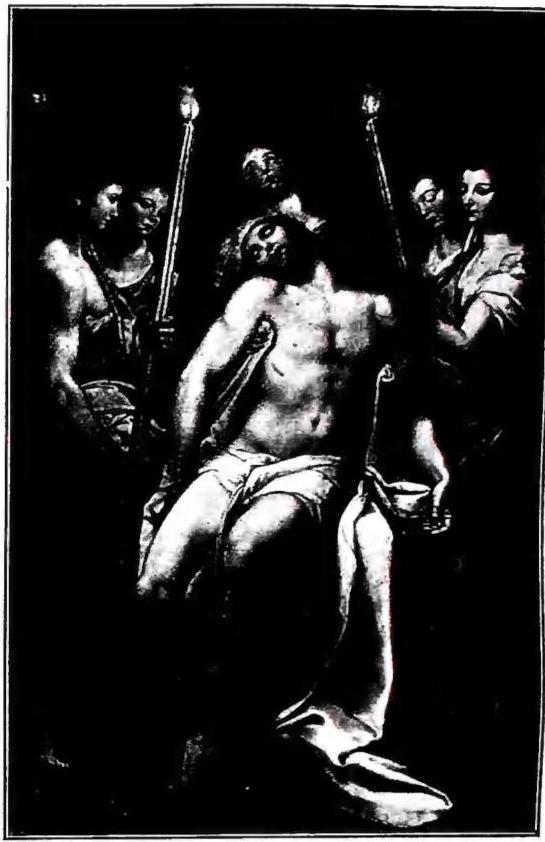
More recent criticism, however, places greater emphasis on the decoration of the Villa di papa Giulio in Rome, on account of the acute sensitivity to landscape and colour displayed there by the painter. In the final years of his life T. painted in the Vatican, in the Logge and subsequently in the Sala Regia, scenes depicting the Donation of Charlemagne and the Battle of Tunis. This is the period in which his manner visibly approaches Michelangelo, as is also clearly demonstrated by the panel with the Dead Christ Supported by Five Angels in the Galleria Borghese in Rome. Taddeo painted very extensively and in his own time enjoyed a good reputation for the ease and fluency with which he reproduced both Raffaello’s rhythms and Michelangelo’s movement of the figures and draughtsmanship, and even the colourism of the Venetians. His painting, however, remained essentially decorative and attached to a certain taste for skillfully blending the various tendencies, which was termed «zuccaresca».
His brother FEDERICO painted even more than he did; he was born in Sant'Angelo in Vado between 1542 and 1543 and died at Ancona in 1609. He began painting in Rome under his brother. He soon became renowned and began working independently in the house of Tizio da Spoleto at S. Eustachio. After receiving commissions in the Vatican for the Sala Regia, he was entrusted with completing the Giudicio begun by Vasari in the dome of S. Maria del Fiore in Florence, a work he completed in 1579. In Florence, in the Galleria degli Uffizi, there is a rich collection of his drawings. He also painted in Venice, in the Sala del Maggior Consiglio, the Barbarossa
(int. Annari)
Then, increasingly embittered, he withdrew from Rome; at Ancona he wrote: L'idea dei pittori, scultori ed architetti, La Dimora in Roma and Il passaggio per l'Italia. Federico’s paintings, which are even more closely tied to academic forms than those of his brother, nevertheless differ from them through a broader eclecticism, greater chromatic richness and, above all, a pronounced proximity to correggismo.