
EMIGRANT, EMIGRATION. - In its proper meaning, it is the abandonment of national territory by one or more members of the community, who transfer to another territory with the intention of establishing their domicile there permanently or temporarily. As such, it presupposes a point of departure—the soil of the nation of origin; a point of arrival—the territory outside the natural or political borders of the homeland; and several individuals who move from one to the other, taking the name of emigrants with respect to the former, and immigrants with respect to the latter. In a somewhat restricted and less proper sense, the term emigration is also applied to population displacements occurring within the territory of the same political society. If, however, it is considered in its entirety as a characteristic phenomenon of the demography of the civilized world in the past and present centuries, emigration is that vast demographic movement composed of individuals and families who, driven by private initiative and under personal responsibility, pass from one civilized and advanced country to another, usually sparsely populated.
These distinctive features sharply separate it from forms of mass migrations that occurred in history, such as ancient barbarian invasions, in which an entire people, driven by the thirst for conquest and the desire for new lands, marched as a unit under an embryonic political regime to conquer them, subjugating the populations they encountered along the way and often laying waste to the surrounding areas. The modern emigration lacks the individualistic and peaceful character of contemporary migration. Furthermore, for the same reason, neither forced population exchanges—imposed in some cases by bilateral treaties between two states seeking to resolve the issue of their respective ethnic minorities—nor the expulsion of significant portions of inhabitants from certain territories, which occurred during the First World War and, to a greater extent, during and after the Second, can be assimilated to II. Emigration is a free and spontaneous movement.
It may be internal, continental, or extra-continental/transoceanic, depending on the destination country toward which the migratory flow is directed; it may be temporary or permanent, depending on the intended duration of the expatriation. It is internal if the migratory flow moves from one region to another within the borders of the state; continental if the destination country remains within the European continent; transoceanic if the
(from J. Lefion, Monsieur E., Paris 1869, p. 261)
JACQUES-ANDRÉ EMERY - Letter written to his confrere Montezignè in April 1703, before appearing before the revolutionary tribunal - Paris, Library of the Seminary of Saint-Sulpice.

I. HISTORY
Contemporary emigration begins with the early 19th century and gradually increases in intensity until it reaches, toward its end and the beginning of the new century, extremely high percentages that find no parallel in any preceding period of history. This constitutes a true exodus of thousands and thousands of individuals and families who, for various reasons, abandon old Europe to relocate to the new continent in search of freedom or better living conditions. For the early years of the 19th century, statistics are lacking to measure the human mass conveyed and swept away by the migratory flow. Statistics, initiated by the United States in 1820, though imperfect and insufficient, can provide an idea of the number and origin of emigrants from 1820 to 1850. During this period, 2,199,000 individuals arrived in the United States, the majority coming from European countries, among which the British Isles and Germany prevailed, followed by France and the Scandinavian states with a significant gap.By the mid-19th century, statistics provided by the countries of origin of emigrants, now sufficiently improved, allow us to establish that, in the five-year period 1846-50, an average of 256,000 people left Europe each year. The preferred destination, given the origin of most emigrants and their linguistic and cultural affinity with the populations overseas, was the United States. Emigration to South and Central America, however, remained scarce during the same period, where settlers lacked security, poorly protected from indigenous raids, good and easy accessibility, and certainty of property titles, along with other political, moral, and religious obstacles; emigration to Asia and Africa was negligible.
In the second half of the 19th century, the migratory flow intensifies, reaching an average of 321,000 annual departures in the five-year period 1851-53. The British Isles, particularly Ireland due to religious oppression and a severe economic crisis, still held the majority. The German flow proved more sustained, reaching a quarter of all departures in the five-year period 1856-60. At the same time, the exodus from Mediterranean countries begins, especially from Portugal and Italy, whose quotas increased year by year with a frightening progressive momentum. Spain participated to a minor extent, while France’s contribution diminished. In the following five-year periods, quotas oscillated between 229,000 and 346,000 annual departures, with a more notable participation from the Scandinavian states and Italy, whose contribution reached 5% of the total. The pace of migrations, after a temporary decline, accelerates again around 1880 and the following years. Irish emigration resumes with an average of 80,000 annual departures, that of Great Britain, excluding Ireland, reaches its peak with 320,000 departures in 1885, the German flow rises again with over 200,000 departures in 1882, and the Italian quota takes a fairly high place with its 200,000 departures in 1888.
In the last decade of the 19th century, European emigration as a whole tends to lose momentum, oscillating between an average of 729,000 departures in the first five-year period and 602,000 in the second, while Italian emigration becomes increasingly sustained with 27.5% and Spanish with 13.4%, and that of Great Britain and Germany declines considerably. In the early years of the 20th century, the tide rises to reach one million annual departures, to which Italy contributes 30.5% of all European emigration, and continues to rise in the period immediately preceding the First World War, reaching the very high peaks of 1,389,000 annual departures on average, with a slight decline caused by the difficulties created by the war during its course. In this last period, Great Britain sustained a population outflow ranging from 453,000 in 1911 to 370,000 in 1913, and was surpassed by Italy, which channeled approximately half a million of its people abroad each year through emigration, recording the highest number of departures compared to any other country from the beginning of the movement until the outbreak of the First World War.
The destination countries of this immense population flow, rapidly shifting from one continent to another, besides the United States, which held the first place in emigrants' preferences, were Canada, New Zealand, the Union of South Africa, and the states of Latin America, particularly Argentina and Brazil, toward which a significant portion of Italian emigration was directed, with a preference for Argentina over Brazil. The phase described so far can be defined as one of perfect individual freedom. The outflow of population, the channels it followed, and the choice of destination countries were left to the spontaneous interplay of natural forces of propulsion and attraction. In the old European countries, no one opposed the continuous outflow of surplus labor forces, whose subsistence was difficult to provide with internal resources; in the new, sparsely populated countries, there were still no interests that opposed their reception. Both considered the migratory movement as a suitable means to solve their problems; the former willingly rid themselves of people who were a source of concern because they were dissatisfied with their condition; the latter saw in European emigration the contribution of new forces capable of enabling their ascent toward prosperity and economic and political autonomy.

To approximately measure the grandeur and importance of the migratory phenomenon, the following figures may serve as an indication. Between 1826 and 1932, according to statistics from emigration countries, between 53 and 59 million people would have left their respective homelands. If to these already imposing figures one adds the probable figures for the period between 1820 and 1845 and, with somewhat greater precision, those from 1932 to 1938, one will not be far from reality in asserting that, throughout the 19th century and part of the 20th until the Second World War, the migratory movement channeled a total of approximately 80 million people in its broad flow, at an average rate of 600,000 or 700,000 per year. No period of mass migration can compare to that of the contemporary era.
(from P. A. Appiani, Vita di S. Emilia, Jeroli 1858)
EMIDIO, saint, martyr - Copper engraving.
If one were now to seek the causes that have produced such a massive displacement of population, it would not be easy to identify them with precision in each instance. Religious persecutions, the desire for freedom, population density and precarious living conditions in certain countries, the mirage of easy earnings, the longing to possibly improve one’s social and economic position, pressing work necessities, propaganda organized by large companies, news received from those who had already made their fortune, and so on—these have variously influenced minds, prompting them to sever ties with their homeland and family and to embark on the uncertain paths of fortune. Attributing the vastness of this movement to one cause or another, as would be the case if one viewed it solely through the lens of economic hardship caused by population density, leads to conclusions that are often contradicted by a more careful analysis of the facts.
II. MORAL AND JURIDICAL ASPECT
The right to emigrate, in order to seek a new domicile by breaking the juridical bond that ties man to the society in which he was born, has been discussed since the dawn of modern international law. Even before Grotius addressed the subject and Vattel later devoted greater attention to it, Vitoria had established certain principles and provided a general solution to the problem. According to Vitoria, the earth with its goods was destined for the service of the human race, so that all men possess the primordial right to make use of them for their own sustenance and perfection. The division of property does not destroy this essential destination of the earth's natural resources, and therefore, if they are not exploited by the people who possess them, any man, even if belonging to another political society, may occupy them to ensure they fulfill their purpose, provided his action does not harm the society to which the territory belongs. This conclusion is reinforced by an appeal to the principle of equality. If a society allows foreigners to search for valuable things within its jurisdiction, it cannot exclude others from enjoying the same concession without a reason grounded in the requirements of the common good. Furthermore, natural law dictates the precept of common solidarity and imposes the necessity of exchange among different peoples; thus, man may establish his domicile in any part of the earth to weave relations of collaboration with other peoples, in whose territory he has the right to reside or transit freely, if this does not cause harm to others. Vitoria's thesis is, therefore, moderately liberalist, as it affirms the human right to emigrate while considering the common good of the immigration country, which may limit the recognized right. The principles he established have become part of Catholic doctrine.Currently, three solutions prevail: two extreme and one intermediate. The extreme solutions derive, respectively, from the excessive cult of liberty, characteristic of the liberal conception, or from theories that lean more or less toward the absolutism of state power and take various forms while maintaining the principle of unlimited sovereignty. The liberal thesis holds that the right to emigrate is nothing but a manifestation of human freedom, directed toward the choice of a domicile more suitable to the interested person, and since individual autonomy is a sacred and inviolable right, the citizen has the faculty to emigrate at his discretion. Consequently, society would have no power to suppress or limit it, except in cases of true emergency. Theories that draw more or less from the concept of absolute state power, starting from the principle that the individual possesses no personal right except those granted by public authority, deny the right to emigrate and attribute to the state a discretionary power to prevent its exercise. Organic, racist, or nationalist conceptions contribute to reinforcing this stance, as they see the bond tying man to his land of origin and to his political and national society as a physical bond.
The third solution, which has become the most common among internationalists, aligns with the opinion expressed by Vitoria. It recognizes man's natural right to emigrate but subordinates its exercise to the common good of the two societies involved, tempering the powers of the state with the limits imposed by the rights of the human person and the individual's freedom with the restrictions required by the collective good. This is the solution embraced by Catholic doctrine. Among the fundamental rights of man is that of personal freedom. The faculty to emigrate is the exercise of this right, aimed at choosing a new domicile or a new field of activity deemed more suitable to life's needs; the state cannot, therefore, intervene to suppress or arbitrarily reduce II. Moreover, the bond that connects man to a particular political aggregate, including the one in which he was born, is not physical but essentially a moral relation, which he may break when necessity or convenience advises II. His right is further strengthened by the character of social life as a means toward the prevailing ends of life. If man cannot do without inserting himself into a social organism, for outside of it he could neither live nor progress, this final necessity does not irrevocably bind him to the stock from which he proceeds, as he may achieve the same purpose—and more securely—in another collective body. He may, therefore, seek under other skies and among foreign nations the means to fulfill the end of his existence.
It follows that the state, by virtue of its sovereign right, does not possess the faculty to absolutely oppose emigration. However, the exercise of this right by the citizen finds natural restrictions in the collective good, whose care is entrusted to the supreme power of the state, which may impose conditions through its laws—as it does for any exercise of personal freedom in the social sphere—so that the emigratory outflow does not prejudice the general interests of the community. The country of origin consequently has the right to subordinate emigration to the prior fulfillment of certain social obligations, such as military service, for example, and may adopt more rigorous measures in cases of necessity, such as the imminence of conflict, or to curb an exodus of the population that, due to its scale, would harm the efficiency of its own life. The more universal interest of the social body then prevails over the interest and right of the individual who wishes to expatriate.
Determining the obligations of the country of immigration proves somewhat more challenging, as it has no positive legal duties toward the immigrant, who does not belong to its social fabric. Nevertheless, if one considers the principle established by Vitoria regarding the essential destination of the earth's goods for the service of mankind, the State has no right to regard its subjects as the exclusive beneficiaries of its territory's resources and to reserve their enjoyment solely for them. Therefore, if it possesses available space where idle natural resources could be developed by the labor of other hands, it has a strict duty of justice to permit these to settle there and derive their means of subsistence. Nonetheless, even in this regard, one must not lose sight of the other principle laid down by the same Vitoria concerning the proper protection of the common good. Thus, it must be admitted that even the country of immigration has the faculty to impose restrictions on the arrival of foreigners, subjecting entry into its territory to particular conditions, so that their influx does not prejudice public order and security. Such restrictions, however, must always be founded on a real exigency of the common good and not dictated by national egoism or other ethnic prejudices. Undoubtedly, not all varieties of the human species can blend with one another without giving rise to serious inconveniences in the moral and social order. By paying attention to the greater or lesser assimilability of human stocks, a State may establish discriminations; these, however, cannot reach the point of condemning entire populations to a life of misery, since every man has the right to derive from the earth the means of subsistence, regardless of the group to which he belongs. Certain restrictive laws existing in some immigration countries, such as, for example, in the United States, must be considered unjust, not because they establish quotas—legitimate under certain circumstances—but because the quota system tends to exclude peoples most in need of relieving their demographic surplus, for unfounded reasons or religious antagonism.
The working conditions of the emigrant in the country of adoption are subject to the general moral and legal laws governing this matter (v. LAVORO). However, mention must be made of a particular aspect highlighted by Pius XII in his radio message of June 1, 1941. Commemorating the fiftieth anniversary of Rerum Novarum, the Pope noted how there exist regions abandoned to the capricious vegetative growth of nature, where labor could usefully be transferred, and how it is often inevitable that some families, by emigrating, seek a new homeland elsewhere. In such cases, the right of the family to a living space must be respected. "Where this occurs," he adds, "emigration will achieve its natural purpose, which experience often confirms, namely, the more favorable distribution of men over the earth's surface, suited to a colony of farmers; a surface that God created and prepared for the use of all."
A brief mention is also deserved in this moral and juridical section regarding the assimilation and naturalization of the immigrant. While it must be affirmed that the host State has the right to work toward the gradual absorption of the foreigner settled in its territory into its social and political fabric, so as to achieve amalgamation with the native populations and ensure unity, it must also be categorically excluded that this process may be forced by oppressive measures. Assimilation should rather be left to the spontaneous interplay of man's natural virtues, which sooner or later produce the associative effect, if prudently aided by the stimulating action of public authority. Naturalization, on the other hand, with the acquisition of new citizenship, being a voluntary act of the individual by which he spiritually adheres to the new political aggregate, can never be imposed by coercive means. Legislations in this regard are not uniform, some being inspired by the ius soli, like that of the United States, others by the ius sanguinis, and still others by a mixed system. It would be desirable to achieve a certain uniformity in this matter to avoid the serious inconvenience of dual citizenship.
The immigrant, whether naturalized or not, enjoys, even within the country that has welcomed him, the right to use his original language within his family and among his compatriots and to freely profess his own religion in places of worship chosen according to his personal preferences. These are universal human rights, commonly recognized even by positive international law for ethnic minorities, which cannot in any way be denied to those who have emigrated, nor can the argument that they delay assimilation hold any value against them.
III. SOCIAL EVALUATION
Judgments on the social value of emigration prove discordant due to the different perspectives from which it is considered and the emphasis placed on certain elements to the exclusion of others, which nonetheless cannot be overlooked in an objective evaluation of the phenomenon.Opponents of emigration, generally of a nationalistic tendency, dwell particularly on the evils it inflicts upon the country. First and foremost, emigration entails the loss of a precious force for the nation, which, if retained within the borders of the homeland, could strengthen its efficiency. The emigrant is lost forever, not only as a numerical element but as a man endowed with intelligence, will, and physical and spiritual industriousness, and with him is lost his progeny, who, born in a foreign land, retains only a faint memory of the homeland of origin. Furthermore, emigration typically carries away the most gifted individuals, in the full vigor of their strength and at the peak of their productivity, who will expend their efforts in foreign lands without any direct benefit accruing to the nation to which they owe their birth, sustenance, and education. The remittances they send do not compensate for the expenses incurred in their upbringing, education, and intellectual and professional formation. It is also inaccurate to claim that emigration expands national culture or purifies the social organism of dangerous toxins by freeing it of its less desirable individuals. In reality, the emigrant, particularly in the second generation, is fully absorbed into the culture of the adoptive country, and only through further expenditure can the country of origin keep alive the flame of its own culture by establishing and maintaining schools and institutions for their assistance. Moreover, as statistics can demonstrate, emigration, far from purifying the social organism, deprives it of its youngest, most active, and most daring members. Those who venture toward an often unknown future are not the weak, the sick, the incapable, or the intellectually and physically impaired. Emigration, therefore, operates a reverse selection, carrying away the capable individuals and leaving behind the unfit. To the aforementioned drawbacks is added its inadequacy in resolving the internal problem of excessive population density in relation to the resources of the land, since a prolific people, despite migratory outflow, will always face the same scarcity of materials and the same demographic imbalance. It is also necessary to consider that emigration often disrupts family life, separating the father from it for long periods, who is not always able to reconstitute domestic unity. Emphasizing these and other reasons derived from national prestige, emigration is judged as a social evil that may be accepted out of dire necessity but cannot be approved as an ordinary means of resolving a nation’s problems of livelihood.
At the opposite pole stand its advocates, in whose favor the arguments previously mentioned, based on man’s freedom to choose his dwelling on earth as he deems most suitable for satisfying his needs, hold sway. It cannot be denied, however, that a portion of truth is contained in the opponents’ reasons, regarding which it must be generally noted that numbers constitute strength only when they can be usefully employed in productive labor; when, instead, they are condemned to inactivity due to the lack of opportunity to employ their energies—a situation to which the country’s economic conditions offer no remedy—they do not represent a value but a burden, which can become a source of discomfort for all, lowering the standard of living and giving rise to restless movements among the dissatisfied masses. The calculations in figures of the economic losses suffered by the country of departure betray a mercantilist mentality. Even from an economic standpoint, moreover, man counts or is valued not for what he costs but for what he is useful for, that is, for what he can produce under certain conditions. If, therefore, in a nation there is a surplus of men relative to demand, such a surplus will not constitute an economic good as long as those conditions persist. In the overall calculation of the advantages and disadvantages of emigration, perhaps the former prevail over the latter. After so many years of experience, the conclusions reached by the International Congress of Public Charity, held in Brussels in 1856, may still be considered broadly valid, according to which: 1) the growth of the population cannot and must not be hindered by legal provisions; 2) the evils of pauperism due to population growth can be effectively, albeit indirectly, mitigated through emigration; 3) consequently, emigrants must be granted full freedom and every possible protection; 4) governments, associations, and private individuals must combine their efforts to derive from emigration all the benefits it can yield.
The positive evaluation becomes somewhat uncertain when emigration is considered in its moral repercussions, since it is undeniable that transplantation into another environment often proves fatal for those who attempt it, nor can it be denied that the departure, especially of the head of the family, can disorganize and overwhelm the family unit. There also exists a sad experience regarding the easy acquisition of new habits, vices, and diseases to which the emigrant’s place of origin was immune. Having weighed the pros and cons, all considerations advise great caution in pronouncing on the social and moral value of emigration.
IV. INTERNATIONAL ASPECT
More than in past times, when a regime of the broadest freedom prevailed, particularly after the First World War and even more so after the Second, emigration has become an international problem that can only be resolved through collective measures. These measures should establish an organic plan for the appropriate distribution of the population across the earth and regulate migratory flows, directing them toward those outlets where there is a need for labor. The changed economic conditions of countries, the increased demands of workers who also abroad claim fair treatment, and the ever-growing regulation of production by the State now prevent mass free emigration and permit only qualified emigration according to the needs of the local economy. On the other hand, the endemic state of hardship in which some overpopulated nations find themselves in relation to employment opportunities creates not only an internal but also an international problem, in whose solution all nations are interested. This is to prevent demographic pressure, with its consequent pauperism, from becoming a bad counselor and pushing toward violent expansion. It is necessary to find an outlet for these dissatisfied masses, mitigating as much as possible the need to emigrate while simultaneously increasing immigration opportunities. This cannot be achieved without collective collaboration.The international character of emigration also results from the close economic interdependence of nations, determined by the unequal distribution of wealth. In the economic sphere, nations cannot live in isolation but depend on one another and complement each other. Those better endowed with resources and sources of raw materials cannot disregard others with depressed economies, which they must assist in raising the common standard of living—a goal often unattainable without a regulated outflow of their demographic surplus. Moreover, the other aspects of emigration are no less international, such as social protectionism, equal treatment between nationals and foreigners, citizenship, and racial and national discrimination. Each of these presents a practical problem in whose solution both immigration and emigration countries have an equal interest. The intimate connection with other international phenomena, such as the circulation of capital and goods, further extends the need for collective regulation, through which the problem may be addressed globally.
Attempts to follow this path have not been lacking, but they have remained fruitless. The lack of a felt international solidarity, the absence of awareness of the interdependence among various economies, the failure to recognize the need to consider and resolve the question of emigration in all its aspects, and exaggerated nationalism have prevented appreciable results from being achieved on the international plane. The only official international body that has carried out positive work, including in the field of emigration, has been the International Labour Organization. It has promoted the conclusion of numerous international conventions with provisions for the protection of the economic, sanitary, and moral interests of emigrants. Additionally, subordinately to the struggle for the prevention and repression of unemployment, it has addressed the international placement of labor. This body survived the Second World War, emerging even strengthened thanks to its excellent structure, and may, in collaboration with the United Nations, still be useful for the effective coordination of efforts aimed at the pacification of nations—a goal largely dependent on the solution given to the problem of emigration.
V. RELIGIOUS ASSISTANCE TO EMIGRANTS
The phenomenon of emigration created, alongside other problems, that of religious assistance to emigrants in the last century. The first emigrants, transferred from regions where religious life was intense to regions that had only recently ceased to be mission territories or were Protestant monopolies, lacking adequate instruction, far from the local clergy by whom they were often not understood, grappling with poverty, exploitation, and the desire to enrich themselves, often ended up falling into the hands of Protestants or, more frequently, into religious indifference or practical atheism. It was the direct or indirect experience of these painful facts that moved some great souls in the last century to organize the apostolate for emigrants and Italian emigrés.The movement is primarily linked to three names: G. B. Scalabrini, Geremia Bonomelli, and St. Francesca Cabrini, as well as various male and female religious congregations, some of which were founded with this specific purpose.
In 1883, a papal letter was addressed to the archbishops of Naples, Genoa, and Palermo for the assistance of emigrants in the ports of embarkation. Committees were established, but little was achieved. The first to take effective interest in the religious assistance of emigrants was the Servant of God Mons. G. B. Scalabrini, bishop of Piacenza. At the behest of the Sacred Congregation de Propaganda Fide, to which he had presented the problem, he drafted a project that Leo XIII approved on 26 June 1887. Part of this project was what later became known as the Pious Society of St. Charles Missionaries for the Assistance of Italian Emigrés (28 November 1887), later also called Scalabrinians.
A year later, he invited Mother Cabrini to send her religious sisters to America for the assistance of emigrants, instead of to China, and on 19 May, he himself presented the Crucifix to the foundress and the first sisters departing. The same invitation was extended in 1900 to Mother Clelia Merloni, foundress of the Missionary Sisters Zealots of the Sacred Heart, and in October of the same year, a first group of these sisters left for São Paulo (Brazil). He later founded a congregation of Missionary Sisters—divided into two branches—with the same purpose as his missionaries (Scalabrinian Sisters).
Another apostle of assistance to Italian emigrants was the bishop of Cremona, Mons. G. Bonomelli, a great friend of Scalabrini. He addressed the issue of emigration in his 1896 pastoral letter, L'emigrazione. In January 1900, he also sent an appeal on the subject to the National Association for Aid to Italian Missionaries (founded by Senator Schiaparelli).
At that time, the Opera di assistenza degli emigrati italiani arose for their material and spiritual assistance in the places where they went to work, of which 20 secretariats were functioning in 1901. It developed until after the 1914-18 war under the direction of the priests of the Opera Bonomelli, who in 1914 began publishing their own periodical, La Patria. The Opera was dissolved in 1928.
With an identical religious and patriotic purpose, the Italica Gens was established, promoted in 1909 by the National Association for Italian Missionaries, which opened secretariats in Italy, the Levant, and America, and provided subsidies to other similar institutions.
Outside of the proper congregations, priests were sent directly from Italy to the regions of Europe and overseas inhabited by groups of Italians. For this purpose, a College of Priests for Italian Emigration was founded in Rome on 13 March 1914 and opened on 6 January 1920. By then, the Sacred Consistorial Congregation,
under which Pius X, with a nota proprio of 15 August 1912, had established a special section for the spiritual care of emigrants (AAS, 4 [1912], pp. 526-27), had already, with the decree Magna semper of 30 December 1918 (AAS, 11 [1919], pp. 39-43), reserved to itself all matters concerning the religious assistance of emigrants, along with the entire movement of priests who, for any reason, intended to emigrate, even temporarily, from Europe to America or the Philippine Islands. The same Congregation appointed a prelate for Italian emigration, who would maintain relations especially with Italian authorities, also naming him rector of the aforementioned College (Notification of the Sacred Consistorial Congregation, 23 October 1920 and 26 May 1921).
BIBL.:
G. B. Scalabrini, L'emigrazione degli operai italiani, Piacenza 1887; Id., L'emigrazione italiana in America, Piacenza 1899; G. Bonomelli, L'emigrazione, Cremona 1896; A. Gemelli, L'assistenza religiosa agli emigranti, Milano 1920; G. Rossini, L'opera di mons. Scalabrini per gli emigrati, Roma 1942; A. Perotti, La Congregazione Scalabriniana, Roma 1947; Atti e documenti della S. Congregazione Concistoriale riguardanti l'emigrazione, Roma 1920-1921; La Civiltà Cattolica, 1900-1920 (passim). - G. D.
VI. CURRENT STATE
The Sacred Consistorial Congregation (Section for Emigration) oversees and directs every particular activity aimed at assisting emigrants in general, and, in a special way, Italian emigrants. Therefore, all religious congregations and priests engaged in the assistance of emigrants report to this Congregation.The Pious Society of the Missionaries of St. Charles, the congregation most specifically dedicated to this type of apostolate, has been under the high direction of the same Sacred Consistorial Congregation since 1926. It comprises 87 houses, of which 39 are in the northern United States and 27 residences in Brazil with churches, schools, and colleges; in these regions, their ministry is carried out among Italian communities already integrated into the communities of their respective nations (Italo-Americans).
Recently, they have opened houses in three Argentine dioceses. Furthermore, their apostolate is realized in the assistance of Italian emigrants, in the strict sense of the word, both during the journey and upon arrival, as well as during their temporary stay abroad. If the stay becomes permanent, the problem of integration into the Catholic life of the country then arises. For 14 years, they have extended their ministry to neighboring European nations (6 residences in France, 3 in Belgium, and 3 in Switzerland). Other male and female religious congregations collaborate in the assistance of emigrants, particularly the Franciscans, Minors and Capuchins, the Jesuits, the Salesians, the Society of Catholic Apostolate, the Oblates of Mary Immaculate, the Guanellians, the Company of St. Paul; among the female congregations, the Missionaries of the Sacred Heart of Jesus (of Cabrini), the Missionary Sisters Zealots of the Sacred Heart, the Daughters of Charity, the Poor Sisters of Palazzolo, the Precious Sisters of Monza, the Sisters of St. Joseph, and the Salesian Sisters.
In addition to religious men and women, other secular clergy priests work among emigrants, directly dependent on the Sacred Consistorial Congregation. These are subject to a superior for each nation or group of nations, appointed by the same Congregation.
Religious assistance, specific to emigrants, must somewhat follow the more or less rapid course of the emigrant's assimilation into the host country and naturally follows different directions depending on whether the emigration is temporary or permanent. Where assimilation is rapid and emigration is permanent, the only means to ensure spiritual assistance is to proportionally increase the number of priests, bringing them from the countries of origin. This is what has been and is being done. In Argentina, there are already about thirty Italian priests who have gone to the dioceses of Buenos Aires, La Plata, Rosario, Mercedes, Santa Fe, Bahia Blanca, Mendoza, Tucumán, and Catamarca.
When true colonization of large uncultivated territories is carried out, the criterion is instead to have emigrant groups followed by a priest of the same nationality. This has been done in Argentina and Venezuela.
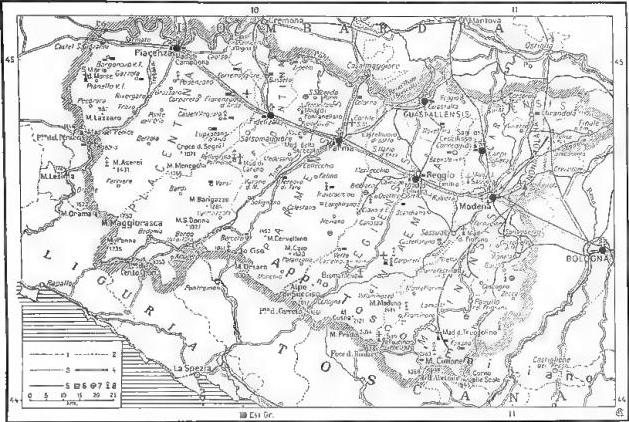
EMILIA - Conciliar region of Emilia: 1) Regional boundaries; 2) Provincial boundaries; 3) Ecclesiastical district boundaries; 4) Roads; 5) Railways; 6) Abbeys; 7) Provostries; 8) Oratories.
In 1948, there were 13 such missionaries in Belgium, 28 in France, 18 in Switzerland, 1 in Sweden, 2 in Luxembourg, 1 in the Netherlands, 2 in England, and 1 in Romania, not counting religious transferred from one country to another by their respective superiors. Recently, for example, a group of Italian Capuchins moved from the United States to Australia to assist Italian emigrants.
In their work in France and Belgium, Italian missionaries are assisted by local Ordinaries and by the ACLI (v.) and ONARMO (v.) organizations. In France, an Episcopal Commission was established for this purpose, presided over by the Archbishop of Sens. In Belgium, each bishop has appointed his own delegate for immigrants; these delegates also report to a national delegate, who coordinates various initiatives in agreement with the superior of the Missionaries.
The organ of the European missions consists of 8 local bulletins. Furthermore, since 1947, a special Migration Office has been operating within the Secretariat of State of His Holiness, dealing with stateless persons and Catholic initiatives arising in various nations in favor of emigrants.