
« RERUM NOVARUM ». — Encyclical de conditione opificum of Leo XIII dated 15 May 1891, known by these words with which it begins; it is the most popular of the modern social encyclicals.
Political problems posed by the events following the French Revolution, economic problems resulting from great capitalist industrialism, social problems emerging in many forms, doctrines of opposing orientation, from an extreme individualistic liberalism to an extreme collectivist socialism, engaged during the last century the attention of pastors of souls and Catholics in general, both ecclesiastical and lay, who were more sensitive to their duties toward their children and their brethren (to mention only a few names: Bishop von Ketteler, Cardinals Mermillod and Manning; Le Play, Périn, Lacordaire, Montalambert, Ozanam, Decurtins, Lorin, Pottier, Vogelsang, Hitze, Toniolo, etc.). Two currents took shape regarding the social question, one tending toward conservatism, the other toward reform, which was subsequently consolidated in « Christian democracy » (v.).
Leo XIII, who had already paved the way for a subsequent and decisive intervention through several encyclicals (such as those on the foundations of human society, the family and Marriage [Arcanum, 1880]; on the origin of civil authority [Diniturum, 1881], on the order of its relations with the Church [Immortale Dei, 1885]; on the principal duties of the Christian citizen [Sapientiae christianae, 1890]; against the errors of socialism [Quod apostolici muneris, 1878] and on the doctrine of human liberty [Libertas, 1888]), published the R. n. in 1891.
This deals expressly with the entire workers’ question, in order to bring fully into relief the principles by which, according to justice and equity, the question itself may be resolved—a question whose difficulty and danger the Pontiff does not conceal, and whose essence and causes he sets forth preliminarily. It then proceeds to criticize the socialist solution, rejecting it as harmful to the worker, inasmuch as it deprives him of his right to save, violates private property, which is a right of nature, distorts the natural competences of the family and the State concerning the support of offspring, and would lead to social disorder. Turning to the Catholic solution, it presents the threefold work of the Church, the State, and those directly concerned, through intermediate organizations. With regard to the Church, it sets forth the necessity and character of her intervention in the question, the moral doctrines taught concerning social relations, her moderating action upon individuals and society, and the charity exercised by her. As for the State, it emphasizes the necessity of its action, indicates its general duties (the pursuit of the common good with particular regard for the needy classes), and then its specific duties concerning the defense of private property, strikes, Sunday rest, the duration of work, especially with regard to women and children, a just wage, and workers’ savings and their corresponding investment in small properties. Finally, it insists upon the work of those directly concerned themselves,
the ancient and meritorious guilds of arts and trades are recalled, the right of association with its limitations is outlined, and the Christian corporative movement is sketched. « Let each one do the part that falls to him, and let there be no delay, since delay might make more difficult the treatment of an evil already so grave. Governments should apply themselves to this through good laws and wise measures; capitalists and employers should always keep their duties in mind; let the proletarians, who are directly concerned, do within the bounds of justice whatever they can; and since the true and radical remedy can come only from religion, let everyone be persuaded of the necessity of returning to Christian life, without which even the measures deemed most effective will be inadequate to the need ».
The magnificent and incisive picture traced by the great Pontiff remains ever living and relevant in its general outlines, because of the immortal doctrine it teaches. Developments and adaptations to changing social conditions have been introduced by subsequent manifestations of the Supreme Magisterium (v. ANNO) down to the reigning pontiff Pius XII (v.).
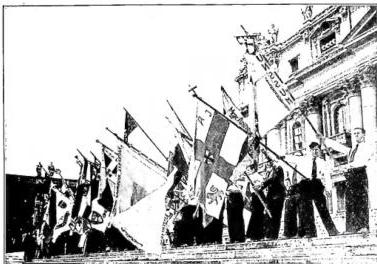
In truth, the encyclical R. n., while the maxims of liberalism—which had long obstructed the effective work of those governing—were wavering, moved the peoples themselves to promote social policy with greater sincerity and commitment, and induced the best among Catholics to lend their useful cooperation in this sphere to the powers of the State; thus they often distinguished themselves in legislative chambers as illustrious supporters of this new policy. Indeed, modern social laws themselves were not infrequently submitted for the vote of the nation’s representatives, and their implementation was demanded and advocated by ministers of the Church imbued with Leonine teachings. « Even if labor laws do not everywhere and in every respect accord with the norms of Leo XIII, it cannot nevertheless be denied that in many points an echo of the encyclical R. n. is heard, to which, therefore, a very considerable part of the improved condition of workers must be attributed » (cf. Quadragesimo anno : AAS, 23 [1931], pp. 185–86). Christian workers therefore rightly customarily commemorate 15 May as their feast day.