
PIERANTONI, LIVIA. — In religion Sister Agostina, born at Pozzaglia (Perugia) on 27 March 1864, died at Rome on 13 November 1894.
Having entered the Sisters of Charity in 1886, she was assigned to the Arciospedale di S. Spirito in Sassia, in charge of the tuberculosis ward, where she displayed admirable patience and charity toward everyone and where she wished to remain despite having contracted the disease and often being mistreated and reviled by some of those patients. One of them, convalescent but dismissed for misconduct, convinced that Sister Agostina had reported him, decided to take revenge; entering the hospital unseen, he lay in wait for his victim and struck her seven times with a dagger, until he pierced her heart. Sister Agostina was given an extraordinary funeral; but it was the beneficial memory of her virtues that led to the initiation of the beatification processes. Her cause was introduced in 1946.
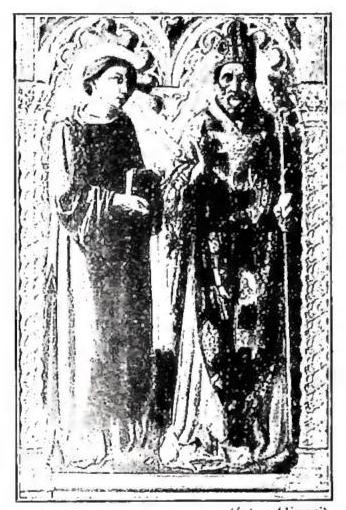
his beginning of studies (Op., 47: PL 145, 710-715 ccc.), which he began at Ravenna and then pursued more fully at Faenza and Parma (Op., 51, 13: ibid. 145, 762; Op., 45, 6: ibid. 145, 699-700).
Later he himself acquired a reputation as a teacher, but only for a short time, because he Fonte Avellana (v.) around the year 1035 (Ep. Agneti imp., cit.). His personality asserted itself within the small group of hermits who lived there; he was requested as a preacher by the abbey of Pomposa, the monastery of S. Vincenzo di Petra Pertusa, and others and, when he returned to his hermitage at Fonte Avellana, he was elected prior there around 1043 (Vita, 6-7: PL 144, 123-25).
This marked the beginning of the marvelous flourishing of this hermitage, which began to establish daughter houses in the Marches, Umbria, Romagna, and Abruzzo, and to give rise to a hermit Congregation inspired by Camaldolese spirituality, even though autonomous in itself (Ep., VI, 32: ibid. 144, 429; Op., 15, prol.: ibid. 145, 335).
Distressed by the ills of the Church, of which the most conspicuous were simony and the immorality of the clergy, he entered into relations with Gregory VI, the first pope to inspire hope for a reform (Ep., I, 1, 2: ibid. 144, 205-207). The injunctions of the emperor Henry III, who wanted him to collaborate with the German pope Clement II, overcame the final reluctance of his spirit, which longed only for contemplation and mysticism (Ep., 1, 3: ibid. 144, 207-208; Op., 19, 5: ibid. 145, 432); and his work on behalf of the Church assumed concrete forms under Leo IX (1049-54), during whose pontificate he wrote his two most famous treatises, the Gratissimus (Op., 6: PL 145, 99-156 and MGH, Libelli, I, ed. L. de Heinemann, Hannover 1891, pp. 15-75) and the Gomorrianus (Op. 7: PL 145, 159-90), although certain frictions with the Pontiff did not always facilitate his cooperation in the reform (Ep., I, 4: ibid. 144, 208-209). His activity (Ep., I, 5: ibid. 144, 209-10) resumed under Victor II (1055-57), until under Stephen IX (1057-58) he was created, against his will, cardinal bishop of Ostia (Op., 19, prol.: ibid. 145, 423). His friend Hildebrand, the future Gregory VII, thus succeeded in having him at his side in the struggle he had undertaken. With him he was present at Siena for the election of Nicholas II (1059-61), opposed by the intruder Benedict X (Ep., I, 7, 8; ibid. 144, 210-13). Under Nicholas II he carried out his first mission to Milan (1059) for the reform of that Church and of others in Lombardy, and there he applied his theory—less than entirely accurate in its formulation, but orthodox in its practical conclusions—concerning the validity of simo-