
QUINQUAGESIMA. — From the Latin, it is the fiftieth day after or before Easter; Greek πεντηκαστή.
1) Strictly speaking, Pentecost (v.), but from the earliest Christian writers and Fathers it was understood in the sense of the festal period of the 50 days between Easter and Pentecost (Tertullian, De orat., 23; De coron. mil., 3). This period was considered particularly solemn, a continuous festival: every day the sacred liturgy was celebrated, prayers were said standing, not kneeling (Tertullian, De orat., 23), fasting was not practiced (id., De coron. mil., 3), and the Alleluia was repeated both in the Office and in the Mass (St. Augustine, Ep. 55, 32; «Quinquagesimam celebrat nobiscum ecclesia toto orbe diffusa»). In a particular way, the martyrs are associated with the joy of Easter and Pentecost through their own Office and Mass.
2) In the Latin rite, it is the seventh Sunday before Easter. The custom of prefacing Lent with several days of penance or fasting is mentioned by St. Maximus of Turin (PL 57, 301; 583) and by Faustus of Riez (CSEL, 21, 328); but the Councils of Orléans, the First (511) in canon 24 and the Fourth (541) in canon 2, opposed II. Nevertheless, it was accepted by Rome, perhaps under the influence of Constantinople, around 520; the Liber Pontificalis says that Felix IV ordered «ut septem ebdomadae ieiunium celebraretur Paschae» (cf. Ordo Romanus XIV, 2 and XVI, 5: ed. M. Andriou, II, Louvain 1951). The Liber Comicus of the Toletan liturgy in the time of St. Ildefonso (657–67) has a Sunday «ante carnes tollendas» corresponding to the Roman Q.
(photo Enc. Calt.)
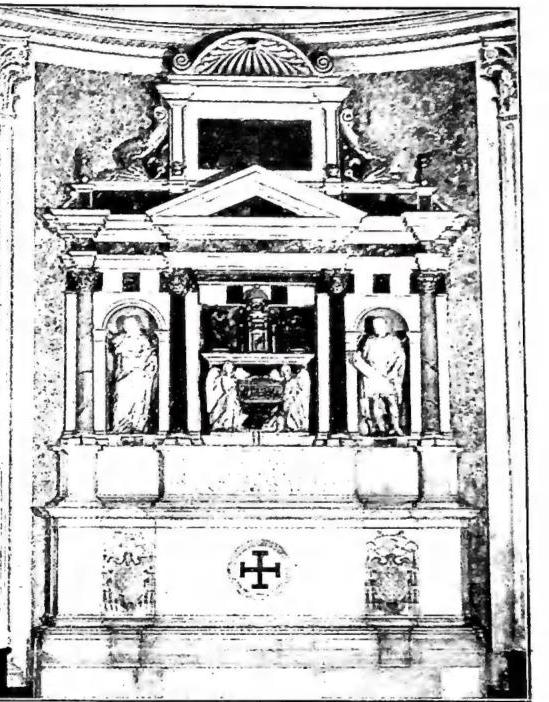
QUIÑONES, FRANCISCO de — Funerary monument of F. Q. by J. Sansovino (1536) — Rome, church of S. Croce in Gerusalemme.