
RATIONALE (LITURGY). - I. Liturgical vestment used in the Middle Ages, known as superhumérale or Logion, which bishops wore over the chasuble during Mass, resembling a pallium but without its specific significance.
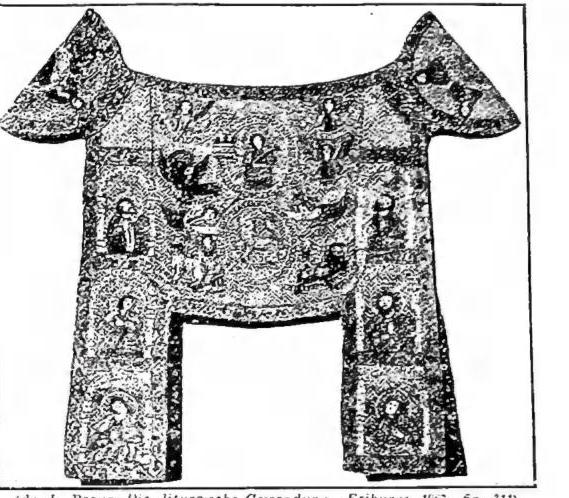
Bishops of Halberstadt received this privilege from Pope Agapito II (946-55); Adalberone II, Bishop of Metz (984-1005), obtained it from Hilduardo of Halberstadt; Poppone, Patriarch of Aquileia, wore it by concession of Pope Giovanni XIX in 1027. In the Middle Ages, it was worn by several other German bishops: those of Minden, Paderborn, Naumburg, Eichstätt, Würzburg, Ratisbona, Spira, Prague, Olmütz, Cracow, Liège, and Toul. Today, it is worn only by the bishops of Paderborn and Eichstätt in Germany, Toul and Nancy in France, and Cracow in Poland—dioceses belonging to the former Holy Roman Empire. It was never used in Rome. J. Braun distinguishes its types: a) one shaped like the letter Y of the pallium, used in Eichstätt, Ratisbona, and Würzburg until the 17th century; b) one shaped like a circular pallium, with two short appendages on the chest and back (used in Cracow, Toul, and also in Eichstätt and Ratisbona); c) a rectangular cloth collar, as wide as the shoulders, hanging about 20 cm over the chest and back, with two longer bands on either side, used in the Middle Ages in Bamberg and Liège. Unlike the pallium, the rationale was always richly adorned with embroidery or symbolic inscriptions and made of purple fabric.
II. A variant of the rationale was a silver or gold plate (instead of the cloth one), resembling the ephod of the Jewish high priest (Ex. 28:2-4), with chains or clasps, attached to the amice. Mentioned in the 12th century by Ivo of Chartres and Honorius, it was Cremona (v.) among pontifical ornaments. It was used in Reims (still at the beginning of the 16th century), Münster, and Mainz, but did not gain wide acceptance. The rationale’s origin is explained either as an imitation of the Jewish ephod or as a substitute for the pallium for non-metropolitan bishops (Braun). Since it is a distinction of the see rather than the person, it is not buried with the bishop.