
BEVAGNA. -
Ancient episcopal see of Umbria, in the province of Perugia, situated at the confluence of the Clitunno and the Topino. It is the ancient Mevania; conquered by the Romans around 308 B.C. and counted by them among the most flourishing municipalities, it remained so until the Lombard devastations of the 6th century.
As regards the origin of Christianity in B., a Christian inscription is preserved in the city (CIL, XI, 2, 5162), but its date is uncertain. A Passion of Saints Vincent and Benignus (BHL, 8776) celebrates the deeds of Vincent, bishop of B., who is said to have lived at the time of the persecutions together with his brother, a deacon named Benignus, both martyrs for the Christian faith. Of these two saints no records older than our Passio are known, and it should not be older than the 6th century. The existence of a St. Bricius, bishop of B., martyred in the 4th century together with other Umbrian colleagues, all celebrated in the famous Passio Proculi, composed after the middle of the 7th century and not before the 9th, has no firmer foundation.
The first bishop of B. whom we know from reliable documents is Innocent, who subscribed at the Roman Synods of 487, 499 and 501. In 591, following the Lombard devastations, St. Gregory the Great entrusted the care of the vacant diocese to a priest; in 597 he committed its visitation to Chrysanthus, bishop of Spoleto, who in 599 was charged with finding a suitable person to govern the bishopric. In 649 the church of B. was governed by Marcian, present at the Lateran Council of that year. The last bishop of B. is Fabius, consecrated around 844 by Sergius II. Subsequently, once the city was destroyed, the cathedral also disappeared, and the ancient diocese was incorporated into Spoleto (v.).
Bibliography4 works
Benedetto Pesci
SACRED ART
Manifestations of art in B. are not found before the Romanesque period. To that era belong precisely the church of St. Sylvester (1195) and that of St. Michael the Archangel, works by a certain Binello, fairly well preserved in their essential architectural lines and rich, especially the second, in sculptural decoration on the facade.
Romanesque-Gothic is the church of St. Mary in Laurenza, mentioned as early as 1293; slightly later is the church of St. Francis, which preserves its original features almost exclusively in the facade.
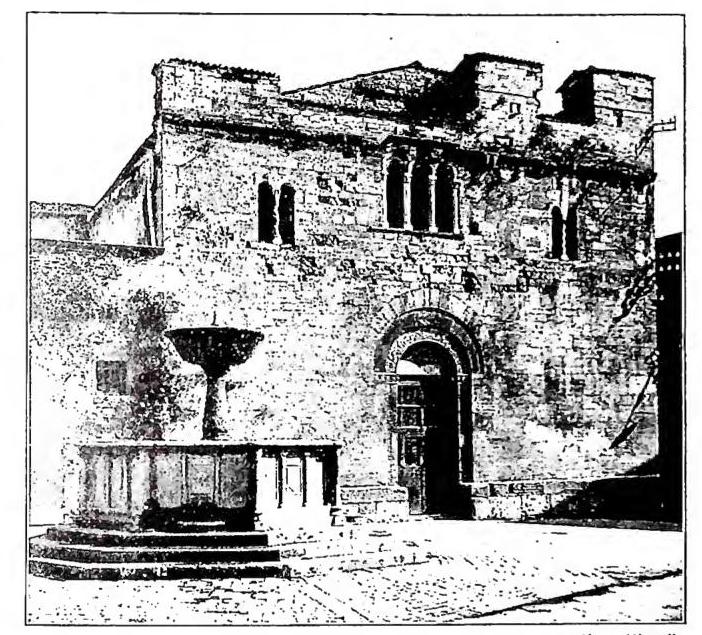
To the early 14th century, if not to the end of the 13th, belongs the Palazzo dei Consoli, which has at its base a loggia with pointed arches and cross vaults.
Later, but likewise of the 14th century, is the church of St. Dominic, which in the apse area has frescoes and wooden sculptures from the end of the 13th century; from the same period is the church of St. Augustine. A modest construction of the end of the 15th century is the church of the Annunziata, where there is a glazed terracotta altar depicting the Annunciation, a Robbiana work of the 16th century. In 1640 the church of St. Margaret was rebuilt, notable only for the Martyrdom of the Saint, a painting by Camassei.
From the 17th century is the church of the Misericordia, where a 16th-century wooden statue of the Risen Christ is preserved. The church of St. Philip was built and decorated in the 18th century; and the frescoes are attributed to the painter G. B. Michelini of Foligno.
Bibliography2 works
Guido Boccolini