
LABARO. - È il vessillo fatto eseguire dallo stesso imperatore Costantino, dopo aver avuto la visione di una croce luminosa con la scritta τῶτα
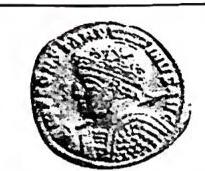
LABARO - Coin of Constantine with monogram on the helmet - Vienna, Coin Cabinet.
The Vita Constantini places the vision in Gaul: it is well known how much its authenticity has been debated (v. Eusebio di Cesarea, II, Opere storiche); but the vision is attested, besides by Eusebio himself (Hist. eccl., IX, 1-11), by two panegyrics, one from 313 and the other from 321. Furthermore, Lactantius speaks of a dream at the gates of Rome, before the battle ad saxa rubra (De mortibus persecutorum, 44). According to a version recorded by Rufinus (Hist. eccl., IX, 9, 1) and later by Socrates (Hist. eccl., I, 3), Constantine would have heard the words τότον νίχα from the angels in a dream. Philostorgius (Hist. eccl., I, 6) reports that the Cross which appeared was in the midst of a rainbow of stars that formed the in hoc vince, in Latin. Eusebius in his history (IX, 9, 10), describing the statue erected by Constantine in memory of the battle of the Milvian bridge and the triumph over Maxentius, says that the Emperor was represented grasping the I. H. Grégoire has highlighted the importance of Rufinus's text regarding the inscription placed beneath the statue of Constantine in the Roman Forum: in hoc singulari signo quod est vere virtutis insigne, to demonstrate that it was a true standard, a vexillum (La statue de Constantin et le signe de la Croix, in L'antiquité classique, 1 [1932], pp. 135-43). St. Ambrose in 388 calls the I. Christi sacratum nomine (Ep. 40: PL 16, 1152): shortly thereafter Prudentius writes that Christus purpureum gemmanti textus in auro signabat labarum, clypeorum insignia Christi scripserat (Contra Symmachum, I, 487-89). Paulinus of Nola describes the monogram Christum and explains its composition by means of the two letters chi and rho (Poem., XIX: PL 61, 612-27). Based on Eusebius's text, G. Wilpert reconstructed the I. (cf. Vision und Labarum Konstantinus des Grossen, Cologne 1913), a reconstruction which he later published in color, having re-examined the data of Eusebius, of Lactantius, and of the monuments (cf. Mosaiken, pp. 28-52 and plate 51, 2).
Valuable documentation on the I. and on some of its variants is provided by Constantinian numismatics. The monogram is the very same coeleste signum Dei recalled by Lactantius in his De mortibus persecutorum, seen in a dream by Constantine and caused to be painted on the shields of the soldiers and placed on the helmet of Constantine. The mint of Siscia struck in the year 317 a coin with the monogram on Constantine's helmet. A coin from the Vienna Coin Cabinet, published by G. Wilpert (Mosaiken, p. 33, fig. 2) and by A. Alföldi, shows the monogram very clearly on the Emperor's helmet (A. Alföldi, The helmet of Constantine, with the christian mono-
νίχα; the description of the standard itself, according to the Vita Constantini (I, 31), is as follows. It consisted of a long staff overlaid with gold, which in its upper part had a transverse beam inclined in the manner of a cross. At the summit was fixed a crown of precious stones enclosing the first two letters of the name ΧΡ(ιστός) intertwined in
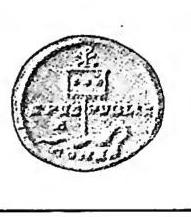
LABARUM - Coinage of Constantine. The labarum piercing the body of a serpent.
gram, in Journal of Roman Studies, 22 [1932], pp. 9-23, pl. 4, 17). A coin of Vetranio shows the labarum with the monogram in the center of the cloth and the surrounding inscription "Hoc signo victor eris" (Wilpert, Mosaiken, p. 42, fig. 9). That this monogram is the Signum Christi is attested by a graffito in the cemetery of Priscilla in which, after wishing the deceased Gregory and Sabbazia "in pace x", the explanation of the monogram "signu Christi" is added (Wilpert, Mosaiken, 29 and photographic reproduction in Sarcofagi, fig. 201).
But the labarum with the monogram in the center of the cloth is found on a quinarius of Constantine and on medals of Constans. A coin of Constantine presents the labarum with the monogram without the crown at the top of the shaft driven into the ground crushing a serpent (Wilpert, Mosaiken, p. 37, fig. 5). On the other hand, in the famous diptych of Aosta, on the cloth of the labarum grasped by the Emperor Honorius, one reads: in nomine ΧΡΙ νιώας semper; and the monogram is found at the end of the shaft inside the crown. Recently H. Grégoire, after studying the Etymologie du Labarum (in Byzantium, 4 [1929], pp. 477-82) and denying that Eusebius is the author of the Vita Constantini (ibid., 13 [1938], pp. 561-83), believed he could also dismiss the vision of Constantine (La vision de Constantin «liquide», ibid., 14 [1939], pp. 341-51); he was answered by J. Zeller (Remarques sur la vision de Constantin, ibid., 14 [1939], pp. 331-39) and A. Alföldi (The conversion of Constantine and Pagan Rome, Oxford 1948, pp. 16-17). Also on a stele from Larissa in Macedonia the monogram surrounded by a crown is called signum Christi (CIL, III 7315); the monogram found in St. Agnes also has in hoc signo... vinces (G. B. De Rossi, Cimitero di S. Agnese, in Bull. di arch. christ., 2nd series, 6 [1875], pp. 80-82); as well as in the inscription of Symphonia seen by A. Bosio: in hoc vinces beneath the monogram (A. Bosio, Roma sotterranea, Rome 1632, p. 215). At Sicca Veneria (today El-Kef in Tunisia) around the Cross with the letters α and ω is written: in hoc signum semper vinces (CIL, VIII, 1767); at Deir-Sanbil in Syria, below the words ΤΟΥΤΙΣ ΝΙΚΑ, two monogrammatic crosses with α and ω are engraved (M. De Vogüé, Syrie Centrale, Architecture civile et religieuse, Paris 1865-77, p. 151). - See pl. XLVIII.