
MECHITARISTS. – Armenian hieromonks, so called from the name of their founder Mechitar (v.). Although their original designation may have been “Armenian Monks of St Anthony the Abbot,” they were nevertheless also called M. during the founder’s lifetime, a title that later became customary.
The Constitutions bear the imprint of the organization of the Western regular Orders, with Armenian disciplinary elements and the distinctive aim of apostolate among the Armenians, in its threefold form: missions, intellectual activity through printing, and the education of youth. A general abbot, appointed for life, presides over the council of the general assistants.
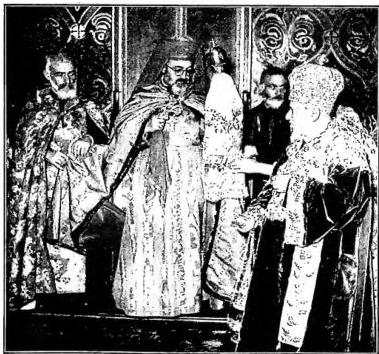
MECHITARISTI – His Eminence Cardinal Gregorio Pietro XV Agagianian, Patriarch of Cilicia of the Armenians, while celebrating the pontifical liturgy at S. Lazzaro for the centenary celebrations of Abbot Mechitar.
monks, gave rise to an autonomous branch of M., first established in Trieste and, from the beginning of the nineteenth century, in Vienna.
Both Congregations have carried out intense missionary, educational, and cultural activity for the benefit of the Armenian nation. In addition to the two mother houses in Venice and Vienna, where the respective two general abbots reside and where two efficient printing presses have been operating for centuries, various missionary stations, schools, and colleges of the M., scattered throughout the principal cities of the former Ottoman Empire, Caucasian Armenia and the diaspora, Syria, Lebanon, Egypt, etc., radiate their beneficial work from these centers.
In the intellectual field, the M., although few in number, have to their credit a remarkable production, unparalleled in quality and quantity within the nation: more than three thousand works; two monthly journals, Pazmaveb and Handés-Amsorya (the former has already completed more than a century of existence), periodically illustrate the Armenian cultural movement. In the educational field, the two centuries-old secondary colleges of Samuel Moorat and Raphael in Venice, directed by the M. of Venice, are renowned.