
MECHITAR VARTAPET, abbot. – Hieromonk, in the world Pietro Manuk, founder of the Armenian Monks of S. Antonio Abate, called Mechitarists, born at Sebaste (Sivaz) in Lesser Armenia on 7 February 1676, died at Venice on 27 April 1749. At the age of 15 he entered the Sourp-Nišan, the Armenian monastery of his city, taking the name M. (consoler).
The Armenian monasteries of the period were not equal to their mission. Sixteen-year-old M. went to the patriarchal monastery of Egmiadzin (Caucasus) to follow the Catholic archbishop Michele, renowned for his erudition. He was disappointed by him and therefore decided to renounce the teachers of his homeland in order to move to Rome (1695), although he had been advised against this in Aleppo by the Jesuit Fr. A. Beauvollier, who considered M. highly learned in the
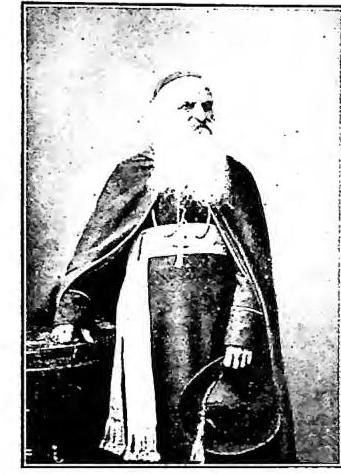
Following the suggestions of the Venetian ambassador in Constantinople, M. went with his disciples toward the Morea (Peloponnese), Venetian territory since 1687, where he arrived at the beginning of 1703; settling at Modon, within a few years he built a magnificent monastery and laid the foundations of a church (1708). In two letters dated 16 June 1705, addressed respectively to Pope Clement XI and to Cardinal Fabroni, prefect of Propaganda, M. petitioned for approval of the Institute as a reformed Armenian monastic Order of St Anthony the Abbot. Propaganda approved its somewhat revised Constitutions ad experimentum (1711).
The work, scarcely transplanted to Modon, was soon uprooted by the Turkish-Venetian war, which ended with the Peloponnese passing to the Turks (1715). M. and a few disciples, stripped of everything, were cast upon the shores of the Venetian lagoon, where they sought asylum and protection, and where the islet of St Lazarus was granted to them, in return for a symbolic rent (26 August 1717).
A larger and more beautiful cenobium with a church and library, completed under M.’s direction in 1740, now provided a worthy home for his work, which, through intense missionary, literary, and educational activity, became the centre of the religious and cultural irradiation of the Armenian people. Indeed, during the fifty years of his activity, M. tirelessly promoted the apostolate among the Armenians in Constantinople, in the inland cities of Armenia, in Transylvania, and in Belgrade. His work, initially
knowledge of Armenian patristics and in the refutation of heretics. He did not, however, abandon the journey he had undertaken until Cyprus, because of a sudden illness contracted there: he returned to his native city.
In the spring of 1696 M. was ordained a priest. Full of zeal and aware of the urgent religious, cultural, and social needs of his people, he envisaged an Order of hieromonk-vartapets, learned and magnanimous preachers, after the model of the regular European missionaries whom
was hampered, was facilitated by a decree of Propaganda (26 September 1718), personally obtained by him, which granted M. and his successors the faculty of sending their own missionaries to the Levant. This decree, together with the fourth vow of the Missions prescribed by the Constitutions, constitutes the canonical basis of the Mechitarist missions.
To his missionary activity M. added intellectual work through the Catholic press. He himself reprinted books of piety and religion and composed others. About fifty works were published through his efforts, among them first the Imitazione (Constantinople 1700), the Libro delle virtù e dei vizi by P. d’Aragona, the Paradiso dell’anima by Alberto Magno, the Esercizi di perfezione by A. Rodriguez, the Compendium Theologicae Veritatis attributed to St Albert the Great, and many others of an ascetical nature. He compiled and published the Grammatica armena, a commentary on Ecclesiastes and on St Matthew, a voluminous work; an Armenian Dictionary, the first of its kind; and many other commentaries. M., admired by his compatriots and by foreigners (he has been called a second «Illuminatore»), was buried in the abbey church at St Lazarus. The first proceedings for his beatification cause have been initiated.