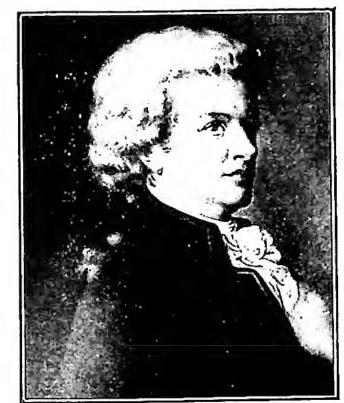
MOZART, WOLFGANG AMADEUS. — Musician, born in Salisburgo on 27 January 1756, died in Vienna on 5 December 1791. Of absolutely exceptional precocity, he was introduced to music by his father and presented very early to the admiration of the cultured and aristocratic society of the principal European artistic centres; already in 1762 the first journey to Monaco and Vienna took place, during which the child performed in concert with his sister Anna Maria. Numerous journeys to Paris, London, and the principal cities of Germany and the Netherlands followed from 1763 to 1766; from 1769 to 1773, three journeys to Italy; in Rome he was received by the Pope, who conferred upon him the title of Knight of the Golden Spur. From 1773 to 1777 he remained in Salisburgo, from where, in search of better prospects, he went to Monaco, Augusta, Mannheim, and finally Paris; recalled by his father, he reluctantly entered the service of the archbishop of Salisburgo, but in the summer of 1781 he resigned his post and settled in Vienna. Having begun his career as a freelance artist, the first years of the Viennese period brought, on the whole, the finest recognition of the master’s genius, but especially after the great success of Le nozze di Figaro, the bitterness caused by envious persons and rivals, led by Salieri, began. In 1787 he returned to Prague for the first performance of Don Giovanni, which achieved a triumph; in November of the same year he succeeded Gluck as «chamber musician» to the Emperor. Returning to Vienna from Prague, where La clemenza di Tito had been performed, he wrote The Magic Flute and devoted himself to composing the Requiem, interrupted by his death.
Prodigious in both number and value was his artistic creation in every musical genre (cf. Ludwig von Köchel, Chronologisch-thematisches Verzeichnis sämtlicher Tonwerke W. A. M.'s, 1st ed. of 1862, revised and supplemented under the direction of A. Einstein, Leipzig 1937). Orchestral music: 41 symphonies, cassations, divertimenti, serenades, marches, and various dances; 25 concertos for piano and orchestra, one concerto for two and another for three pianos, 6 concertos for violin and piano, concertos for various instruments. Chamber music: 7 quintets for strings, one with horn and one with clarinet, 26 string quartets, one quintet and other quartets for various instruments, 8 trios, 42 sonatas for violin; divertimenti, cassations, serenades for various instruments; 17 sonatas, 4 fantasias, numerous variations for piano. Secular vocal music: arias, Lieder, songs, choruses. Theatrical music: La finta semplice (1768), Bastien et Bastienne (1768), Mistridate (1770), Ascanio in Alba (1771), Il sogno di Scipione (1772), Lucio Silla (1773), Il re pastore (1775), La finta giardiniera (1775), Zaide (1779–80), Idomeneo (1781), Die Entführung aus dem Serail (1782), Le nozze di Figaro (1786), Der Schauspieldirektor (1786), Don Giovanni (1787), Così fan tutte (1790), La clemenza di Tito (1791), Die Zauberflöte (1791).
Religious music is of considerable importance, much of it composed during the Salisburgo period; in addition to 12 church sonatas for organ and instruments, offertories, motets, vespers, and litanies, M. left the mark of his genius
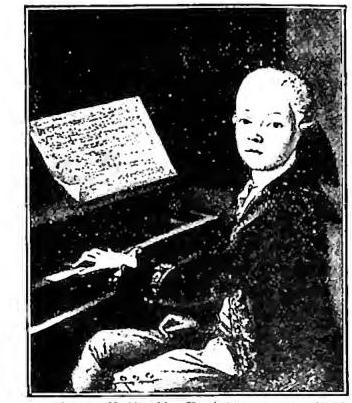
MOZART, WOLFGANG AMADEUS — Portrait of M. 211 years. Painting by Holbling — Salzburg, Mozart Museum.