
PALIMPSEST. – A word borrowed from the Greek language, composed of the adverb παλν (= “again”) and the verb φλω (= “to clean, wash away, shave, scrape”), used to designate a writing material, predominantly from antiquity (whether parchment or papyrus is immaterial), from which a pre-existing writing has been erased with pumice and a scraper or washed away with a sponge. The purpose of this procedure is to permit the writing material already used to be used again, so much so that the word p. was transferred to the newly written work.
The expression codex rescriptus is often used as a synonym for p.; in fact, however, it embodies a different concept, since it presupposes an entire volume consisting wholly of leaves from which an earlier writing has been scraped, whereas one may speak of a p. even when only some leaves had already been written on once; indeed, the term is legitimate even when dealing with isolated portions of writing traced on a scraped leaf, as well as in the case of documents rather than codices.
Today it is legitimate to ask whether the system followed by medieval writers—erasing the writing from codices and documents that the modern scholar preserves with such care—was not highly questionable. Undoubtedly the procedure is an indictment of those who resorted to it, but there are many mitigating circumstances. First of all, it must be observed that the price of parchment, especially when of good quality, was extremely high in the Middle Ages; consequently, when confronted with writings of any kind of content that at the time possessed no real value, people were readily induced to destroy the pre-existing work in order to reuse the parchment, when it proved particularly durable. Secondly, it must be borne in mind that ancient writings, for the most part continuous, had become difficult to read once the practice of separating one word from another had come into use; those who erased them therefore acted in the belief that they were eliminating a useless text. At times, moreover, these were codices whose contents seemed by then outdated (collections of laws no longer in force, pre-Hieronymian Latin versions of the Bible, obsolete liturgical texts). The accusation that the destruction was directed solely against texts by classical authors is, in any case, entirely without foundation.
On the other hand, the recourse to p. is very ancient: Cicerone mentions it in a letter to Trebazio; the Digest speaks explicitly of new and already used and scraped writing material, and declares both valid for documentary purposes. It was precisely the sanctioning of this principle that encouraged the trade in scraped parchment, creating a means of speculation that was no minor cause of the destruction of so many ancient works.
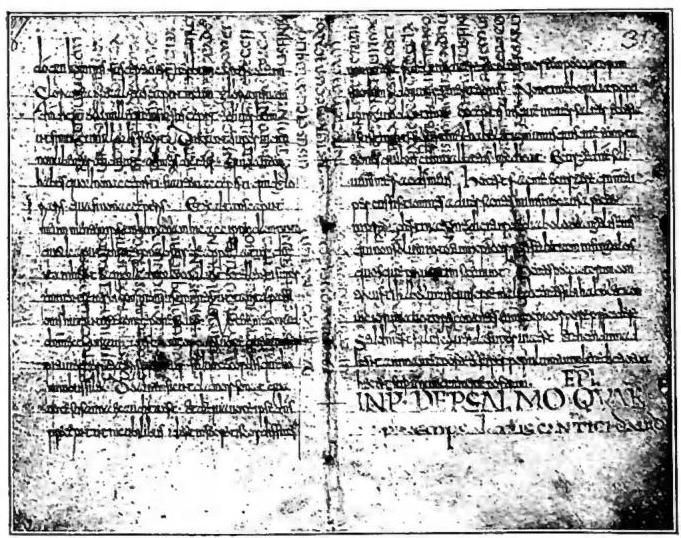
(courtesy of p. Dold)
PALINSESTO - The text p. forms part of a Preface to the so-called «Gallican Masses» published by Fr. J. Mone in 1850 - Karlsruhe, Library, cod. Aug. CCLIII, f. 90°.
torio. This procedure, besides seriously damaging the writing material, also made it impossible, for codices that had already been subjected to chemical treatment, to resort to the more modern methods based on photographing the p. through ultraviolet rays. This system, which was used extensively and fruitfully above all by the Benedictine monks of the Beuron Archabbey, is completely harmless and exploits the phenomenon of fluorescence produced by animal skin subjected to ultraviolet rays: in this way, the dark strokes of the letters stand out sharply against the background, more distinctly for the second writing and less distinctly for the original one because of the scraping, producing a contrast of tones which, fixed on the photographic plate, makes it possible to read both texts. It goes without saying, however, that reading requires long and patient work, because the individual letters do not always preserve their full strokes and the lines of the first writing, if the scraping has been very intense, appear as barely perceptible shadows.
In the collection of E. A. Lowe, Codices latini antiquiores, 132 p. are recorded in the 5 vols. published so far, for the most part examined with chemical reagents, but fortunately in many cases only for a few leaves.
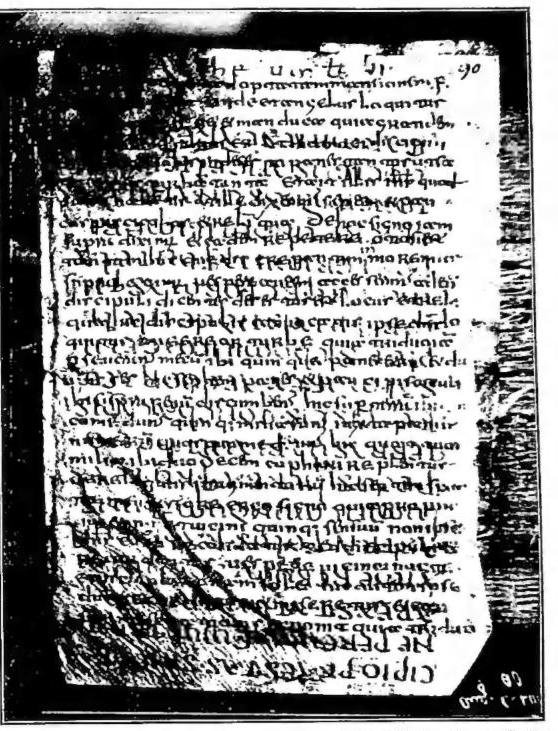
(courtesy of Fr. Dold)
PALINSESTO - The p. text is from the Vetus Latina (Dan. 8:12–20), from cod. Würzburg MP. th. 64° (5th century).
The same Niebuhr published in 1820 fragments of the Fabulae of Hyginus and of Cicero’s Pro Fonteio from cod. Vat. Pal. lat. 24 (the same manuscript also contains fragments of Gellius’s Nactes Atticae), and in 1823 passages by the Spanish poet Merobaudes from cod. Sangall. 908. In 1828 F. Blume brought to light passages from Livy from cod. Veronese cap. 40, formerly 38; in 1850 Fr. I. Mone published the Gallican Masses from cod. Aug. CCLIII; in 1857 A. F. Pertz extracted fragments of Licinianus’s History of the Roman Republic from an Egyptian “trisest” (a manuscript rewritten three times); in 1871 E. Ranke made known passages from the Vetus Latina of the Pentateuch and the Prophets from cod. Wirceburg. Mp. th. f. 64 a; in 1879 P. Krüger published the Fragmenta Taurinensis of the Codex Theodosianus from cod. Taurin. Naz. A II 2 (other fragments are in cod. Vat. lat. 5766); in 1887 H. Winnefeld brought to light the so-called Sortes Sangallenses from cod. Sangall. 908.
In the 20th century, improved technical means broadened the investigation of p. and multiplied the publication of texts recovered from them. Particularly noteworthy in this regard is the series Texte und Arbeiten (Beiträge zur Ergründung des älteren lateinischen christlichen Schrifttums und Gottesdienstes), published by the Palimpsest-Institut of the Archabbey of Beuron, in which a text of the Prophets in the Vulgate (1917), a Gregorian Sacramentary (1919), a Gospel pericope (1923), another Sacramentary (1925), fragments of the Latin text of the sapiential books (1928), passages from St. Paul and the Psalms (1928), a liturgical text (1930), the oldest text of the Vulgate (1931), a Psalter (1933), the oldest liturgical book of the Latin Church (1936), and liturgical texts of the Sacramentary, the Comes, and the Capitolary incorporated into the Missal have been published or studied. Other studies appeared in the Revue bénédictine (1924–26), in the Jahrb. für Liturgiewissenschaft (1923 and 1933), in the Zentralblatt für Bibliothekswesen (1917–18, 1926, 1941), in the Ephem. Liturgicae (1940), in Biblica (1938), in the Anzeiger der Akad. der Wissenschaft, in Wien. Philos.-hist. Klasse (1942), and in the Sitzungsber. der österreich. Akad. der Wissenschaft. Philos.-hist. Klasse (1948). - Vedi tav. XLVI.