
AGAPE (ἀγάπη «love, charity» in the New Testament). — According to the traditional view, a liturgical banquet in use in Christian communities of the first four centuries, modeled on and in memory of the Last Supper, to manifest fraternal charity and to aid the poor, initially joined to the celebration of the Eucharist and later separated from II. But the nature of the agape (especially its relation to the Eucharist) and its origins are now highly controversial; the problem is one of the most obscure of the apostolic age.
Today, while rationalist critics tend to emphasize the antiquity and importance of the agape, many Catholics significantly diminish II. Four prevailing opinions can be distinguished, the first three of which trace the agape back to apostolic times, while the fourth places it after A.D. 150. The first two opinions connect the agape with the Eucharist, the last two (mostly upheld by Catholics) separate it entirely.
1) The traditional opinion, supported by conservative Protestants (Th. Zahn, J. F. Keating) and by many Catholics (R. Cornely, J. E. Belser, F. X. Funk, V. HERMON, F. Cabrol, J. M. Hanssens, B. Allo, A. Arnold), sees the origins of the agape in the apostolic age, in close connection with the Eucharist; it relies mainly on 1 Cor 11:20–34; the separation from the Eucharist occurred in the 2nd century.
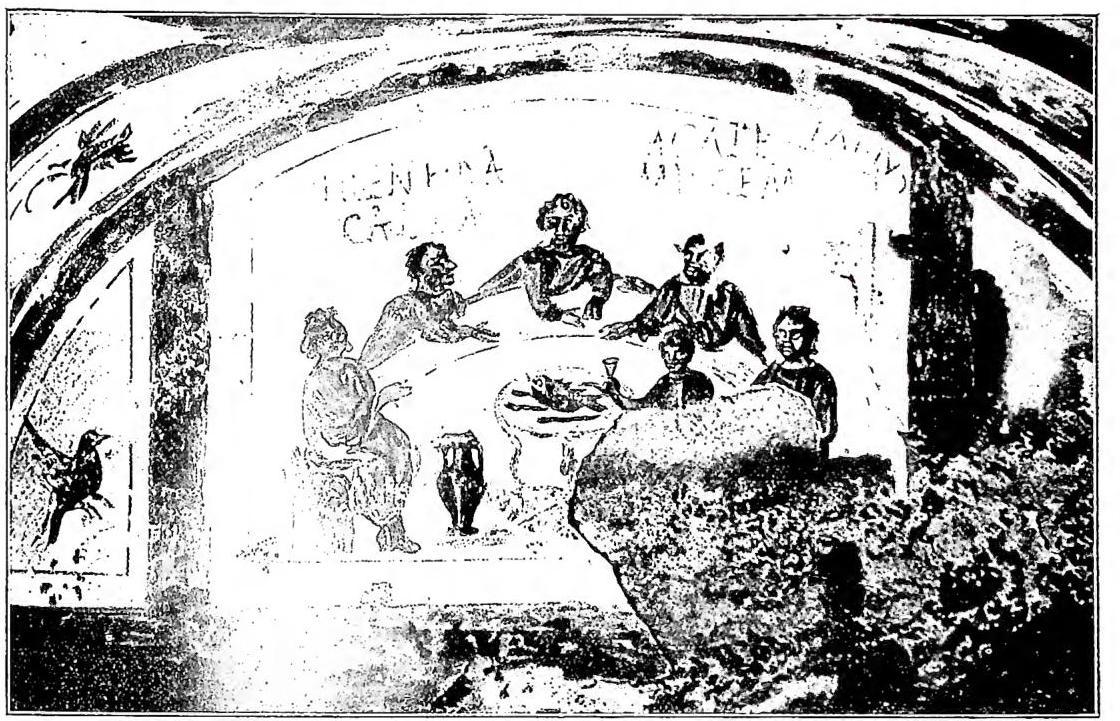
AGAPE - Funeral banquet, symbol of heavenly peace - Rome, Cemetery of SS. Peter and Marcellino.
1) The term agape (ἀγάπη) in the New Testament denotes "love, charity," but in the post-apostolic age it came to designate a specific type of communal meal. The first to use it in this sense was probably St. Paul in 1 Cor. 11:33-34, where he speaks of the agapē as a meal to be held in common by the faithful. The Didachē (10:6) also mentions it, though it is not clear whether it refers to a liturgical meal or simply a common meal. The Epistola Apostolorum (15) connects it with the Eucharist, but this is an isolated instance.
2) The origin of the agape is uncertain. Some scholars (e.g., H. Lietzmann, Messe und Herrenmahl, pp. 202-210, 249 sg.) suggest that it arose from the primitive Christian sopar (evening meal) which was later combined with the Eucharist when the latter was transferred to the morning. Others (e.g., A. Schweitzer, Die Mystik des Apostels Paulus, Tübingen 1930, p. 270) reject this theory. A third view (E. Baumgartner, K. Völker) holds that the agape dates back to apostolic times but was always separate from the Eucharist. H. Leclercq, however, considers it a funeral meal derived from both Jewish and pagan customs.
3) The agape is traced back to the apostolic age, but even then it was separate from the Eucharistic celebration (E. Baumgartner, K. Völker). The Greek Fathers, from Chrysostom to Theophylact, placed this meal after the Eucharistic rite. H. Leclercq regards the agape as a funeral meal deriving from analogous Jewish and pagan customs.
4) The agape was introduced only in the 2nd century; it therefore has no connection with the Eucharist (P. Batiffol, followed by P. Ladeuze, J. Thomas, H. Rongy, W. Goossens).
This negative thesis, first advanced by G. Albaspino (Aubespine, 1630), seems preferable, despite the recent reaction of A. Arnold. From the texts of the New Testament and the Apostolic Fathers, it cannot be demonstrated that there existed common meals that were liturgically linked with the Eucharist. The "breaking (v.) of bread" (Acts 2:42; 20:7, 11) was the Eucharistic celebration; even if Acts 2:46 refers to common meals, there is no evidence that they were united with the Eucharist, let alone the charitable meals of Acts 6:1-6. In Jude 12 and 2 Pet. 2:13 (in codex B and a few others, the more attested reading being ἀπάται "deceits"), the agapai of Christians are mentioned, but (although the Vetus Latina translates "epulae, convivia" in both passages) these agapai refer to the communities (or assemblies) of the faithful, as in St. Ignatius of Antioch. The classic locus is 1 Cor. 11:20-22 and 33-34; the common interpretation (1st, 2nd, and 3rd opinions) sees here a fraternal ritual meal, connected (not by Baumgartner and Völker) with the Eucharist: St. Paul does not reproach the meal nor its Eucharistic relation, but the disorders to which it gave rise. However, Batiffol, Ladeuze, Thomas, and Goossens seem to understand better: the Corinthians had introduced on their own initiative, before the Eucharistic supper, a meal which the Apostle condemns as an intolerable abuse.
The Didachē, 9-10, where Zahn and Lietzmann see the agape united with the Eucharist, seems to refer only to the Eucharist (Batiffol, Völker, Greiff); in 11:9 it probably concerns a common, non-liturgical meal, and in 14-15 the exclusively Eucharistic celebration.
Decisive are the texts (of 107/8) of St. Ignatius of Antioch (Rom., prol.; Smirn., 6:2; 8:2; 12:1; Trall., 2:3; Magnes., 1:1; Philad., 11:2), where ἡ ἀγάπη, understood as a concrete institution, always means "community" or "assembly" (like ἐκκλησία, with a more intimate tone of brotherhood). In 112 Pliny (Epist., X, 97, to Trajan) reports of common evening meals of Christians with ordinary table prayers, but it does not appear that they were liturgical. St. Justin, who carefully describes the Eucharistic synaxis (1 Apology, 65-66), does not mention any common meal.
It is therefore very doubtful that before 155 there existed common meals called agapai, and even more uncertain that they served as a framework for the Eucharistic celebration.
The agape appears in some churches as an organized institution in the second half of the 2nd century. Ἡ ἀγάπη "fraternal association" takes on the meaning of "common meal"; an identical semantic shift had already occurred for φρατρία and δίασος, the reverse for συσσίτιον.
In Asia Minor, the Epistola Apostolorum, 15 (c. 175) connects it with the Eucharist on Easter morning. But, while retaining its religious purpose and value, the agape is a simple "banquet" of the community (ἀγάπη ἦτοι δοχή) in the Didascalia Apostolorum, II, 28, 1-5 (ed. F. X. Funk, I, [1905], pp. 108-109). In Carthage, Tertullian describes the agape in 197 (Apologeticum, 39): a meal presided over by the clergy, "what is called dilectio among the Greeks... We help the poor with this refreshment," and, having become Montanist (De ieiunio adversus psychicos, 17), he reproaches: "with you the agape seethes in cooking pots." Similarly, the Passio Sanctarum Perpetuae et Felicitatis, 17, calls a fraternal official meal an agape ("they dined not a free supper but an agape"), but without any connection to the Eucharistic liturgy. Clement of Alexandria (Paedagogus, 2, 1) contrasts the worldly deipnaria with the agapai pleasing to the Lord, who prescribed inviting the poor.
Church ordinances, whether official or quasi-official, describe the agape and its evolution in the 3rd and 4th centuries. The Traditio Apostolica of Hippolytus, known as the Constitutiones Ecclesiae Aegyptiacae (early 3rd century), lays down various rules on the agape (XVIII-XXII: F.X. Funk, Constitutiones Apostolorum, II [1905], pp. 113-14). After canon II of the Council of Gangra in Galatia (343), the Canones Hippolyti (second half of the 4th century) are very explicit: cann. 164-68 on meals for the poor (more important and solemn), can. 169 on anamnēsis for the dead; cann. 183-85 on meals for widows.
These meals concluded the "peace offerings" of sacrifices: the remains of the victims or offerings were consumed in the temple precincts (Deut. 14:23, 26), and such meals were recommended to have a charitable purpose (Ps. 21 [22]:27; Is. 58:7).
W. O. E. Oesterley and H. Lietzmann trace the origin of the "Palestinian agape" to the haburah (a Jewish religious association that gathered around a teacher for a meal). A slight influence (overemphasized by H. Leclercq) of pagan funeral banquets, widespread in various confraternities (hetaeriae [Pliny, loc. cit.] or collegia, ἔρανοι or θίασοι), which often had the sole purpose of gathering for common meals (συσσίτια, δείπνα φυλετικά or θεματικά or φρατρικά or ὄργεωνικά), especially funeral meals (νεκόσια, silicernium, coena novendialis), is also plausible. The practice of the parentalia was also very widespread.
AGAPE - Convito sacro, simbolo dell'Eucaristia - Roma, Cimitero di Priscilla.

Da Tertulliano in poi, l'a. ha finalità caritativa. E già verso il 200 « refrigerare, refrigerium » sono espressioni tecniche designanti le a. semiliturliche in onore dei Martiri. Nelle catacombe di S. Sebastiano fu rinvenuta (1915-16) la « tricilia » o sala in cui i cristiani celebravano tale « refrigerio » (v.).
Dopo il 350 predomina il carattere funerario di suffragio per i defunti. A torto però il Leclercq vede nell'a. sempre e solo il significato di convito funebre.
Non sembra vi fosse normalmente unita la celebrazione eucaristica. L'a. aveva di solito luogo la sera (« post lumina »: Tertulliano, Apol., 39) e l'Eucaristia, almeno fin dal tempo di Traiano, di mattina. L'Eucaristia fu poi celebrata congiuntamente, ma prima e distinta, nel pasto funerario (Canones Hippolyti, 169: « Primum antequam consideant, mysteria sumant »).
Può ammettersi una certa dipendenza dell'a. dai conviti funerari giudaici (II Sam. 3, 32; Ier. 16, 5, 7; Tob. 4, 17-18; cf. Os. 9, 4 e Ez. 24, 17, 22; per i tempi del Nuovo Testamento: Fl. Giuseppe, Ant. Iud., II, 1, 1) e dall'uso dei
stiani provenivano in gran parte da tali associazioni, le cui usanze aiutano a spiegare il largo affermarsi di un'istituzione che oggi apparirebbe inattuabile. S. Girolamo, In Os., 9, 4 (PL 6, 891) richiama i νεκροδείπνα dei Greci e i parentalia dei Latini. Ma s. Agostino, concorde con s. Cirillo Aless. (PG 4, 216), nega la dipendenza da quelle usanze religiose pagane: « Nec sacrificia eorum vertimus in agapes..., agapes nostrae pauperes pascunt sive frugibus sive carnibus » (Contra Faustum, XX, 20: PL 42, 383).
La reazione antignostica avrebbe dato all'a. forma stabile, secondo K. Völker (Mysterium und Agape, pp. 184-203, ove studia l'influsso dei fattori extracristiani).
Nel sec. IV, il pasto offerto ai bisognosi dalla Chiesa o da qualche ricco fedele è assorbito da più vaste istituzioni caritative e si va sopprimendo. Il Concilio (ca. 360-65) di Laodicea in Frigia (cann. 27-28) proibisce « ciò che si chiama a. nelle basiliche, di mangiare nella casa di Dio e d'imbandirvi mense » (Hefele-Leclercq, I, p. 1014). Il Concilio di Ippona del 383 (can. 29) e il 3° Concilio di Cartagine (397), can. 30, rinnovano tale divieto, sola eccezione fatta « hospitiorum necessitate ». Ma dovranno nuovamente proibire il tenace uso i Concili di Orléans (533), di Tours (567) e il Trullano (692).
Esclusa dalle chiese, l'a. sopravvive nei cimiteri associata al culto dei defunti come « refrigerium », come elargizione in suffragio, ma è presto vietata dalle autorità ecclesiastiche in Italia e in Africa, per gli abusi che occasionava e per l'interpretazione pagana cui si prestava. Cf. s. Ambrogio, De Helia, 17, 62 (CSEL 32, 2, 448). S. Agostino (Confess., 6, 2: PL 32, 719) narra di sua madre
che a Milano andò al cimitero, come usava in Africa, con provviste per mangiare e da distribuire, ma l'ostiario la respinse allegando il divieto di s. Ambrogio « quia illa quasi parentalia superstitioni gentilium essent similima »; nel 392 induceva il vescovo di Cartagine Aureliano a sradicare « iatas in coemeteriis ebrietates et luxuriosa convivia » aggiungendo che quasi tutta l'Italia e Chiese transmarine o non li praticarono mai o li soppressero (Epist. 22, 2-3: PL 33, 91); condanna poi l'uso in termini severi (Sermo 15 de Sanctis: « miror cur... hodie tam pernicious error in creverit ut super tumulos defunctorum cibos et vina conferant »; Epist. 29, 10: PL 33, 118 sg. lamenta le quotidiane ubbriscature a S. Pietro). S. Paolino di Nola descrive il pranzo dato da Pammachio ai poveri (come avveniva a Nola, a Verona, in Gallia) nella basilica di S. Pietro alla morte di sua moglie Paolina (Epist. 13, 11-16: PL 61, 213); ma deplora le intemperanze che in simili banchetti avvenivano (Carm. 27, 555-78). S. Girolamo scrive a Eustochio (584) delle vanitose vedove cristiane di Roma: « cum ad agapem vocaverint, pracco conducitur » (Epist. 22, 32). A diventa ormai sinonimo di « elemosina », e tale uso del termine rimase nel medioevo (cf. C. D. Ducange, Glosarium medica et infimae latinitatis, ed. G. A. L. Henschel, I, Parigi 1840, p. 138). Per i monumenti paleocristiani V. BANCHETTO e FRACTIO PANIS.