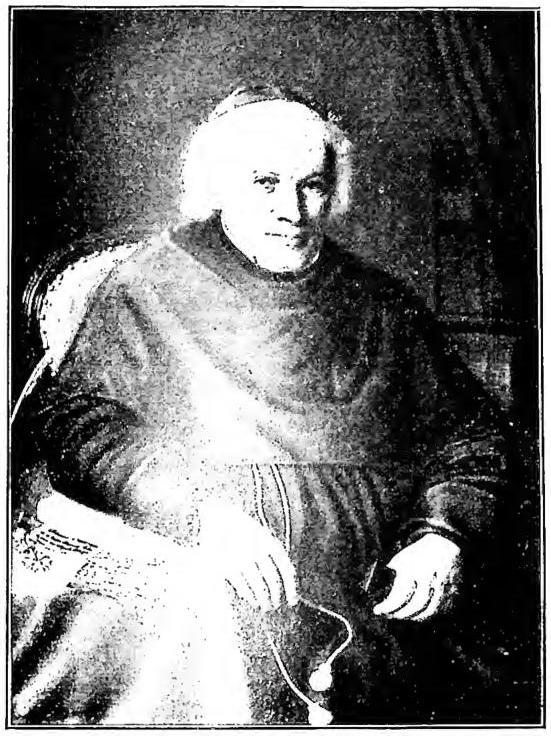
GIRALDO DI CAMBRAI

GIRALDUS of Cambrai. — Ecclesiastic and writer, also called G. of Barry. Born at Manorbeer (Pembrokeshire), from a noble Welsh family, and died toward the end of 1222 or in 1223. He studied in Paris and, returning to England around 1172, became archdeacon of Brecknock in 1175. A first election as bishop of St. David’s was not confirmed by King Henry II.
G. returned to Paris to study law; in 1185 he accompanied Prince John on the expedition to Ireland, during which he wrote his works *Topographia Hibernica* and *Expugnatio Hibernica*. In 1188, together with Baldwin, archbishop of Canterbury, he preached the Crusade in Wales with great success. A second nomination of G. as bishop of St. David’s was opposed by Hubert, archbishop of Canterbury, despite G.’s appeal to Innocent III, for which he came to Rome in person. Disappointed by these conflicts, G. in 1203

GIRALDUS OF CAMBRAI – GIRARD GREGORIUS

and Fribourg. Having distinguished himself with his *Plan for Public Education* for the Swiss Republic, in 1799 he was appointed Catholic advisor to the Minister of Education in Lucerne. After the government passed to Bern, G. became the first Catholic parish priest of that city after the “Reformation.” Recalled to Fribourg in 1804 to reorganize and direct the elementary schools of the city, he revealed his genius by transforming the artistic system of the school of the time into a nursery of culture, where interest and activity replaced memory, and joy and desire for knowledge replaced the coercion of a science already established and imposed on the minds of pupils.

The results were magnificent, and the fame of the Fribourg school spread throughout Europe, the Americas, and India. Everywhere in Switzerland, England, France, Greece, Russia, France, and even in Italy by the pedagogue Fr. Baghetti. Even Lambruschini later paid homage to G. as a disciple to his master. But the method of mutual instruction, which entrusted a group of children to the teaching of one of their more intelligent peers under the guidance of the teacher, was considered in Fribourg as a subversion of the social order, a negation of the principle of authority. Despite the remarkable results and the recognition accorded to G. by the most esteemed pedagogues of the time, on June 2, 1827, the civil authorities, in agreement with the ecclesiastical authority, suppressed mutual instruction. G. retired to Lucerne, where he taught philosophy at the state lyceum from 1827 to 1834. He was repeatedly consulted for advice and directives on the organization of schools in various Swiss cantons, took part in meetings and congresses, and was several times guardian and provincial minister in his Order.

G.’s name remains linked to the method of mutual instruction, a method adopted initially due to the shortage of teachers in his school, but from which he derived the greatest advantages. His fundamental principle was to meet the innate need for vitality and movement in children. The mechanism consisted of a competition of emulation among pupils to reach the point of being able to teach their fellow pupils, for, as G. said, “the best way to learn is to teach.” Another result of this method was to form future leaders in the art of command and to instill in pupils a civic sense of obedience to laws and constituted authorities. This self-education, education from within, not imposed but naturally developed on the principles of freedom and personality, was finally manifested in the jury of pupils called to resolve disciplinary issues arising within the school. The effectiveness of this educational system was based on the fundamental principle of the maternal method, which, by fostering the natural development of all faculties, formed the complete man through love and conviction: “If you care about the progress of your pupils, make yourself loved by them.” It was the method that the mother, “educator by nature,” had taught him. A method intuitive at first, and then abstract. G. deduced his method above all by recalling the way in which a mother teaches her child his native language. This became for him the great instrument for the formation of the complete man. By studying his native language, the child becomes aware of the notions he acquires by himself, exercising all natural faculties, without limiting himself to mere memorization. The same maternal principle applies to moral and religious formation, not by inoculating virtue but by awakening and cultivating the good tendencies that are germinal in the child’s heart. “To form Christ in man,” is for G. the ideal and supreme end of education.

At his death, the Grand Council of Fribourg ordered that his effigy be displayed in all schools, and a public subscription raised in the city a bronze monument to him, which perpetuates his memory to this day.