
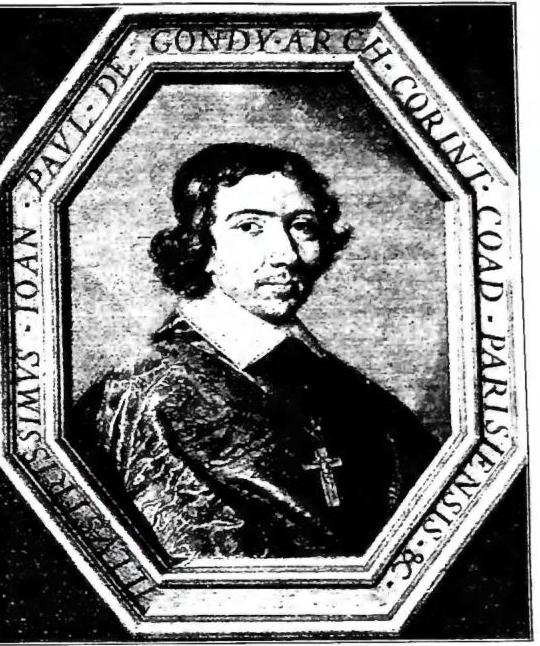
RETZ, CARDINAL. — Jean-François Paul de Gondi, born at Montmirail on 20 September 1613, died at Paris on 24 August 1679; the Duchy of R. (or Rais) had been conferred in 1581 by Henry III upon the marshal of France Alberto di Gondi, his great-grandfather. Antonio, Alberto’s father, of noble Florentine lineage, had come to France in the retinue of Caterina de' Medici.
From a young age he displayed uncommon intelligence: the Histoire de la conjuration du comte de Fiesque, compiled from that of Agostino Mascardi (1590–1640) and published in 1631, attests to his taste for psychological analysis and, at the same time, for intrigue. Viewed with suspicion by Richelieu, he resigned himself to the ecclesiastical state, taking his doctorate at the Sorbonne, and in 1643 was consecrated titular archbishop of Corinth and appointed coadjutor to his uncle, the archbishop of Paris. He worked to win over the people of the capital and to become the defender of ecclesiastical privileges against the Court.
After Mazarin’s return, thanks to the general amnesty in the spring of 1649, he allied himself with the disgraced Condé, who had been arrested together with the members of his family; still relying on Parliament, he succeeded in having him released and in driving Mazarin out once again (February 1651). The Queen nevertheless succeeded in separating him from the Condés and in securing his assistance in having Louis XIV declared of age (1651); in return, she promoted his appointment as cardinal. Mazarin’s return to France at the end of the year again drove him toward the now unpopular side of the Fronde. When the Fronde ended, he returned to his intrigues, but public opinion did not react at all to his arrest and imprisonment in the château of Vincennes (19 December 1652); before the Court’s inflexibility, the clergy’s protests were of no avail.
Thus ended his last ambitious project: a bourgeois and popular “third party” between those of royal absolutism and the landed nobility. Meanwhile, after his uncle’s death (21 March 1654), R. became by right titular archbishop of Paris. Mazarin induced him to resign by promising him freedom; but the Pope refused to accept the resignation of a prelate who was not free. The cardinal of R., meanwhile transferred from Vincennes to Nantes, nevertheless succeeded in freeing himself through a daring escape (8 August 1654). Mazarin’s implacable hostility excluded him from the amnesty that accompanied the Peace of the Pyrenees. He lived in Spain, in Rome (where at the Conclave of 1655 he succeeded in securing the election of Cardinal Chigi, Alexander VII, over the Mazarinian candidate), in Germany, Holland, Belgium, and the England of Charles II, until, thanks to the good offices of the Palatine princess Anna di Gonzaga and after an explicit renunciation of the diocese, he was able to return to his Lorraine domain of Commercy.
Readmitted to the Court, he was again entrusted with important official missions on the occasion of the Conclaves of 1667 and 1676; but his final years were occupied chiefly with literary and philosophical interests, awakened in him with particular intensity by contact with Cartesianism and with Madame de Sévigné, and with the composition of his extensive Memoirs, an admirable outlet, not free from cynicism, for all his belated resentments. These testify to exceptional psychological insight, supported by an art of narration and caricature of the first order and by an unsuspected conceptual subtlety, which contributed considerably to the work’s eighteenth-century success. It was first published in 1717 at Nancy.