
GOLDONI, CARLO. — Comic playwright, born in Venice on 26 February 1707, died in Paris on 6 February 1793.
His life is so intimately interwoven with his art, even in its external circumstances, that the Mémoires, written in the final years of his life in the easy French of eighteenth-century international culture, are the most suitable guide to understanding his theatre. Born in Venice to a family originally from Modena, he accompanied his father in his adventurous wanderings, studied grammar and rhetoric with the Jesuits in Perugia, and scholastic philosophy under a learned Dominican in Rimini; he was an assistant physician in Chioggia, a law student at the Collegio Ghislieri in Pavia, an assistant and coadjutor in the criminal chanceries of Chioggia and Feltre, graduated at Padua in ’51, and became a Venetian lawyer. He gained his theatrical experience, as author and actor, during this apprenticeship in study; and then, moving from dilettantism to a profession, when he had left Venice and began a wandering life of his own: an “honored adventurer,” as he called himself in one comedy; and “poor, merry, modest adventurer,” as Carducci defined him in a little wreath of sonnets in which his portrait is pleasantly framed against a historical and picturesque background. Passing through the composition of “interludes,” musical farces to be performed between the acts of the principal opera, and of grandiloquent and earnest tragicomedies in verse, he gradually came to discover his own nature.
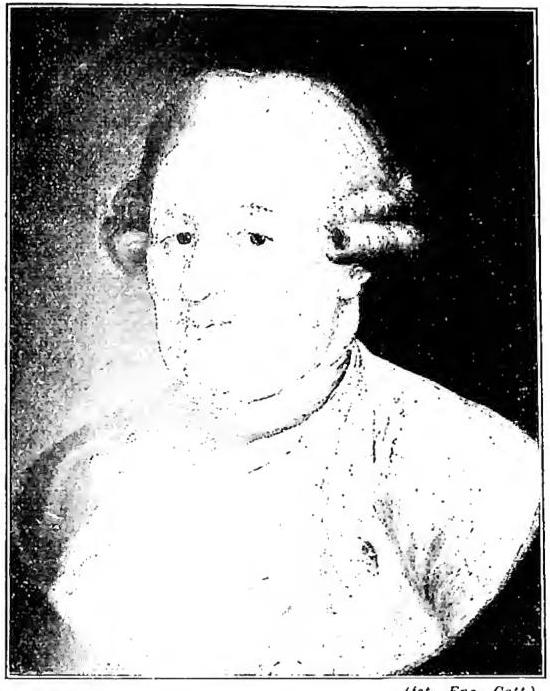
(photo Enc. Cutt.)
GOLDONI, CARLO – Portrait, in a contemporary painting.
Rome, Biblioteca Angelica.
he settled there with the Medebac company, returning to Venice after several years of comic wandering and legal practice in Pisa; and this was the most intense period of his work, when he studied himself and studied with indefatigable ardor: the period of La vedova scaltra, La putta onorata, La famiglia dell'antiquario, La locandiera, La figlia obbediente); of S. Luca (where, in a broader setting, with a more serious commitment to the public and to literary polemic against Pietro Chiari and Carlo Gozzi, he devoted himself in two different directions, that of adventurous comedy in martellian verse, the trilogy of Ircana, for example, and that of comedies in the Venetian dialect, by now free of every encumbrance of masks, magnificently fluent and moving, I rusteghi, Le baruffe chiocotte, La casa nova; but there are also masterpieces of extraordinarily bold psychological observation, such as the trilogy of La villeggiatura and Gli innamorati). The final period was the Parisian one, beginning in August 1762: he went there to revive the declining fortunes of Italian comedy in France; and he had to begin again from the start, working on the customs of the actors of the arte, adapting himself to them in order to persuade them more effectively. But among the scenarios he wrote, precisely in the manner of the arte, the most harmonious invention of Il ventaglio, a pure theatrical game, free from every concern other than repartee and dance; and he composed two comedies in French, Le bourru bienfaisant and L’avare fastueux, the Venetian’s homage to the tradition and household of Molière.
He thus passes from an apprenticeship to a theatrical mission, to put it in a Goethean manner that underscores the poet’s commitment in that supremely theatrical century of his.
Founder of the new Italian comedy, he placed at the center of the plot the observation of morality and custom, gathering around it the play of a most free and joyful imagination. Yet within the aridity of a formula, the art of the experienced and humane author can scarcely be confined: he is always ready for the surprise of unforeseen novelties amid old appearances, always attentive to the vicissitudes of his creatures and to the infinite variety of human nature and the circumstances of life. Nor is he a comic playwright who proposes a program to be discussed anywhere other than within the warm and shifting circle of the spectators: even when he spoke of the “reform” of comedy, which was growing idle and degraded in the scurrility of the commedia dell’arte performers, or of “characters,” almost as if to justify the invention of comic personages according to the canons of verisimilitude, he was concerned only with establishing, with the present and future assembly, a stable and conscious understanding. Intellectual ambitions, doctrinal pedantry, and vainglory were foreign to a man who grasped the most gracious aspects of his century, its festive indulgences, its profound trust in the human and the reasonable. Italian comedy opens with him upon its third season, after having known the mimetic fragmentation of medieval minstrelsy and the technical organization of the commedia dell’arte; but in the patient and most fertile labor of his cautious arrangement and willing proposal, the traditions of an expressive form that had been so substantial a part of Italian custom remain intact in their authentic significance. His dialogue has such immediacy that it seems to draw its persuasive force solely from the evidence of the thing directly seen and the word immediately heard, within a very brief circle of suggestion. Mimetic dialogue, precisely; and the structure of his comedies is so exactly calculated that the wisdom of the composition and the clarity of the stage coloring seem spontaneously to arise in the act of performance: with the illusion of improvisation that belonged to the arte. To arrive at this synthesis, which opened itself to the modern without losing anything of the ancient, and to win the people of Italy without revolutions to a new word and to more attentive participation in moral life, he made use of the innovations introduced over the course of a century into French and native theatre; and literary comedy, developed from Molière through his French and Italian epigones, held no secrets for him; yet every discovery matured within the concreteness of a minutely detailed experience that calculated all the possibilities of the actors and the exact response of the public.
His greatness lies in the spontaneity he attains while representing a human nature that, with admirable ease, assumes its forms, never entirely ugly and wounded, but reasonably disposed toward the better. An innate goodness, then, and the gifts of a confident but too easily satisfied Christian society, one in which Christianity had wholly absorbed itself into custom and no longer dared to reintroduce the themes of theological speculation. From the theatre, in which he experiments with enormous effort, achieving splendid effects of clarity and agile modulation, he moves toward a moral observation that grounds human coexistence precisely in terms of reasonableness, well-bred conduct, and wise disposition: vices and passions appear there, but they are softened by prudent caution and seem distanced by a thought that makes the moral norm and good dispositions prevail over every excess of will and passion. And that moral observation is summed up in a witty and lucid harmony, as though the poet were offering a formula with which to recompose, in thoughtful yet confident grace, the image of all life. It would be far too easy to reduce, within the limits of eighteenth-century custom and morality, so mature and complex an experience—so shrewd and perceptive precisely because it is so averse to clamors and proclamations, alien to any Romantic delight in surprising good faith, good sense, and common sense. In reality, G. is the most mature heir of Italian humanistic civilization, and from there, from his comedy and his proposal, proceed the customs and social life of nineteenth-century Italy, insofar as they possessed the most active participation, the greatest willingness, and the greatest confidence: the history of Manzoni’s poetics is inexplicable without G.; yet the social life of the peninsula itself is incomprehensible without him, even though G., in European theatre, remains the unsurpassable model of the most discerning theatricality, which seems to resolve everything in the harmony of gesture and repartee.