
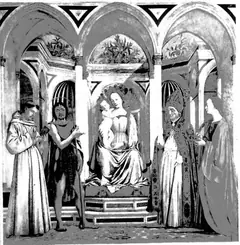
DOMENICO, VENEZIANO. Venetian painter, as can be gathered from his name, active in Florence, where he died in 1461. Very little information about him is available; it may be assumed that he received his first training in Venice. In 1438 (the first certain date concerning him) he wrote from Perugia to Piero de' Medici a letter in which he dared to place himself alongside two of the most celebrated Florentine painters of the time, Filippo Lippi and Fra Angelico; the following year he painted with Piero della Francesca, who was his pupil, frescoes in S. Maria Nuova, which no longer exist today. He was influenced by Masaccio, Paolo Uccello and Pisanello.
His works are very few: the most important is the Madonna and Four Saints in the Uffizi Gallery in Florence, in which the light and joyful colors — pale green, light blue and soft pink — shine in the luminous and transparent atmosphere and foreshadow the art of Piero della Francesca.
The predella of this painting was broken up and its fragments have been identified in the Contini collection in Florence, in the Fitzwilliam Museum in Cambridge, in the Kaiser-Friedrich-Museum in Berlin and in the Duveen collection in New York. Other works by D. are: a fragmentary fresco representing the Madonna Enthroned with Two Saints, formerly in Florence on the via dei Cerreani and now in the National Gallery in London; and the Sts. John the Baptist and Francis, painted in fresco in S. Croce, which, however, are also attributed to Andrea del Castagno. At the exhibition of Italian art held in London in 1930 a Madonna with the Child was attributed to him, it seems with good reason. Some also still assign to him a Nativity in the Kaiser-Friedrich-Museum in Berlin and a Madonna in the Berenson collection at Settignano.
D. V., even alongside the major Florentine painters of the 15th century, asserts himself as a strong individuality, distinguished by very singular gifts of coloring and atmospheric transparency.
Bibliography
Vincenzo Golzio