
MONODIA. – From the Greek μόνες = alone and ὠδὴ = song, today every form of choral or solo singing, ancient or modern, with or without instrumental accompaniment, in which there is no superimposition of sung parts is considered m.; thus singing is monodic even when performed by several male or female voices, if they simultaneously execute the same melodic line. It is precisely the linearity of the musical design that constitutes the characteristic of m.
M. is the only stylistic framework in which refined Hellenic culture manifested itself in the musical field: the doubling at the octave, with the flourishes of hetero-
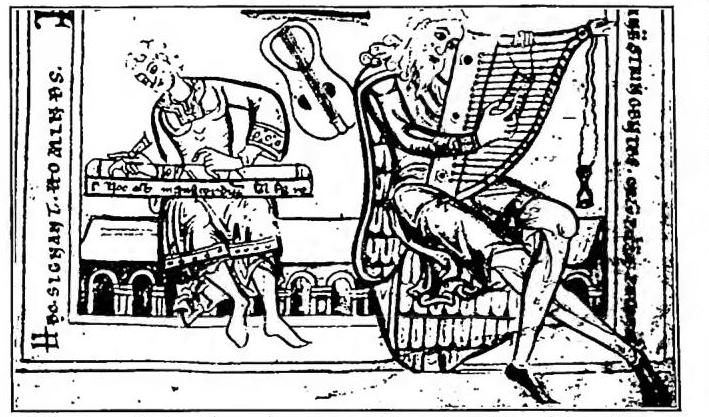
phony, does not represent a notable variation on the law of m. Complexity enters Greek m. through the multiplication of harmonic genera (chromatic and enharmonic in addition to diatonic); of poetic-metrical types; and of choral structures, among which the triticus – strophe, antistrophe, epode – soon attained the golden form of a classical model. In Christian-Latin m., the evolutionary process was restrained by almost ascetic limitations, suggested by the lofty purpose to which the musical compositions were devoted. The hieratic character of liturgical m. is affirmed by the choice of musical texts, taken from Holy Scripture, in the 5th, 6th, and 7th centuries, which are those of the most abundant and authentic production. The performance itself, far removed from excessively contrasting effects, maintains an atmosphere of gravity and sweetness.
The constructive technique of Christian m., even with the emergence of liturgical-musical poetry, from the 9th to the 13th century (tropes, sequences, versus, verbets, planetus, hymns), generally remains faithful to the generative principle of Greek m. itself, in which the curves outlined by the intonations of verbal accents sketch the contours of melodic development. The religious music of sequences and tropes flows into liturgical drama, which does not wholly create its own lyricism, but takes already known antiphons and responsories, often intended for the “dramatized” celebration of liturgical offices, while secular music exploits the new directions of modal rhythm in the m. of the troubadours, trouvères, and Minnesänger. Later, the Lied would revive the fundamental idea of m. in music closely adhering to the literary text, so as to transform the musical elements of language (rhythm, phraseological accentuation, cadences) into melody rendered in conventional semeiography. But between troubadour music and the Lied, a period of great splendor and decisive influence, with close connections to sacred music, would flourish precisely in Italy.
The historical vicissitudes of the monodic genre show how erroneous it would be to regard this genre as an elementary and initial manifestation of musical sensibility and technique; rather, in certain concrete realizations, monophony reached the most ambitious heights of art through the refinement of its flourishes, while in others, as in the modern popular song, it responds to an immediate tendency toward popular lyrical expression.