
VERGERIO, PIER PAOLO the Elder. — Man of letters and diplomat, b. at Capodistria around 1370, d. at Budapest on 8 July 1444.
He studied at Padua; in 1386, in Florence, he entered into friendship with Coluccio Salutati; in 1388–90 he taught logic at Bologna and composed the comedy Paulus. In 1390–96 he was at Padua in the service of the Carrara lords, when Petrarch’s fame was flourishing there; he published his poem Africa, addressed two speeches to Francesco Novello, and composed 7 Orationes pro s. Hieronymo. In 1398–99 he studied Greek in Florence with Crisoloro. Returning to Padua in 1400, in 1402 he composed the treatise De ingenuis moribus et liberalibus studiis for the education of young nobles, which he dedicated to Ubertino da Carrara, earning him a place among the pedagogues. He compiled a Vita Petrarca (printed by A. Solerti in Le vite di Dante, Petrarca e Boccaccio, Milan, n.d., pp. 294 ff.) and a Historia Principum Carrarensium (in RIS, Scriptores, XVI, 113–84); moreover, in March 1405 he received doctorates in arts, medicine, and law. When the Carraresi fell from power that year, he went to Rome, to the Curia, where he turned to ecclesiastical subjects and composed two speeches on the schism. In 1414 he was at Constance with Giovanni XXIII and entered the Chancellery of the emperor Sigismund, who created him poeta laureatus; he was with him at Perpignan in 1415 and then, in July 1420, attended in Prague the disputation with the Hussites. One of his writings, Pro reintegranda uniendaque Ecclesia, is found in Archiv. storico per Trieste, Istria, Trentino (1882, pp. 351–74); he was never a priest. After leaving Constance in 1418, he did not return to Italy.
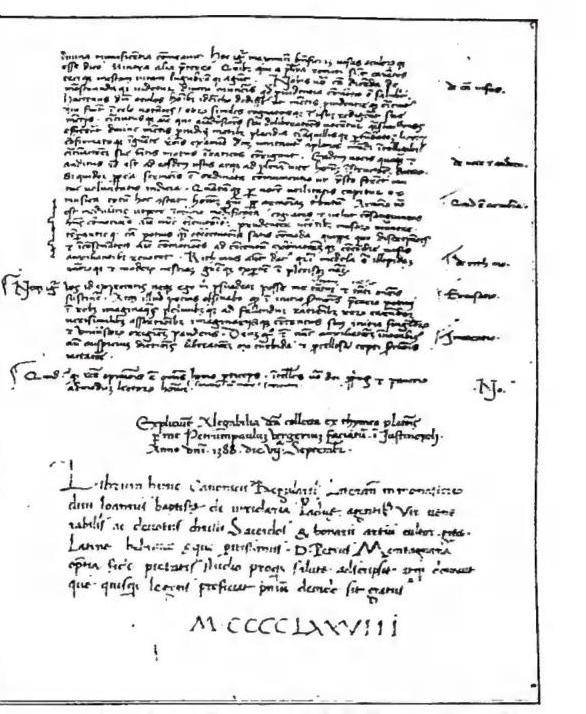
diis adolescentiae by V. humanism, all the more noteworthy since it predates the discovery and dissemination of the older pedagogical works of Plutarch, Quintilian, Xenophon, Cicero, and Plato. Following the current of Christian humanism, V. seeks to unite and fuse in pleasant harmony the liberal studies founded on the classics and good morals founded on knowledge and the practice of religion; and he aims at the formation both of the Italian commander, capable of replacing the mercenary commanders, and of the governor of the people, who must have on his side not only blind force, but also culture, refinement, civility, and above all that experience of the past which gives maturity to judgment and assurance in decision-making. Letters should not be cultivated solely for the pleasure they provide, but especially for the light of the past that they cast upon the present, and from the experiences of other princes and peoples they derive that wisdom which safeguards against errors. Religion is therefore the fundamental element, followed by literature, history, drawing, music, gymnastics, the sciences, and the military arts with their exercises. Thus we have an encyclopedic and harmonious education, in which converge the energies of religion, the chivalric traditions, consisting of rigorous gymnastic and military training, Greek and Roman culture, the seven liberal arts, and the medical and legal doctrines of the universities; all of this, however, imparted with an alert awareness of the forms of knowledge that have greater importance for social life, because erudition enclosed in its ivory tower is useless egotism, and strength alone is not enough to govern a state well.