
CALDERÓN DE LA BARCA, PEDRO. - Playwright, b. in Madrid on Jan. 17, 1600, d. there on May 25, 1681. He pursued his studies first at the Jesuit college in Madrid, then at the Universities
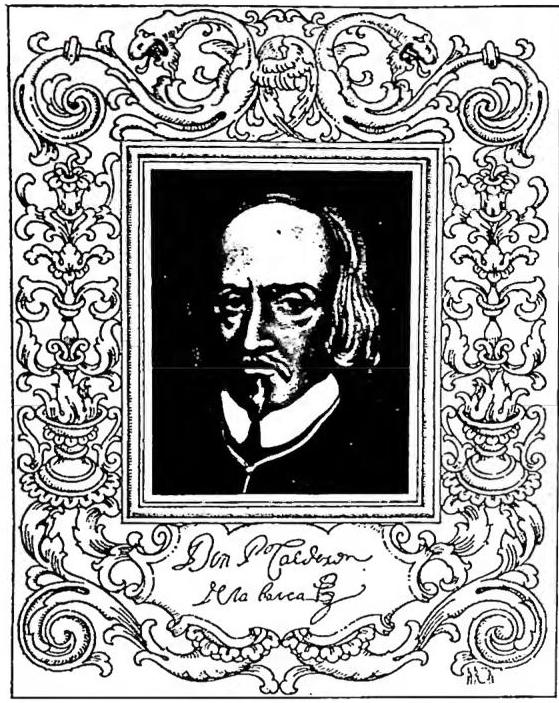
Literary success, achieved in the poetic competition for the canonization of ss. Teresa, Ignazio di Loyola, Francesco Saverio, and Isidoro (1522) and with the first drama of certain dating, Amor, honor y poder (1623), won the recognition of Lope de Vega in his El Laurel de Apolo (1630) and of Filippo IV, who for the mythological comedy El mayor encanto, Amor made him a knight of Santiago (1635) and, in 1636, superintendent of court entertainments. At the age of 51 he decided to embrace the ecclesiastical state; he was chaplain of the Reyes-Nuevos in Toledo and then in Madrid chaplain of honor to the king and dean of the Congregation of S. Pietro. Priestly and courtly duties did not interrupt his activity as a writer, solicited by the whole of Spain. After the accession to the throne of Carlo II (1666), who was little inclined to patronage, he lived in poverty, devoted to prayer and art. His death was a bereavement for all Spanish-speaking countries. He wrote 73 autos, 108 comedies, interludes, lyrics, poems, panegyrics.
SPIRITUAL PROFILE. - The singer of Catholicism enacted, in his absorbed life, a watchful inner concentration in which the intellect, illuminated by an ardent faith, quieted youthful passions and reflected itself, balancing it, in the structure of his literary works. C.'s biographical trajectory indeed matches his activity as a writer, imparting to it a tone of Christian sincerity that has brought Alighieri to mind.
He embraced the priesthood in maturity, associating piety and poetry in the single mission of confirming and defending the Catholic faith of his compatriots. In his view of life he overcame a fundamental stoic pessimism with the comfort of Christian hopes; he saw in the world an itinerary toward death, and in death the beginning of true life, the awakening from dream to reality. Few writers have, like him, dramatized the sense of transience, the torment of existence: and lonely and almost dreamlike he lived, even in palace environments. In Toledo he spent his days in sacred ministries, in the meditation of eternal truths, in the contemplation of artistic monuments; recalled to Madrid, he surrounded himself with a devoted and scholarly isolation in his home, among pious images and books of science and faith. In his will he arranged that his corpse be clothed in the Franciscan habit, the girdle of St. Augustine, and the Carmelite scapular, and buried in the manner of the poor.
Such a superior detachment was not achieved without struggles against a passionate and rebellious nature. The moral excesses of his youth (he had an natural son) and concessions to the vengeance of honor in his jealousy dramas found a corrective in the exemplariness of his mature life and in his dramas of Christian forgiveness. His piety rested on a solid rational basis derived from Thomistic theology with Augustinian echoes and centered on the cult of the Eucharist and the Immaculate Conception. And to the triumph of these two spiritual focal points he consecrated, with hidalgo fervor, his pen at a time when heresy flamed around Spain and the Church needed defenders. Thus arose the autos sacramentales, to which C. entrusted the best of his soul and creative energies.
THE "AUTOS SACRAMENTALES". - These were one-act plays on religious subjects, performed by day, in the open air, for the feast of Corpus Christi. Valdivielso, Lope de Vega, Tirso de Molina, and Mira de Amescua composed them; C. established their definitive form.
In them he set forth the essence of the Catholic creed, with a preference for the themes most contested by Protestantism: Transubstantiation, the problem of Grace and free will, and the Immaculate Conception of Mary. And since the Eucharist is the center of Redemption, the autos turned out to be, besides a Eucharistic apotheosis, a powerful panorama of the history of humanity, debased by original sin and rehabilitated by the sacrifice of Calvary. C. summoned all his capacities: intense faith, theological culture, theatrical experience, the tectonic skill of his spirit, mastery of literary technique, and a tendency toward symbolism and idealistic transposition. Everything was channeled into the royal torrent: mythology, medieval legend, sacred and profane history, dogmatic teaching, and even the casuistic concerns of the era, in a synthesis that, although moving not infrequently among abstractions and allegories, avoids coldness and conventionalism, quickening everything with a warm breath of humanity and religiosity, and reaching unsuspected heights of faith and poetry.
Valbuena has attempted a classification of the autos, dividing them into: philosophical-theological (e.g., El gran teatro del mundo; El veneno y la triaca); biblical (e.g., La cena de Baltasar); evangelical (e.g., La siembra del Señor); marian (e.g., La hidalga del valle); historical-legendary (e.g., El santo rey don Fernando); occasional (e.g., La segunda esposa y triunfar muriendo); mythological (e.g., El divino Orfeo).
A grouping into cycles is also possible. One consists of: La vida es sueño, La nave del mercader, La viña del Señor, Lo que va del hombre a Dios, La divina Filotea. The five dramas outline the spiritual dialectic of humanity, from the earthly paradise to the Tabernacle, from the fall to sanctification through union in Christ. Another five autos constitute a Marian cycle, which develops the entire theological system relating to the Virgin.
In all of them, then, the Eucharist, while remaining the inspiring center, is indirectly alluded to, and symbolic figures play a major role: Love, Humanity, Earth, Paganism, the Synagogue, Faith, Grace, Free Will, etc. Yet the whole is as if immersed in a flow of intense lyricism, which so blends with the action as to constitute one of the most original fruits of European theater, a suggestive world that expresses Spain and the drama of humanity. Because of their artistic and devotional merits, some autos have been performed at Eucharistic Congresses, e.g., in Einsiedeln (1924) and Godesberg (1926).
THE COMMEDIES "DEVOTAS". - Akin to the autos, from which they differ in technique and structure, are the comcomedias devotas or de santos. They too, in fact, have overtly apologetic intents, profiling themselves as a pathway toward religious truth, achieved through study and meditation, in a surprising dramatization.
El mágico prodigioso narrates the story of the student Cyprian, who, in order to win the love of Justina, surrenders his soul to the devil; but when he reaches out to embrace his beloved, he sees a skeleton before him; therefore he converts to Christianity and faces martyrdom. It presents more differences than similarities with the content of Goethe's Faust. In El purgatorio de san Patricio, Ludovico Enio, struck by the sight of his own skeleton, thinks of saving himself by visiting the Saint's cave and upon his return describes the torments of hell in colors that Menéndez y Pelayo compares to Dante's. In La devoción de la Cruz the bandit Eusebio is converted at the sight of the Cross and dies confessing his sins.
Other comedies derive their subject matter directly from the Bible, such as Los cabellos de Absalón and Judas Macabeo. In the comedies as well, mythology is, for C., a pretext for religious allegories; not for nothing is the same subject sometimes found in both the comedies and the autos. Thus El mayor encanto, amor, which deals with the loves of Ulysses and Circe, is related to the auto Los encantos de la culpa. Undeniable is the symbolism of La estatua de Prometeo, in which the figure of the rebellious protagonist is haloed almost with Christian redemption in the final pardon granted by the gods.
OTHER WORKS OF C. AND CHARACTERISTICS OF HIS THEATER. -
Even in the other works of C., it is possible almost always to isolate religious motifs and interests. His historical comedies (e.g., El príncipe constante; El alcalde de Zalamea), comedies of manners (e.g., La dama duende), plays of jealousy (e.g., El médico de su honra), etc., implement, along with the autos, the author's dramatic criteria, which, while picking up the threads of his predecessors, especially Lope, infuse them with reflection, structural balance, a fusion of the lyrical with the dramatic, and a greater characterization of the personages.
Nevertheless, his art moves within baroque syntax, retaining its metaphorical and decorative tension, its pursuit of contrast and the immoderate. In his best-known drama, La vida es sueño, the Polish prince Segismundo, segregated because of his prophesied predestination to evil, passes through successive psychic phases, from demonic brutality to an industrious purification. Interposed between these phases is the screen of sleep, which equates dream with reality and instills the conviction of the illusion of human events and the concreteness of awakening in God. Menéndez y Pelayo saw in it a theological debate on original sin and redemption; Alfonso Reyes, the struggle between free will and fatalism. It is a Christian focusing of earthly values, to be transcended in the vision of the afterlife. Rarely has art known how to animate abstractions, as in this characteristic work, and infuse them with such a high sense of human thoughtfulness.