
BALTASSAR (Greek version and Vulgate; Heb. Bēl-šar-sar, from the Assyrian Bēl-šar-sur: “Bēl protects the king”). — King of the Neo-Chaldean dynasty, known to us from the prophet Daniel and from the almost paraphrastic Danielic account of Fl. Josephus (Antiq. Ind., X, 231–48).
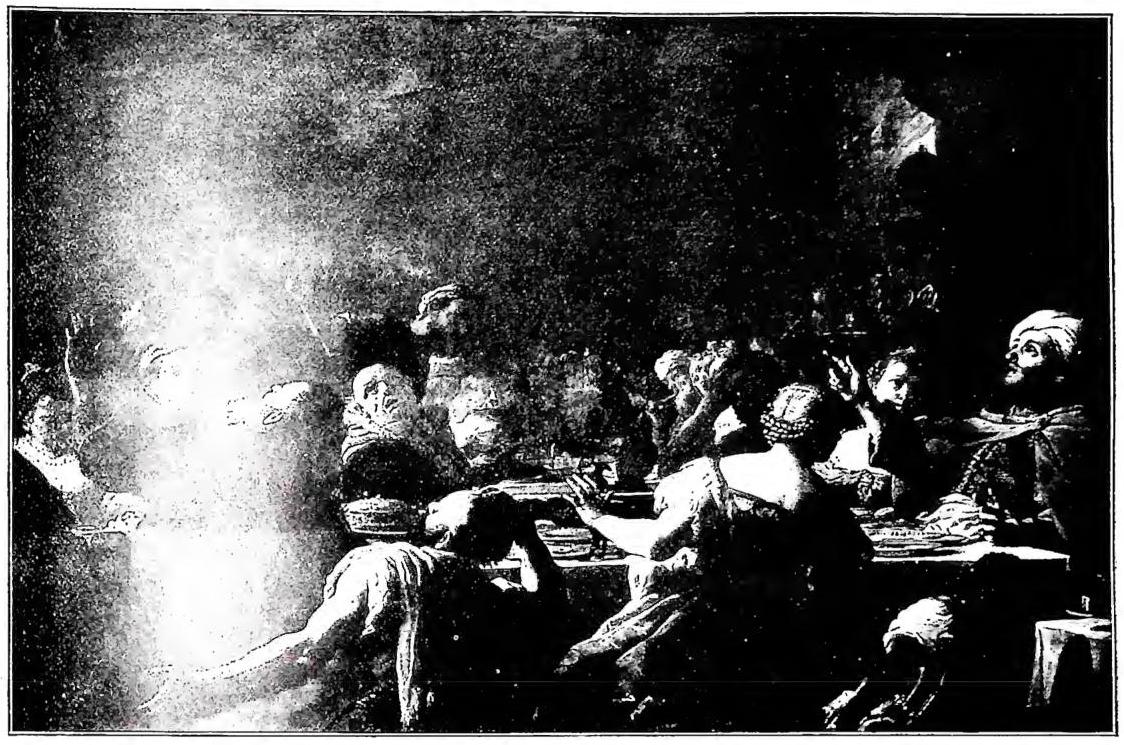
At the sumptuous banquet prepared by B. for a thousand nobles, the sacred vessels from the destroyed temple of Jerusalem were profaned, and the terrified king saw the fingers of a mysterious hand writing on the wall Mane Thecel Phares (v.), by which God foretold the imminent end of the king and the kingdom at the hands of the Medes and Persians. This took place that very night (Dan. 5). In the 1st and 3rd years of B.’s reign (Dan. 7, 1; 8, 1), Daniel received the visions concerning the four great empires of the world, the messianic kingdom, and the fortunes of the rule of the Diadochi and Epigoni.
(Alinari photograph)
BALTASSAR – The Banquet of B. by Mattia Preti (17th century) – Naples, National Museum.
far-uşur; the latter is identified with the “son of the king” mentioned in the Chronicle of Nabonidus.
Although the extrabiblical documents are silent concerning B.’s royal dignity, everything leads one to believe that his father associated him with the kingdom as early as 542. From cuneiform inscriptions it is known that Nabonidus was inept at governing, occupied himself solely with collecting Chaldean deities in the capital (Babel), and around the seventh year, either because of a strange religious inclination or because he was compelled to do so, withdrew to Temâ, an isolated locality in northern Arabia. And Daniel (5:7, 16), reporting that B. had promised the third place in the kingdom to whoever succeeded in interpreting the inscription on the wall, implies that the first and second places were occupied by the father and the son.
According to the Chronicle of Nabonidus, on the 14th of the month of Tisri, Sippar on the Euphrates was occupied by Cyrus. Nabonidus, who was confined there, fled toward Babel, which Gubaru (= Darius the Mede of Daniel), governor of the Gutium and commander of one of Cyrus’s armies, conquered two days later. Nabonidus was captured and banished to Carmania; while B., according to Dan. 5:30, was killed. In all likelihood, in Babel B. not only replaced his father in governing the empire, but also presided over the defense of the capital itself. His fatal banquet may perhaps also be alluded to by Xenophon, Cyropaedia, VII, 5, § 15, and Herodotus, I, 191.
That in Dan. 5:2, 11, 13, 22 B. is called the son of Nabuchodonosor may be explained by the fact that the Semitic languages lack a special term for indicating “descendant,” whereas the word “son” has a very broad usage and meaning (including grandson or descendant, and any successor). It seems that Daniel preferred to the name of the father, known for his incapacity, that of the predecessor, who was a celebrated statesman and warrior. It may also be that B. was Nabuchodonosor’s actual grandson (d. in 562). Since it is not easy to prove the existence of a blood relationship between Nabonidus and Nabuchodonosor, some hold that the former married a daughter of the latter; this nevertheless remains a mere hypothesis.