
PALATINE CHURCHES and CHAPELS. – These are those which, having been intended to meet the religious needs of the Head of a State and his household, or merely because of the powers acquired over
being rejected at the outset by Patriarch Calecas as a dangerous and anti-traditional novelty. The subsequent development of this fundamental point necessarily affected many other aspects of the ancestral theology, first and foremost those concerning the doctrine of Grace, identified by the P. with the light of Thabor, as one of the infinite properties of God, uncreated and eternal, inseparably united with and at the same time distinct from the divine essence. The notion of the gifts of the Holy Spirit and of the inabi-
over them by the Head of a State, stand in a relationship of very particular dependence upon him.
I. HISTORY
According to the assertions of Eusebius, Sozomen, and the other writers on the life of Constantine, the origin of that private oratory intended for the religious service of the sovereign, attached to the royal Palace and called sacellum, oratorium, cappella regia, or palatina, seems to be traced precisely to this Emperor. Among the more notable palatine churches and chapels in the West are S. Vitale at Ravenna, S. Cesario on the Palatine, the Cathedral of Aachen, S. Marco in Venice, the Palatine Chapel of Palermo, the Sainte-Chapeille in Paris, the Hofkirche of Dresden, etc.; and, for the papal court, the chapel of S. Lorenzo at the Lateran.From its very beginnings, although in its fundamental characteristics it presented itself as a private oratory, the palatine chapel possessed distinctive features of its own: it was libera et exempta ab omni ecclesiastica iurisdictione; no interdict could be imposed upon it, nisi de mandato Sedis Apostolicae speciali; it was served by the so-called Clerici regi or Palatini, who did not depend upon ecclesiastical authority and were not subject to the jurisdiction of the diocesan ordinary; rather, appointed by the sovereign, they constituted a body of their own, governed, in spiritual matters, by the grand chaplain and, in temporal matters, by the sovereign himself. Furthermore, whereas only certain religious practices were carried out in a private oratory, in that of the sovereign any sacred ceremony or function could be celebrated, without the need for any special authorization from the ecclesiastical authorities; and, greatest among its privileges, the royal chapel also served as the personal parish of the sovereign, his family, and the court.
Subsequently, alongside the palatine chapels properly so called, others gradually emerged with a profoundly different structure. In these cases, as a result of successive donations by the prince, the royal chapel eventually acquired its own patrimony, completely separate from that of the sovereign; thus, abandoning its original character as a temporale officium et ministerium, it was transformed into an autonomous entity, with a juridical status not unlike, in most cases, that of an ecclesiastical collegiate church, possessing its own organization and regularly erected in canonical form. Its clergy, until then regarded as salaried by the sovereign’s household, acquired the status of beneficiaries and, once invested by the sovereign with their prebend, the consequent canonical immovability.
This transformation entailed: 1) that the sovereign ceased to be the owner of the chapel and of its ecclesiastical goods, so that his right was limited to that complex of powers constituting the right of patronage, with the sole substantial difference that, whereas the patron had only the right to present the candidate to the ecclesiastical authority, the sovereign himself proceeded to the plena collatio of the benefice; 2) that its parochial character ceased to be a privilege, since the palatine church was regularly erected as a parish.
Finally, alongside the aforementioned royal chapels or churches, those churches must be recalled (improper palatine churches or ad honorem) which, having originated as sacred places open to the worship of all the faithful, with rich endowments, ordinary pastoral care, and ecclesiastical jurisdiction, were later endowed by the sovereign with the status of palatinity, sometimes because they themselves placed themselves under his protection, but more often for political purposes, when they became the center of the Ghibelline organization loyal to the prince, in opposition to the cathedral, the center of the Guelph party devoted to the pontiff.
II. NATURE AND CHARACTERISTICS OF PALATINITY
The characteristics of palatinity correspond to the essentially political purpose of the institution, consisting in guaranteeing the sovereign the ability to fulfil his religious duties without the threat of episcopal interdict.They are, broadly speaking, as follows: 1) the designation of the chapel or church for the exercise of the Head of State’s private worship;
2) its function as a personal parish for the Head of State and his household; 3) the Head of State’s right of ownership over the chapel, if it has retained its original character as a private oratory; the right of patronage, if it is an autonomous institution; 4) the sovereign’s right to appoint the ecclesiastics in charge of the church or chapel, with the power, when it is a private oratory, to revoke them ad nutum; 5) the exemption of the church or chapel and its clergy from episcopal jurisdiction; 6) particular liturgical and ritual privileges in religious ceremonies and functions.
III. PALATINE CHURCHES AND CHAPELS IN ITALY BEFORE THE CONCORDAT
In Italy, the institution of palatinity had real importance in the Kingdom of the Two Sicilies, where it found its regulation in the bull of Benedict XIV Conventi of 27 July 1741; it subsequently acquired particular significance with the subversive laws of 1866, since, in order to escape suppression, some churches invoked and obtained the status of p., overstating the significance and content of the ancient royal documents and diplomas in their favor.Before the Concordat, the following could be distinguished:
a) churches and chapels attached to royal palaces: they depended on the Ministry of the Royal Household, which was responsible for ordinary and extraordinary administration and provided for the expenses of worship, maintenance, and repair of the building whenever the institution lacked its own means; the chaplains, appointed by the sovereign not as a private individual but as an organ of the State, depended on the Ministry of the Royal Household and were regarded as royal employees; b) institutions dependent on the Ministry of Grace and Justice: among these, those without their own endowment charged their expenses and honoraria to the Ministry’s budget; those with their own endowment were administered by the general administrators for vacant benefices as royal delegates, under the protection and supervision of the Minister of Grace and Justice, who approved their budgets and acts exceeding ordinary administration; c) institutions dependent on the Opera nazionale dei Combattenti: oratories attached to royal villas and palaces which, under decree-law no. 1792 of 3 Oct. 1919, had passed from the Crown to the State and were consequently transferred to the Opera nazionale dei Combattenti, which became their owner, with the obligation to provide for worship and maintenance in the case of those lacking assets. The appointment of chaplains, for these institutions as well, remained the responsibility of the Ministry of Justice, which also administered the assets of the chapels that, while dependent on the Opera nazionale dei Combattenti, possessed their own endowment; d) the Puglian p.: for these, while their legal personality was retained, administration of the endowment was centralized in an autonomous institution headed by a delegate appointed by the king on the proposal of the Minister of Grace and Justice, after consultation with the Ministry of the Royal Household; the budgets of this institution and its acts exceeding ordinary administration had to be approved by the Ministry of Grace and Justice, while the clergy of the churches in question were remunerated by fixed allowances.
IV. AFTER THE CONCORDAT
Under the Concordat (art. 29, letter g), the Italian State renounced the privileges of ecclesiastical jurisdictional exemption enjoyed by the palatine clergy throughout Italy (except for those attached to the churches of the Holy Shroud of Turin, of Superga, of the Sudarium of Rome, and to the chapels annexed to the residences of the sovereigns and royal princes). The other churches and chapels that, before the Concordat, had enjoyed a particular regime by virtue of their status as p., became simple collegiate churches; consequently, the appointments and provisions relating to them fell under the general rules laid down in this regard for all other ecclesiastical bodies. The Concordat also established that a special mixed commission would provide each basilica or p. church with an adequate endowment, according to the criteria indicated for the property of sanctuaries in art. 27 of the Concordat itself. This arrangement was implemented for the former p. churches of Apulia, which, with their own endowment and their own church-maintenance board, were transferred to the authority of the ecclesiastical authorities; the Royal Delegation was suppressed, and the Autonomous Body “Opere Laiche Palatine Pugliesi” was established in Bari.By an agreement between the Italian State and the Holy See, concluded on 13 June 1939, rendered effective by Law no. 1887 of 30 November 1939, and entering into force on 2 February 1940 upon the exchange of ratifications, it was then determined which chapels, in addition to those expressly indicated by art. 29 of the Concordat, had retained the characteristics of palatinity; the legal status was established of the churches of S. Gottardo in Milan, of S. Francesco di Paola in Naples, and of the chapel of S. Pietro in the Royal Palace of Palermo, which, besides being annexed to the royal palaces, had full parochial functions; the procedure was specified for the appointment of the king’s major chaplain (palatine ordinary) and of the ecclesiastical officials attached to the p. churches or chapels; finally, the “mensa” of the major chaplain and his clergy was constituted.
It should nevertheless finally be noted that the republican form recently assumed by the Italian State could lead one to consider the institution of palatinity itself subject to transformation in meaning and content or, at the very least, in function.
V. THE CHURCH OF THE PANTHEON
In addition to the transformation and extinction of certain palatine churches, the Concordat (art. 15) provided for the creation of a new one (that of the Pantheon: S. Maria ad Martyres), with an entirely special and sui generis function, since it was intended not only for the private worship of the Head of State, but also for the State’s own religious ceremonies. That article further established that the military ordinary archbishop(fol. Fides)
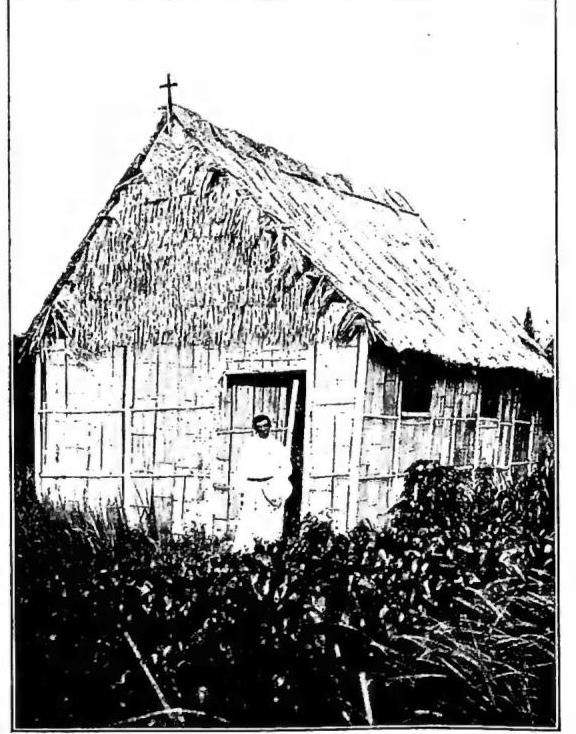
PALAWAN, APOSTOLIC PREFECTURE of — Mission Chapel. Palawan.
would preside over the Chapter of the Church of the Pantheon in Rome, forming with it the clergy that would provide religious service for the said Basilica and for all functions, even outside Rome, which, in accordance with canonical norms, might be required by the State or by the household of the Head of State. For this purpose, the Holy See agreed to confer upon all the canons forming the clergy of the Pantheon the dignity of apostolic protonotaries ad instar for the duration of their office. Each of them is appointed by the ecclesiastical authority (the cardinal vicar of Rome) upon presentation by the Head of State (though preceded by the confidential indication of the person to be presented by the ecclesiastical authority), as though the right of patronage over the church belonged to him. The presentation, which takes place by decree of the Head of State, is followed by the institutio collativa, which is obligatory under the Concordat.