Machine translation of the 1948–1954 Italian original. The original text is authoritative.
GIACOMO di VITRY. — Cardinal, celebrated preacher and writer, born around 1170 at Vitry in France, perhaps at Vitry-sur-Seine, died in Rome on 1 May 1240. He studied at the University of Paris, where he obtained the degree of master. According to his contemporary Vincenzo di Beauvais (Spec. hist., XXX, 10), he was also parish priest at Argenteuil near Paris.
Attracted by the mystical movement that had manifested itself in the diocese of Liège in Belgium, he entered the priory of the Canons Regular of S. Augustine at Oignies, made famous by the mystic Maria d'Oignies, an oblate of that priory. Under the impulse of this ardent soul, G. devoted himself to popular preaching (ca. 1211–13); he then placed himself at the service of the Crusades, preaching first against the Albigensians and then in favor of the Holy Land (1213–15). Elected bishop of Acon in 1215, the following year he went to the Papal Curia, then in Perugia, where he found Innocent III dead, and came into contact with the Franciscan movement. Retained as bishop at the Curia, he went to Genoa, where he embarked for Acon, which he reached in Nov. 1216. He immediately devoted himself to apostolic work and assisted (1218–21) the Christian army at Damietta, where he also met with St.
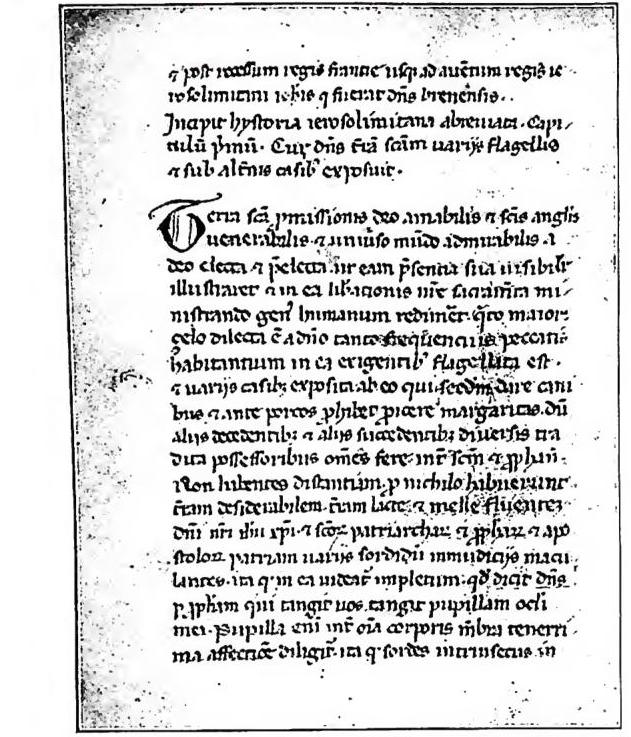
(photo Enc. Cott.) GIACOMO DI VITRY - Historia orientalis: Incipit hystoria Ierosolimitana. Cod. Vat. lat. 5265, fol. 5° (13th century) - Vatican Library.Francesco d'Assisi. Subsequently he made two journeys to Italy (1222-23, 1225-26). He resigned the bishopric in 1228 and retired to Oignies. In 1229 Gregory IX created him cardinal bishop of Frascati, and, in this capacity, he took part in the peace negotiations with Frederick II at Gaeta. Little is known of the remainder of his cardinalatial activity. One year after his death, his mortal remains were transferred to Belgium and buried at Oignies. G. was one of the most distinguished figures of his time and an ardent promoter of the internal reform of ecclesiastical life, and this is also revealed in his writings. They are: Vita Mariae Oigniensis (d. in 1213), an important source for knowledge of the religious movements in Belgium at that time. Written in 1215, it was incorporated almost in its entirety into the Speculum historiale of Vincent of Beauvais, XXX, chaps. 10-51, and published in full by the Bollandists, Acta SS. Iunii, IV (Anversa 1707, pp. 542-72); Historia occidentalis e orientalis (ed. D. Dubois, Douai 1597; the Historia orientalis alone also in Bongars, Gesta Dei per Francos [I, Hannover 1611, pp. 1047-1172]); Sermones de tempore (Anversa 1575, Venezia 1578); Sermones vulgares, excerpts from which are found in J. B. Pitra, Analecta novissima spicigii Solesmensis (II, Frascati 1888, pp. 344-442); Th. Fr. Crane, The «exempla» or illustrative stories from the «sermones vulgares» of Jacques de Vitry (Londra 1890); S. Frenken, Die Exempel des Jacob von Vitry (Quellen und Untersuchungen zur lateinischen Philologie des Mittelalters, 5, 1, Monaco di Baviera 1914). The seven letters written from 1216 to 1221, some of them addressed to several persons, were critically edited by R. Röhrich, Die Briefe des Jacobus de Vitriaco, in Zeitschrift für Kirchengeschichte (14 [1894], pp. 97-118; 15 [1895], pp. 568-87; 16 [1896], pp. 72-114). Some of them are also found in E. Martène et U. Durand, Thesaurus novus anecdotorum (III, Parigi 1717, cols. 287-306).
BIBL.:Histoire littéraire de la France. XVIII, Parigi 1835, pp. 209-46; F. L. Matzner, De Jacobi Vitriacensis vita et gestis.
Münster in V. 1863; Th. Fr. Crane, The «exempla» or illustrative stories from the «sermones» of Jacques de Vitry, Londra 1890, pp. XXII-LIII; Ph. Funk, Jacob von Vitry, Leben und Werke (Beiträge zur Kulturgeschichte des Mittelalters und der Renaissance, 3), Lipsia e Berlino 1909; J. Greven, Die Anfänge der Beginen (Vorreformatorische Forschungen, 7), Münster in V. 1912, pp. 54-109. Livario Oliger
Cite this article
“GIACOMO DI VITRY.” Enciclopedia Cattolica, vol. VI (1951), p. 225. Azione Romana digital edition, https://azioneromana.com/article/giacomo-di-vitry.